

On this page
Why do teachers say dy/dx is not a fraction?
Every calculus student encounters a baffling contradiction. In limits, your teacher insists that dy/dx is a single indivisible operator: the instantaneous rate of change of y with respect to x. You are told never to treat dy and dx as standalone numbers, and never to say "dy divided by dx". Yet in differential equations, that same teacher casually multiplies both sides by dx.
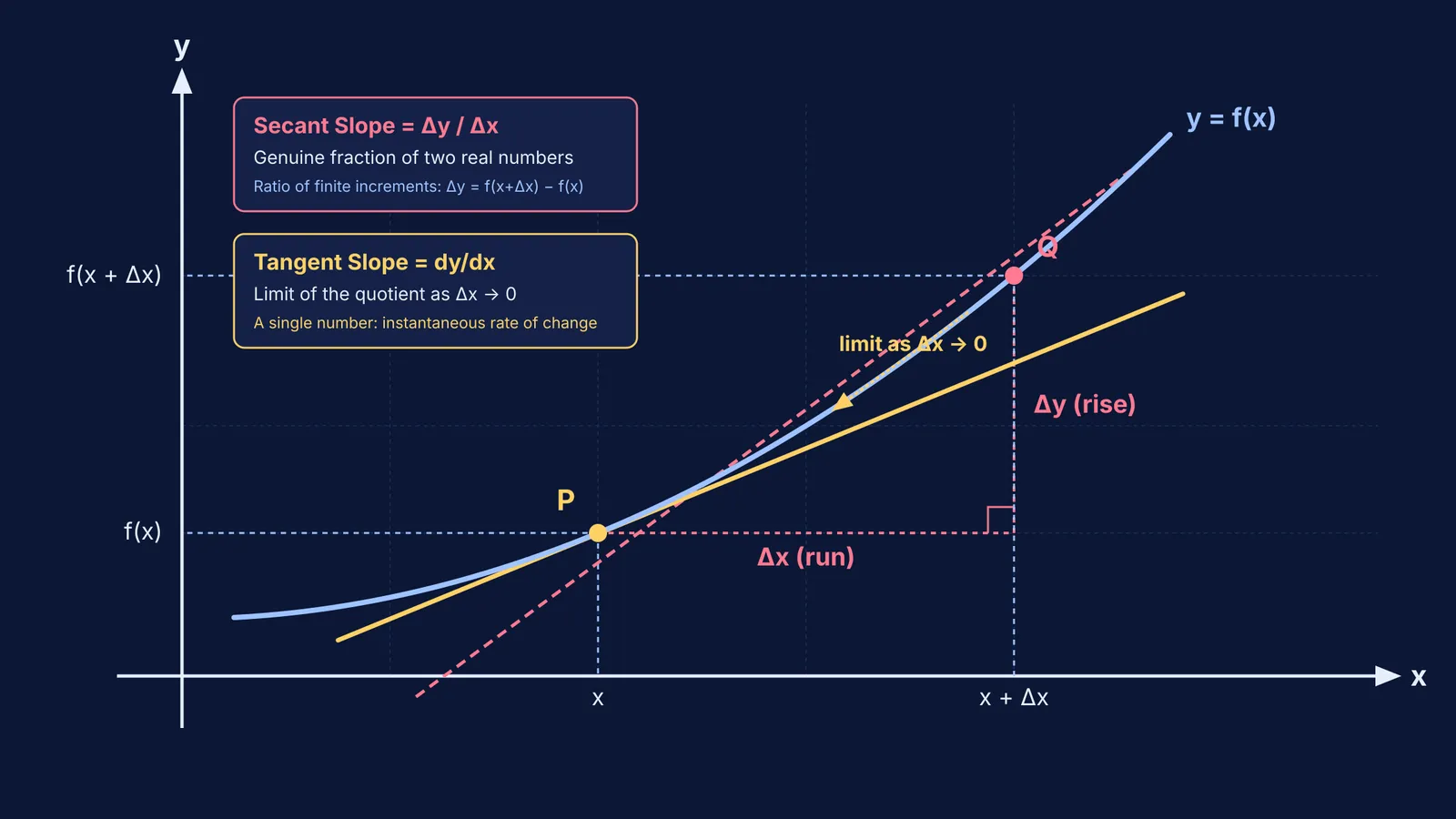
This contradiction causes widespread confusion. In a 1983 study on student understanding of differentiation, researcher Anthony Orton investigated how 110 students aged 16 to 22 interpreted elementary calculus. Orton found that 43 out of 110 students (approximately 39%) could not deduce that a secant line becomes a tangent line as the chord interval shrinks to zero, frequently treating the derivative as an arbitrary algebraic trick.
Official textbooks highlight this boundary. In the NCERT Class 12 Mathematics textbook, students are warned that dy/dx is an indivisible symbol representing the limit of the difference quotient Δy/Δx as Δx approaches zero. As mathematical historian Judith V. Grabiner showed in her study of Augustin-Louis Cauchy's 1823 foundations of analysis, calculus gained logical rigor only when Cauchy defined the derivative as a limit: dy/dx = lim (Δx → 0) [f(x + Δx) − f(x)] / Δx. While Δy and Δx are real numbers whose quotient Δy/Δx is a genuine fraction, their limit dy/dx is a single number: the slope of the tangent line. The symbols dy and dx do not exist as independent numbers that can be divided in standard real arithmetic.
The Fermi Simulation Lab provides interactive simulations for the ideas that are easier to see than to read, letting you watch the secant difference quotient converge onto the instantaneous tangent.
Why does the chain rule look like fraction multiplication?
If dy/dx is not a fraction, why does Leibniz notation act like one? Gottfried Wilhelm Leibniz introduced the symbols dy and dx in 1684, deliberately designing them to mirror ordinary algebra, as discussed in historical analyses of early mechanics and differentials.
The clearest example is the chain rule: dy/dx = (dy/du) × (du/dx). This looks like cancelling the intermediate differential du from top and bottom. The reason this shortcut works is that beneath the limit, the underlying increments Δx, Δu, and Δy are real numbers. For finite changes with Δu ≠ 0, basic arithmetic gives Δy/Δx = (Δy/Δu) × (Δu/Δx). Because the limit of a product equals the product of individual limits, taking the limit as Δx → 0 transforms a true fraction identity into Leibniz's chain rule. Leibniz notation is not sloppy; it is deliberate shorthand that preserves the algebra of finite increments at the limit boundary.
How does separation of variables actually work without dividing by dx?
In the NCERT Class 12 chapter on differential equations, equations like dy/dx = 2xy are routinely solved by "multiplying by dx" to get (1/y) dy = 2x dx, then integrating both sides to obtain ln |y| = x² + C.
Why does this give the exact right answer? The rigorous justification is integration by substitution:
Rearrange without breaking the derivative: (1/y) (dy/dx) = 2x.
Integrate both sides with respect to x: ∫ (1/y) (dy/dx) dx = ∫ 2x dx.
Apply the substitution rule: because y = y(x), the chain rule guarantees that ∫ f(y) (dy/dx) dx = ∫ f(y) dy. The left side becomes ∫ (1/y) dy without ever splitting dy/dx apart.
Multiplying by dx is simply a dependable bookkeeping device that skips writing out substitution on every line. You can see similar patterns in homogeneous differential equations.
The Fermi Problem Library has worked problems with a step-by-step solver that explains the reasoning rather than printing an answer, clarifying each substitution.
Where does treating dy/dx as a fraction break down?
The fraction illusion collapses the moment you leave first-order single-variable calculus:
Higher-order derivatives: The second derivative d²y/dx² is the operator d/dx applied to dy/dx. It is not a fraction squared. For fractions, 1 / (a/b) = b/a, but d²y/dx² does not equal 1 / (d²x/dy²); the chain rule gives d²x/dy² = −(d²y/dx²) / (dy/dx)³. Furthermore, in parametric differentiation and second derivatives, while dy/dx = (dy/dt) / (dx/dt), the second derivative d²y/dx² does not equal (d²y/dt²) / (d²x/dt²).
Multivariable partial derivatives: Naive cancellation would suggest that (∂z/∂x) × (∂x/∂y) × (∂y/∂z) equals +1. But Euler's cyclic chain relation proves it equals −1: (∂z/∂x)_y × (∂x/∂y)_z × (∂y/∂z)_x = −1. The rigorous framework established by Karl Weierstrass and the epsilon-delta definition of a limit exists precisely to prevent such arithmetic traps.
The four-point checklist: when is it safe to treat dy/dx like a fraction?
Use this four-point test before using differential shortcuts:
First-order chain rule: Safe. Writing dy/dx = (dy/du) × (du/dx) as if du cancelled is mathematically sound for differentiable functions.
Separation of variables: Safe. Moving dx and dy to opposite sides is a proven shorthand for integration by substitution.
Second and higher derivatives: Unsafe. Never invert or square d²y/dx² like a fraction; always differentiate dy/dx with respect to x.
Partial derivatives: Unsafe. Never cancel terms across partial derivatives, where the cyclic relation yields −1 instead of +1.
The Fermi Concept Library covers every concept in physics, chemistry, biology, mathematics and computing, each with its own lesson and its place in the map.


