

On this page
In school chemistry classrooms across CBSE, ICSE, and state boards, table salt (NaCl) and hydrochloric acid (HCl) are grouped together as strong electrolytes. When dissolved in water, both turn a bulb on between copper electrodes. Yet at the molecular level, they reach a conducting state through fundamentally different mechanisms.
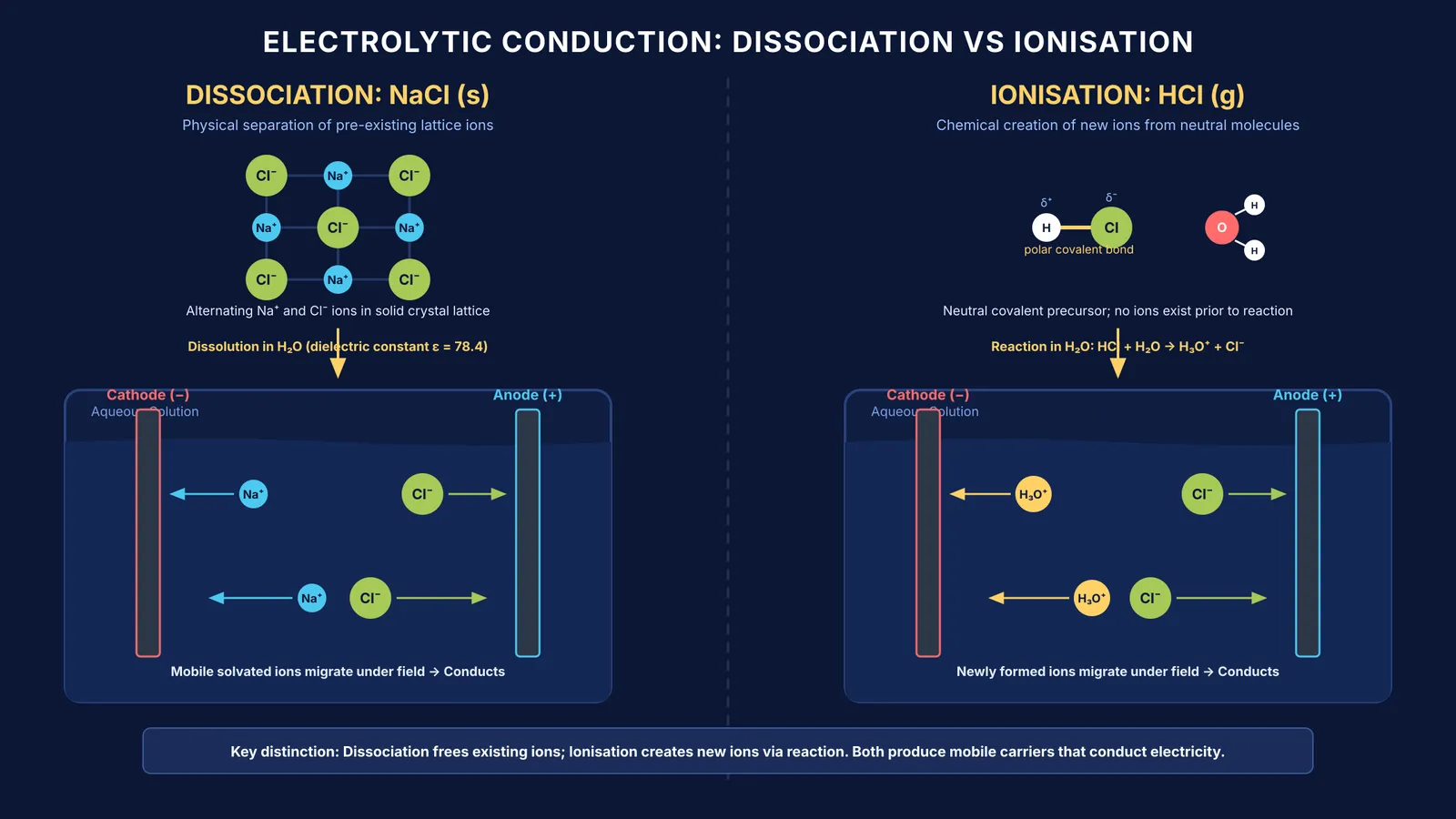
Sodium chloride does not create ions in water; it releases ions already locked inside a solid crystal lattice. Pure hydrogen chloride, by contrast, contains zero ions; it generates ions through a chemical reaction with polar water molecules.
What is the difference between ionisation and dissociation?
The International Union of Pure and Applied Chemistry (IUPAC) defines dissociation as the separation of a molecular entity or ion pair into two or more entities (IUPAC Compendium of Chemical Terminology). Solid sodium chloride consists of alternating sodium cations (Na⁺) and chloride anions (Cl⁻) packed into a face-centred cubic lattice. Dissolving NaCl in water does not produce charge; it separates pre-existing ions from their electrostatic lattice into free solution.
By contrast, IUPAC defines ionisation as the generation of one or more ions from a neutral precursor (IUPAC Compendium of Chemical Terminology). Pure hydrogen chloride gas consists of neutral covalent molecules. Ions only form when HCl reacts with water, breaking the polar covalent H-Cl bond heterolytically.
In the *Journal of Chemical Education*, chemist Emeric Schultz noted that dissociation refers to separating components that were already associated (Schultz, 1997). Calling the reaction of HCl in water dissociation obscures the bond-breaking event. Chemist David L. Adams reinforced that ionisation is a chemical transformation creating new ions, whereas dissociation is the physical separation of existing ones (Adams, 1998).
When studying ionic equilibrium, confusing these initial states leads students to stumble on physical properties. The Fermi Concept Library maps every concept across physical chemistry, each with its own lesson and place in the map, showing which species exist before and after dissolution.
Why do covalent molecules only ionise in polar solvents?
Why does sodium chloride dissolve and conduct in water, while dry hydrogen chloride dissolved in benzene refuses to conduct? The explanation lies in solvent permittivity and hydration thermodynamics.
Liquid water has a high relative permittivity of 78.4 at 25 °C (Fernandez et al., 1997). Under Coulomb's law, this reduces the electrostatic attraction between Na⁺ and Cl⁻ ions by a factor of nearly 78, allowing water dipoles to hydrate the ions and overcome lattice enthalpy.
In a non-polar solvent like benzene, with a relative permittivity of 2.27 at 25 °C (Maryott & Smith, 1951), electrostatic shielding is absent. In dry benzene, dissolved HCl remains in neutral molecular form, carries zero electric current, and leaves dry blue litmus paper blue.
In water, the oxygen lone pair pulls the proton from chlorine:
HCl(g) + H₂O(l) → H₃O⁺(aq) + Cl⁻(aq)
Cleaving the H-Cl covalent bond requires 431 kJ/mol. The reaction is driven forward because proton hydration releases −1090 kJ/mol at 25 °C (Marcus, 1987). This released enthalpy easily compensates for breaking the covalent bond.
To see how proton transfers connect across acid-base frameworks, read our guide to Arrhenius, Bronsted-Lowry and Lewis acids.
Why do both processes produce electrically conducting solutions?
In 1834, Michael Faraday coined "electrolyte" for substances that conduct electricity through the migration of ions (Faraday, 1834). In 1887, Svante Arrhenius showed in *Zeitschrift für physikalische Chemie* that electrolytic conductance depends on the concentration of freely moving ions (Arrhenius, 1887).
Once in aqueous solution, an external electric field draws cations (Na⁺, H₃O⁺) toward the negative cathode and anions (Cl⁻) toward the positive anode. Conductivity equals the sum of mobile charges: κ = Σ nᵢ zᵢ e uᵢ. Because both dissociated NaCl and ionised HCl release high concentrations of mobile univalent ions, both yield conducting solutions.
Their behavior without water reveals their true nature. In its molten state above its melting point of 801 °C, liquid NaCl conducts electricity because thermal energy frees the pre-existing lattice ions, fulfilling the classical definition of a molten electrolyte (IUPAC Compendium of Chemical Terminology). In contrast, pure liquid HCl below −85 °C remains an electrically insulating covalent liquid because no polar solvent is present to induce ionisation.
For calculations linking conductance to dilution, explore molar conductivity and Kohlrausch's law, or review ionic equilibrium and pH calculations.
How can you test whether an electrolyte dissociates or ionises?
To determine whether an unknown electrolyte dissociates or ionises, use this four-step diagnostic test:
Check the pure bonding: Metal-nonmetal salts (such as KCl and NaOH) contain ionic lattices and dissociate. Non-metal compounds (such as HCl and CH₃COOH) contain polar covalent bonds and ionise.
Test the pure molten liquid: If the dry substance conducts electricity when melted, it contains pre-existing ions. If the liquid is an insulator, it is covalent.
Test in non-polar solvents: In dry benzene or toluene, ionic salts do not dissolve, while covalent molecules dissolve without conducting because no ionisation occurs.
Measure degree of conversion (α): Strong electrolytes convert fully (α ≈ 1) in dilute water, whereas weak electrolytes like CH₃COOH achieve only partial ionisation (α ≪ 1) governed by Ostwald's dilution law.
For worked problems on electrolyte behaviour and equilibrium constants, the Fermi Problem Library provides worked problems with a step-by-step solver that explains the reasoning rather than printing an answer.


