

On this page
When you mix two solutions that share a common ion, such as sodium chloride (NaCl) and calcium chloride (CaCl₂), the final concentration of that ion depends on how much of it came from each original solution and the new, larger volume they now share. This is a fundamental principle, much like calculating the particle concentration for finding molar mass from osmotic pressure.
This calculation is a standard step in chemistry problems for the JEE Main and NEET-UG exams. It relies on the definition of molarity: the number of moles of solute divided by the volume of the solution in litres. Chemistry LibreTexts, 4.5: Concentration of Solutions/04%3A_Reactions_in_Aqueous_Solution/4.05%3A_Concentration_of_Solutions) Before you can add the amounts together, you must account for the stoichiometry of each salt.
How many chloride ions does each salt produce?
When a strong electrolyte dissolves in water, it dissociates completely into its component ions. Chemistry LibreTexts, 4.5: Concentration of Solutions/04%3A_Reactions_in_Aqueous_Solution/4.05%3A_Concentration_of_Solutions) The concentration of each individual ion is the molarity of the solution multiplied by the number of those ions in one formula unit of the compound.
NaCl: Sodium chloride dissociates into one Na⁺ ion and one Cl⁻ ion. A 1.0 M solution of NaCl therefore has a chloride ion concentration of 1.0 M.
CaCl₂: Calcium chloride dissociates into one Ca²⁺ ion and two Cl⁻ ions. A 1.0 M solution of CaCl₂ yields a chloride ion concentration of 2.0 M.
This means you cannot simply add the initial molarities of the two solutions together. You must work out the absolute number of moles of chloride each one contributes.
How to find the concentration of chloride ions after mixing?
When you dilute a solution or mix it with more solvent, the number of moles of solute remains constant, but the concentration changes as the volume increases. Chemistry LibreTexts, 4.5: Concentration of Solutions/04%3A_Reactions_in_Aqueous_Solution/4.05%3A_Concentration_of_Solutions) To find the final concentration, you need the total moles of chloride and the total final volume.
Calculate the moles of chloride from NaCl: Multiply the volume of the NaCl solution (in litres) by its molarity, and then multiply by 1.
Calculate the moles of chloride from CaCl₂: Multiply the volume of the CaCl₂ solution (in litres) by its molarity, and then multiply by 2.
Find the total moles: Add the results from step 1 and step 2.
Find the total volume: Add the volumes of the two original solutions (assuming they are additive, which is standard in textbook problems).
Divide to find the final molarity: Divide the total moles (step 3) by the total volume (step 4).
This process of calculating moles first is identical to the method used for mixing and diluting solutions: finding the final molarity.
What is the concentration in a worked example?
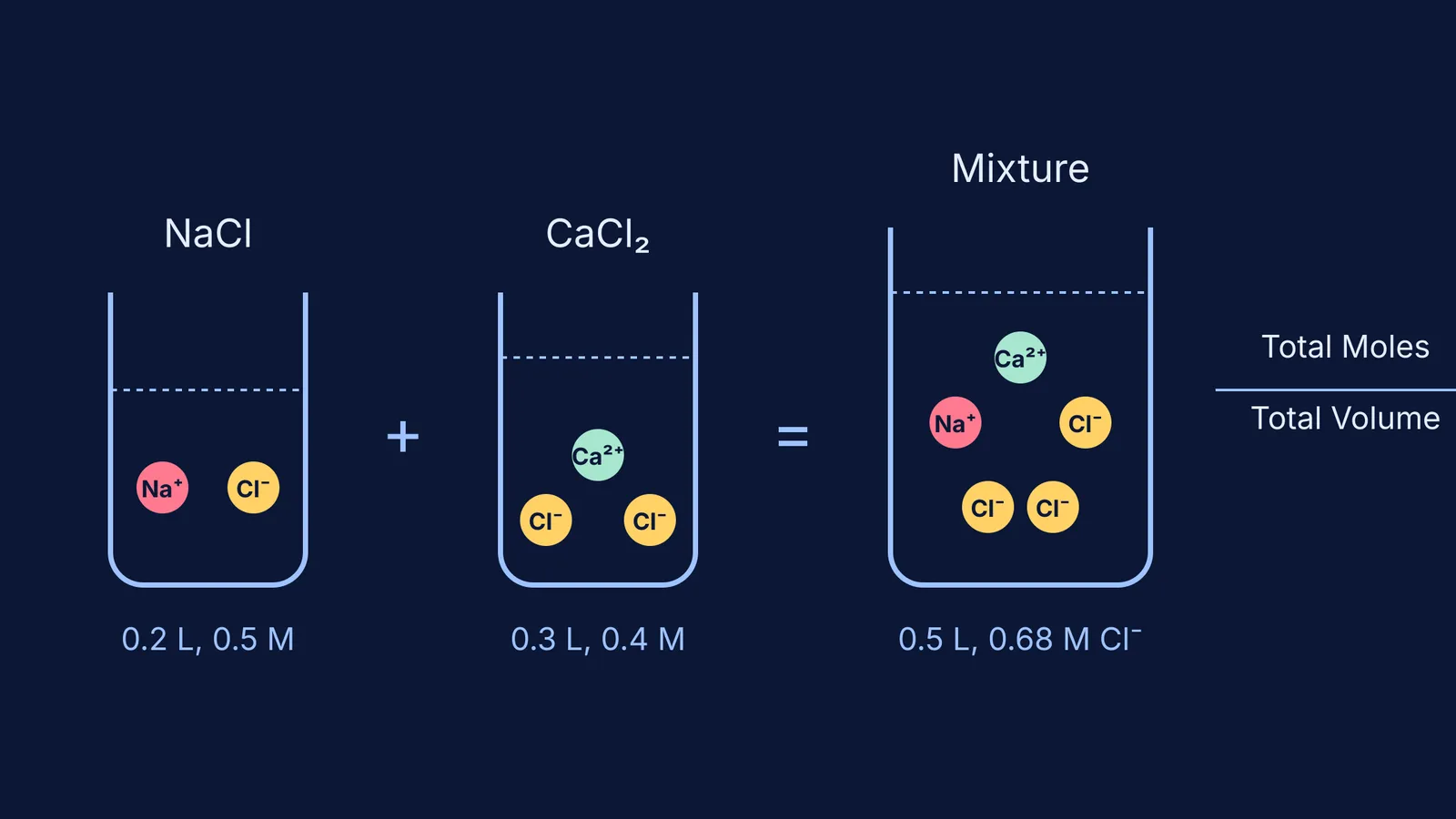
The standard approach applies here. Chemistry LibreTexts, 4.5: Concentration of Solutions/04%3A_Reactions_in_Aqueous_Solution/4.05%3A_Concentration_of_Solutions) Suppose you mix 200 mL of 0.5 M NaCl with 300 mL of 0.4 M CaCl₂. What is the final concentration of chloride ions?
Step 1: Moles of Cl⁻ from NaCl The volume is 200 mL (0.2 L). Moles of NaCl = 0.2 L × 0.5 mol/L = 0.1 mol. Since NaCl provides one Cl⁻, this is 0.1 mol of Cl⁻.
Step 2: Moles of Cl⁻ from CaCl₂ The volume is 300 mL (0.3 L). Moles of CaCl₂ = 0.3 L × 0.4 mol/L = 0.12 mol. Since CaCl₂ provides two Cl⁻, this is 2 × 0.12 = 0.24 mol of Cl⁻.
Step 3: Total moles of Cl⁻ Total = 0.1 + 0.24 = 0.34 mol.
Step 4: Total volume Total = 200 mL + 300 mL = 500 mL (0.5 L).
Step 5: Final concentration Final [Cl⁻] = 0.34 mol / 0.5 L = 0.68 M.
If you are working through physical chemistry problems and find yourself losing track of the stoichiometry, the Concept Library has every concept in physics, chemistry, biology, mathematics and computing, each with its own lesson and its place in the map. Fermi's AI tutor can work out what you already know, build a plan for the session, and teach through it — writing on a board, drawing the figure, running the simulation, and checking understanding as it goes.
What if the problem involves other ions?
The same framework applies to any mixture of solutions. Chemistry LibreTexts, 4.5: Concentration of Solutions/04%3A_Reactions_in_Aqueous_Solution/4.05%3A_Concentration_of_Solutions) If you need to find the concentration of sodium (Na⁺) or calcium (Ca²⁺) in the mixture above, you calculate the total moles of that specific ion and divide by the total volume.
For sodium, all of it comes from the NaCl solution (0.1 mol). The final concentration of Na⁺ is 0.1 mol / 0.5 L = 0.2 M. For calcium, all of it comes from the CaCl₂ solution (0.12 mol). The final concentration of Ca²⁺ is 0.12 mol / 0.5 L = 0.24 M.
You can verify your work by checking the charge balance. The total positive charge concentration (from Na⁺ and Ca²⁺) must equal the total negative charge concentration (from Cl⁻). Positive charge: (1 × 0.2 M) + (2 × 0.24 M) = 0.2 + 0.48 = 0.68 M. Negative charge: 1 × 0.68 M = 0.68 M. The charges balance, confirming the calculation is correct.


