

On this page
Inverse proportion is a major stumbling block for middle-school students. A 2015 study published in the *International Journal of Science and Mathematics Education* found that only 23% of 8th graders could correctly solve an inverse proportion problem. The most frequent error the researchers observed was the "illusion of linearity"—the mistaken belief that if one quantity increases, the other must automatically increase too. Students often learn direct proportion first, and it becomes their default tool for any word problem involving three given numbers and one missing value, leading them straight into a mathematical trap.
What is inverse proportion?
In direct proportion, two quantities rise and fall together. If you buy twice as many apples, you pay twice as much money. But in inverse proportion, as one quantity increases, the other decreases at exactly the same rate. The defining mathematical rule of inverse proportion is that the product of the two variables remains constant: x × y = k.
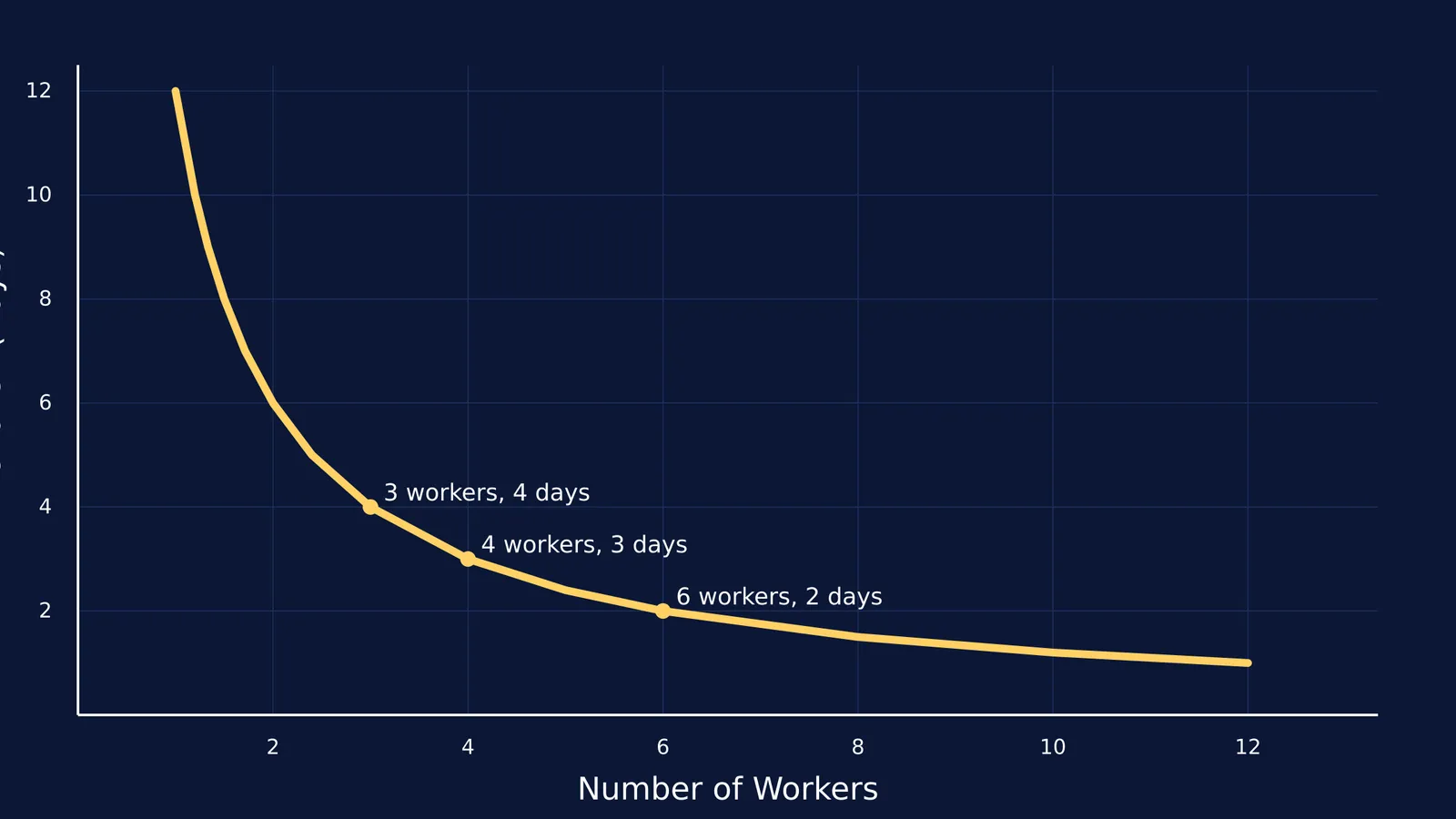
When you double the number of workers on a job, the time taken to finish that job halves. When you triple the workers, the time is divided by three. Because the total amount of work to be done does not change, multiplying the number of workers by the number of days always yields the same total.
How do you solve workers and days problems?
Workers-and-days questions are a staple of the Class 8 NCERT mathematics syllabus, particularly in Chapter 13. These problems rely on the concept of "man-days"—a measure of the total effort required to complete a specific task.
Imagine a contractor estimates that 3 persons can rewire a house in 4 days. If he decides to use 4 persons instead of three, how long will they take?
Find the constant product (total work): 3 workers × 4 days = 12 man-days.
Set up the equation for the new situation: 4 workers × y days = 12 man-days.
Solve for the unknown (y): y = 12 / 4 = 3 days.
If a student struggles with visualising how these setups work, the Fermi Problem Library includes a step-by-step solver that explains the reasoning behind the constant product rather than just printing the final numerical answer.
What if workers leave partway through the job?
A common twist in examinations is when workers leave or join partway through a job. To solve these, you still track the constant product, but you subtract the work already completed before the change happened.
Suppose 10 workers plan to build a wall in 6 days, making a total of 60 man-days of work. After 2 days, they have completed 20 man-days of effort (10 workers × 2 days). The remaining work to be done is 40 man-days. If 2 workers fall ill at that point, the remaining 8 workers must finish those 40 man-days. You divide the remaining work by the remaining workers: 40 / 8 = 5 days. The job takes 7 days in total instead of the original 6.
How do food-for-soldiers problems work?
Another classic format tests the exact same concept using animals on a farm or soldiers in a fort. Here, the constant product is the total amount of food available, rather than the total amount of work.
Suppose a military fort has enough food to feed 1000 soldiers for 20 days. If 200 soldiers are transferred to another base, how long will the food last for the remaining troops?
The total food stock is the constant product: 1000 soldiers × 20 days = 20000 soldier-days.
The new number of soldiers is 1000 - 200 = 800.
Let y be the new number of days. The equation is 800 × y = 20000.
Solving for y gives 20000 / 800 = 25 days.
Because there are fewer mouths to feed, the rations stretch further. This dynamic is mathematically identical to quadratic word problems in Class 10, where speed and time are inversely proportional for a fixed journey distance.
How can you tell if a problem is direct or inverse proportion?
When faced with a new problem, students can avoid the illusion of linearity by asking one simple question before doing any maths: *If I have more of the first thing, will I need more or less of the second thing?*
More workers → fewer days: Inverse proportion (x₁ × y₁ = x₂ × y₂).
More speed → less time: Inverse proportion.
More items → more cost: Direct proportion (x₁ / y₁ = x₂ / y₂).
Teaching students to identify the constant—whether it is the total work, the food stock, or the total distance—gives them a reliable anchor. If they need to review how these mathematical formulas map to real-world physical situations, the Fermi Concept Library breaks down proportional reasoning into its fundamental parts.
Just as converting units using dimensions requires keeping track of underlying quantities, solving inverse proportion problems is entirely about finding the hidden total that never changes.
To practise more of these problems and see every step explained, try a few examples in the Fermi Problem Library.


