

On this page
An intrinsic semiconductor is a pure crystal, such as silicon or germanium, with no added impurities. At absolute zero, it acts as a perfect insulator. At room temperature, thermal energy breaks a few covalent bonds, releasing a small number of free electrons and leaving behind equal numbers of vacancies, or holes.
According to NCERT Class 12 Physics, a pure silicon crystal has an atom density of about 5 × 10²⁸ m⁻³, but its intrinsic carrier concentration (ni) is only about 1.5 × 10¹⁶ m⁻³ at 300 K. Because the number of electrons (ne) exactly equals the number of holes (nh), their conductivity is too low for most practical electronic devices.
If you want to understand how these electrons transition between the valence and conduction states, the Fermi Concept Library maps out the energy bands behind solid-state physics, helping you see the theory before you memorise it.
Why do we need doping in semiconductors?
To make semiconductors useful, we deliberately add specific impurities to the pure crystal—a process known as doping. This transforms the material into an extrinsic semiconductor.
Even a microscopic amount of dopant causes a massive shift. If you dope silicon with just 1 part per million (ppm) of an impurity, you introduce roughly 5 × 10²² dopant atoms per cubic metre, as derived from NCERT Class 12 Physics values. This floods the crystal with new charge carriers, boosting its conductivity by a factor of millions compared to its intrinsic state.
What are n-type and p-type extrinsic semiconductors?
The type of extrinsic semiconductor you get depends entirely on the valency of the dopant atom you add to the pure lattice.
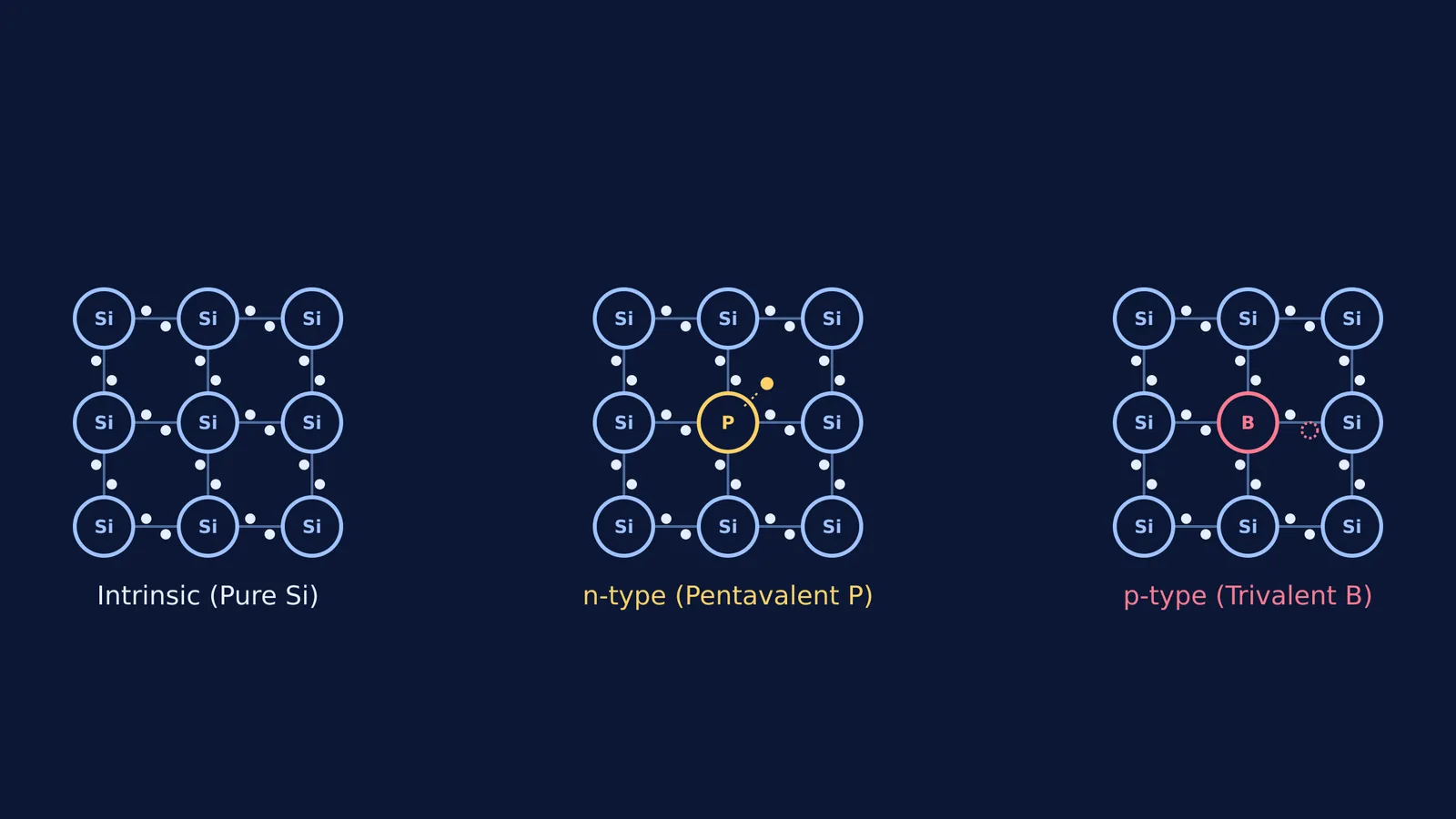
n-type (Pentavalent doping): When you add a Group 15 element like phosphorus (P), arsenic (As) or antimony (Sb), it brings five valence electrons. Four form covalent bonds with the surrounding silicon atoms, but the fifth electron is left loosely bound and free to move. Because these dopants donate free electrons, they are called donor impurities.
p-type (Trivalent doping): When you add a Group 13 element like boron (B), aluminium (Al) or indium (In), it has only three valence electrons. It forms three bonds with silicon, leaving a vacancy or "hole" in the fourth bond. Nearby electrons can jump into this hole, allowing the hole to move through the crystal. These are called acceptor impurities because they accept electrons from the lattice.
If you are exploring how energy levels differ across materials, see our guide on Energy bands: conductors, semiconductors and insulators compared.
Majority and minority carriers: who carries the current?
In an intrinsic semiconductor, current is carried equally by electrons and holes. In an extrinsic semiconductor, one type of carrier dominates.
In n-type semiconductors: Electrons are the majority carriers (ne ≫ nh), while holes are the minority carriers.
In p-type semiconductors: Holes are the majority carriers (nh ≫ ne), while electrons are the minority carriers.
How to solve semiconductor doping problems?
When you increase the number of majority carriers by doping, the number of minority carriers drops. This relationship is governed by the mass action law, which states that in thermal equilibrium, the product of electron and hole concentrations is constant:
ne × nh = ni²
Here is a quick framework for finding the minority carrier concentration in a doped crystal:
Identify the intrinsic concentration: Find ni (e.g. 1.5 × 10¹⁶ m⁻³ as given by NCERT Class 12 Physics).
Find the majority carrier concentration: This is usually equal to the number density of the dopant atoms (ND for donors or NA for acceptors).
Apply the formula: Divide ni² by the majority concentration to find the minority carriers.
Worked example: Pure silicon (ni = 1.5 × 10¹⁶ m⁻³) is doped with 10²² m⁻³ atoms of phosphorus. Find the hole concentration.
Since phosphorus is a donor, ne ≈ 10²² m⁻³.
nh = (1.5 × 10¹⁶)² / 10²²
nh = (2.25 × 10³²) / 10²² = 2.25 × 10¹⁰ m⁻³.
If you get stuck applying the mass action law to different materials, the Fermi Problem Library will walk you through the math, acting as a step-by-step solver that explains the reasoning rather than just printing an answer. For more practice with these exact equations, check out our walkthrough of n-type and p-type semiconductors: carrier concentration problems.


