

On this page
When you treat formaldehyde or benzaldehyde with a concentrated base, two molecules react together: one is oxidised to a carboxylic acid, and the other is reduced to an alcohol. This is the classic Cannizzaro reaction. But what happens if both aldehyde groups are already on the same molecule?
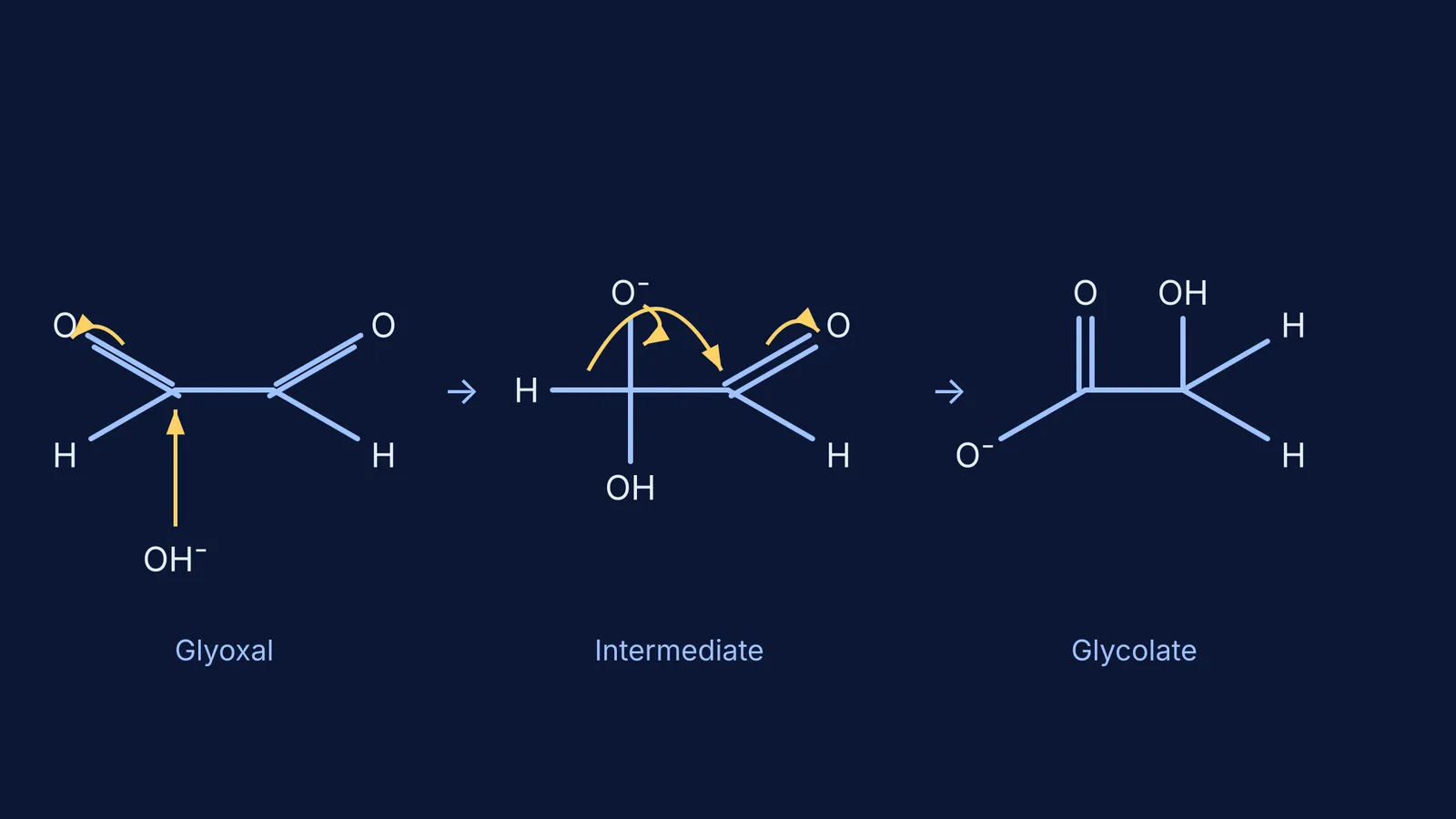
The intramolecular Cannizzaro reaction of glyoxal is a disproportionation where one aldehyde group is oxidised and the other is reduced within the same molecule to form glycolate (Salomaa, 1956). Glyoxal (CHO–CHO) is the simplest dialdehyde. When exposed to a strong base like NaOH, it does not need to find a partner. Instead, the reaction happens entirely within the molecule, forming the glycolate ion (HOCH₂COO⁻), which gives glycolic acid when protonated.
Because the two reacting groups are permanently held next to each other, this internal version is highly efficient. In 2013, researchers Pan Wang and colleagues at the Shanghai Institute of Organic Chemistry published a study in the *Journal of the American Chemical Society* demonstrating that catalytic variants of this intramolecular reaction for aryl and alkyl glyoxals can achieve nearly quantitative yields (Wang et al., 2013).
Why does it not undergo aldol condensation?
Like all Cannizzaro substrates, glyoxal lacks α-hydrogens. An α-hydrogen is a hydrogen atom attached to the carbon immediately next to the carbonyl group. If glyoxal had one, the strong base would pull it off to form an enolate ion, which would then attack another molecule in an aldol condensation.
Because glyoxal has no such hydrogens, the base has nothing to deprotonate. Instead, it must act exclusively as a nucleophile, attacking the carbonyl carbon directly. This kicks off an internal oxidation and reduction sequence rather than a condensation.
What is the step-by-step mechanism?
The reaction moves through three distinct steps. The critical moment is a hydride shift — moving a hydrogen atom and its two bonding electrons from one carbon to the adjacent one.
Nucleophilic attack: The hydroxide ion (OH⁻) attacks one of the highly electrophilic carbonyl carbons of glyoxal. This pushes the electrons from the C=O double bond up onto the oxygen atom, creating a tetrahedral intermediate with a negative charge (an alkoxide mono-anion).
Intramolecular hydride shift: This is the rate-determining step, meaning it is the slowest step and dictates the overall speed of the reaction. The negatively charged oxygen pushes its electrons back down to reform the C=O double bond. Because carbon cannot form five bonds, it must let something go. The hydrogen atom is expelled as a hydride ion (H⁻) and transfers directly to the neighbouring carbonyl carbon.
Rapid proton transfer: After the hydride shift, the first carbon has become a carboxylic acid (COOH) and the second has become an alkoxide (CH₂O⁻). This state is inherently unstable: the carboxylic acid is highly acidic, and the alkoxide is strongly basic. A rapid internal proton transfer happens instantly, moving the H⁺ from the acid to the alkoxide to form the stable glycolate ion (COO⁻ and CH₂OH).
How do we know the hydride transfers directly?
One of the most elegant proofs in organic chemistry relies on heavy water (D₂O). When chemists run the Cannizzaro reaction in a solvent made of deuterium oxide, the resulting alcohol product does not contain any deuterium attached to the newly reduced carbon.
If the hydrogen had detached completely and floated into the solvent as a free H⁺ or H⁻ ion, it would have swapped with the surrounding D₂O, and deuterium would appear in the final product. The complete absence of deuterium proves that the hydride ion never leaves the molecule; it crosses the gap directly from one carbon to the other.
How do you draw the hydride shift?
When drawing this mechanism for an exam, examiners look closely at the curved arrows in the second step. If you review reaction mechanisms in the Fermi Concept Library, where every concept has its own lesson and its place in the map, you will notice how electron flow always moves from a region of high density to an electrophilic centre.
Here is a checklist for drawing the critical shift correctly:
Start your first arrow on the lone pair of the negatively charged oxygen, pointing to the C–O single bond to show the double bond reforming.
Start the second arrow exactly on the C–H bond of that same carbon, pointing to the carbon atom of the other aldehyde group. This shows the hydride moving.
Start the third arrow on the C=O bond of the second aldehyde group, pointing up to its oxygen atom, showing the bond breaking to accommodate the incoming hydride.
This concerted push-and-pull is what oxidises the first half of the molecule and reduces the second half at exactly the same time, giving you the final glycolate product in one smooth sequence.


