

On this page
In a flat, two-dimensional plane, the rules are simple: if two straight lines are not parallel, they must eventually cross. But when you add a third dimension, a new possibility emerges.
Do two lines in 3D always intersect?
No. In three-dimensional space, two lines can be parallel, intersecting, or skew. According to Paul Dawkins' Calculus II notes at Lamar University, skew lines are lines that are not parallel but still do not intersect. This is a phenomenon unique to 3D space.
Think of two aeroplanes flying in different directions and at different altitudes. Their paths are not parallel, but because of the height difference, their flight lines will never cross.
When you are preparing for exams like the JEE, questions often give you the equations of two lines and ask you to decide which of these three cases applies. If the direction vectors are multiples of each other, the lines are parallel. If they are not, you must test whether they share a common point. (If you are working with points rather than lines, you might also use the section formula in 3D or test for collinear points with vectors).
How to check if two lines intersect?
To test if two non-parallel lines intersect, you need to see if there is a single point (x, y, z) that lies on both of them. We do this by equating their coordinates.
Write a general point for each line. Turn the line's Cartesian or vector equation into parametric form. Use a different parameter for each line—for example, s for the first line and t for the second.
Equate the coordinates. Set the x-coordinate of the first line equal to the x-coordinate of the second. Do the same for y and z. This gives you three equations in two variables (s and t).
Solve two equations. Pick the two simplest equations (usually the x and y equations) and solve them simultaneously to find the values of s and t.
Check the third equation. Substitute your values of s and t into the z-equation. If the two sides are equal, the lines intersect. If they do not match, the system has no solution, meaning the lines are skew.
If you struggle to picture how these systems work in space, the Fermi Concept Library holds every concept in mathematics, each with its own lesson and its place in the map.
How do you find the point of intersection?
Let us apply the coordinate test to two lines given in Cartesian form.
Line 1: (x − 2) / 1 = (y − 3) / 2 = (z − 4) / 3 Line 2: (x − 1) / 2 = (y − 6) / −1 = (z − 6) / 1
First, set each equation to a parameter. Let Line 1 equal s, and Line 2 equal t. For Line 1, the general point is: x = s + 2 y = 2s + 3 z = 3s + 4
For Line 2, the general point is: x = 2t + 1 y = −t + 6 z = t + 6
Next, equate the coordinates to build your three equations: x-coordinates: s + 2 = 2t + 1 => s − 2t = −1 y-coordinates: 2s + 3 = −t + 6 => 2s + t = 3 z-coordinates: 3s + 4 = t + 6 => 3s − t = 2
Now, solve the first two equations for s and t. From the first equation, we get s = 2t − 1. Substitute this into the second equation: 2(2t − 1) + t = 3 4t − 2 + t = 3 5t = 5 t = 1
Putting t = 1 back into our expression for s: s = 2(1) − 1 s = 1
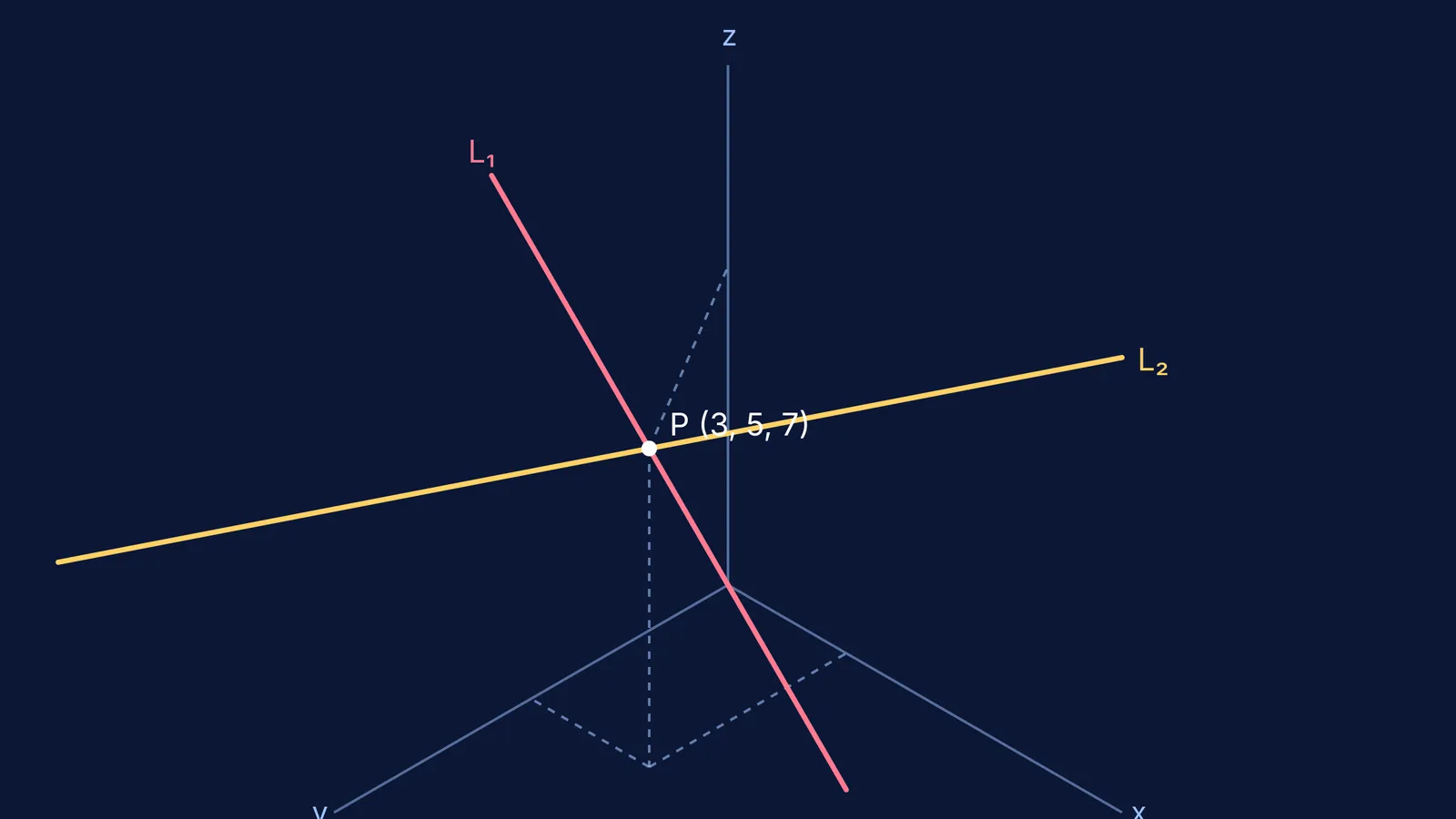
Finally, we run the crucial check. Substitute s = 1 and t = 1 into the third equation (the z-coordinates): Left side: 3(1) + 4 = 7 Right side: 1 + 6 = 7 Since 7 = 7, the third equation is satisfied. The lines intersect.
To find the actual point of intersection, substitute s = 1 into the general point for Line 1 (or t = 1 into Line 2). x = 1 + 2 = 3 y = 2(1) + 3 = 5 z = 3(1) + 4 = 7
The lines intersect at the point (3, 5, 7). If we had found that the z-coordinates did not match, we would know immediately that the lines were skew. This method works for any pair of lines, much like finding the condition for three lines to be concurrent in 2D geometry.


