

On this page
Draw a circle, draw any two chords that cross each other, and measure the pieces. No matter how you draw them, the product of the two segments on the first chord will exactly match the product of the two segments on the second.
This property is a specific case of the broader power of a point theorem. Whether you are finding an unknown length in a geometry problem or proving a larger circle theorem, this equation is the most direct tool for the job.
What is the intersecting chords theorem?
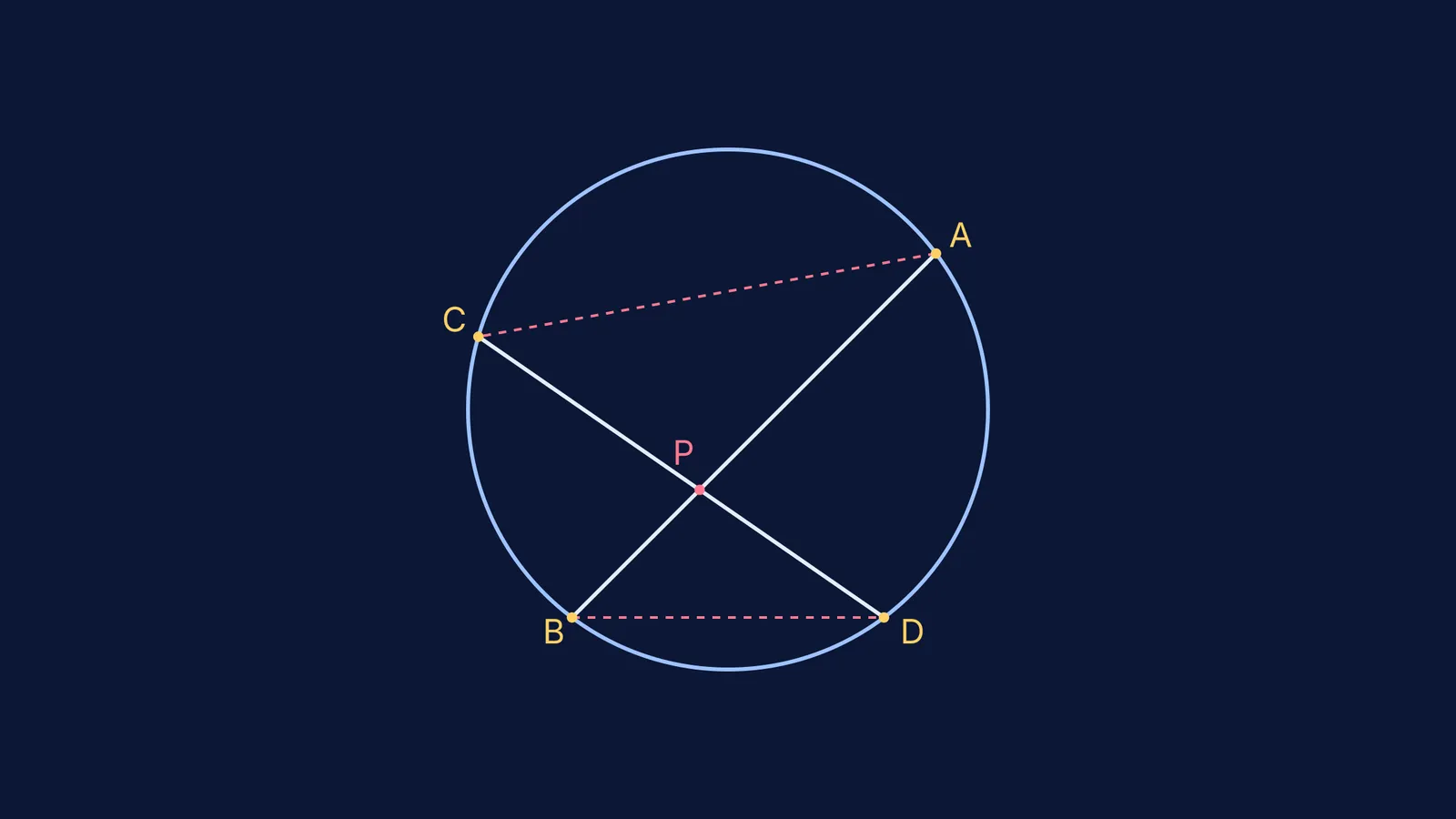
The rule behind the intersecting chords theorem is straightforward: if two straight lines cut one another within a circle, the rectangles contained by their segments are equal in area. This relationship was recorded as Proposition 35 in Book 3 of Euclid's Elements. In modern terms, if chord AB and chord CD intersect at P, the segment lengths follow this equation:
PA × PB = PC × PD
This holds true wherever P lies. If P is exactly at the centre, the chords are diameters, and all four segments equal the radius r, making r × r = r × r. As P moves away from the centre, the segments change in length, but their products remain constant.
Proof using similar triangles
We can prove this theorem by finding two triangles that share the exact same angles.
Draw the circle with chords AB and CD crossing at point P.
Draw a dashed line connecting point A to point C, and another connecting point B to point D. This creates two triangles: ΔAPC and ΔDPB.
Look at the angles inside these triangles. The angle ∠CAB (top triangle) and the angle ∠CDB (bottom triangle) both open out onto the same arc CB. The inscribed angle theorem states that angles subtending the same arc are equal, so ∠A = ∠D.
Similarly, ∠ACD and ∠ABD both subtend arc AD, so ∠C = ∠B.
The angles at the intersection point, ∠APC and ∠DPB, are vertically opposite and therefore equal.
Because all three angles match, ΔAPC and ΔDPB are similar triangles. When triangles are similar, the ratio of their corresponding sides is equal:
PA / PD = PC / PB
Cross-multiply this fraction, and you get the theorem:
PA × PB = PC × PD
If you find it hard to spot the arcs and subtended angles on a page, the Fermi Simulation Lab lets you drag the intersection point around the circle to see how the similar triangles adapt.
A worked length problem
Questions usually give you three of the four segment lengths and ask you to find the missing one.
Problem: Two chords AB and CD intersect at point P inside a circle. You measure the segments and find that PA = 6 cm, PB = 4 cm, and PC = 3 cm. Find the length of the entire chord CD.
Step 1: Write down the theorem. PA × PB = PC × PD
Step 2: Substitute the known values. 6 × 4 = 3 × PD 24 = 3 × PD
Step 3: Solve for PD. PD = 24 / 3 = 8 cm
Step 4: Answer the question asked. The problem asks for the length of the full chord CD, not just the segment PD. CD = PC + PD CD = 3 + 8 = 11 cm
If you make a mistake in a step like this—for instance, stopping at PD = 8 cm without calculating the full chord—the Fermi Problem Library will point out the gap in your reasoning rather than just printing the final answer.
Connection to the power of a point
The intersecting chords theorem is one of three related rules grouped under the "power of a point" concept. The power of a given point P with respect to a circle of radius r is a measure of how far P is from the circle's centre.
If the distance from P to the centre is d, the power of the point is defined as d² − r². Because P is inside the circle, d is less than r, making this value negative. To keep distances positive, we often write the intersecting chords equation as r² − d².
Every chord through P has a segment product of r² − d². If you know the circle's radius and the intersection's distance from the centre, you can find this product without measuring any chords.
Does it work outside the circle?
The formula PA × PB = PC × PD only applies when the intersection point P is inside the circle. However, if you extend the chords outside the circle until they meet at an external point P, a nearly identical rule applies, called the intersecting secants theorem.
The proof method for that theorem is exactly the same: you draw dashed lines to form two triangles, prove they are similar using shared arcs, and cross-multiply the side ratios. If you are preparing for competitive exams like JEE Main, mastering the similar-triangle proof is more useful than memorising the final formulas, because the same logic solves problems about a circle through three given points or the concurrent lines of a triangle. You can trace how these geometry rules connect to each other in the Fermi Concept Library.


