

On this page
When solving 3D geometry or vector algebra problems, you often need to find a line or a vector that evenly divides the angle between two given vectors. The secret is that you cannot simply add the original vectors together—unless they are already exactly the same length. Instead, you must scale them first.
Why does adding unit vectors give the angle bisector?
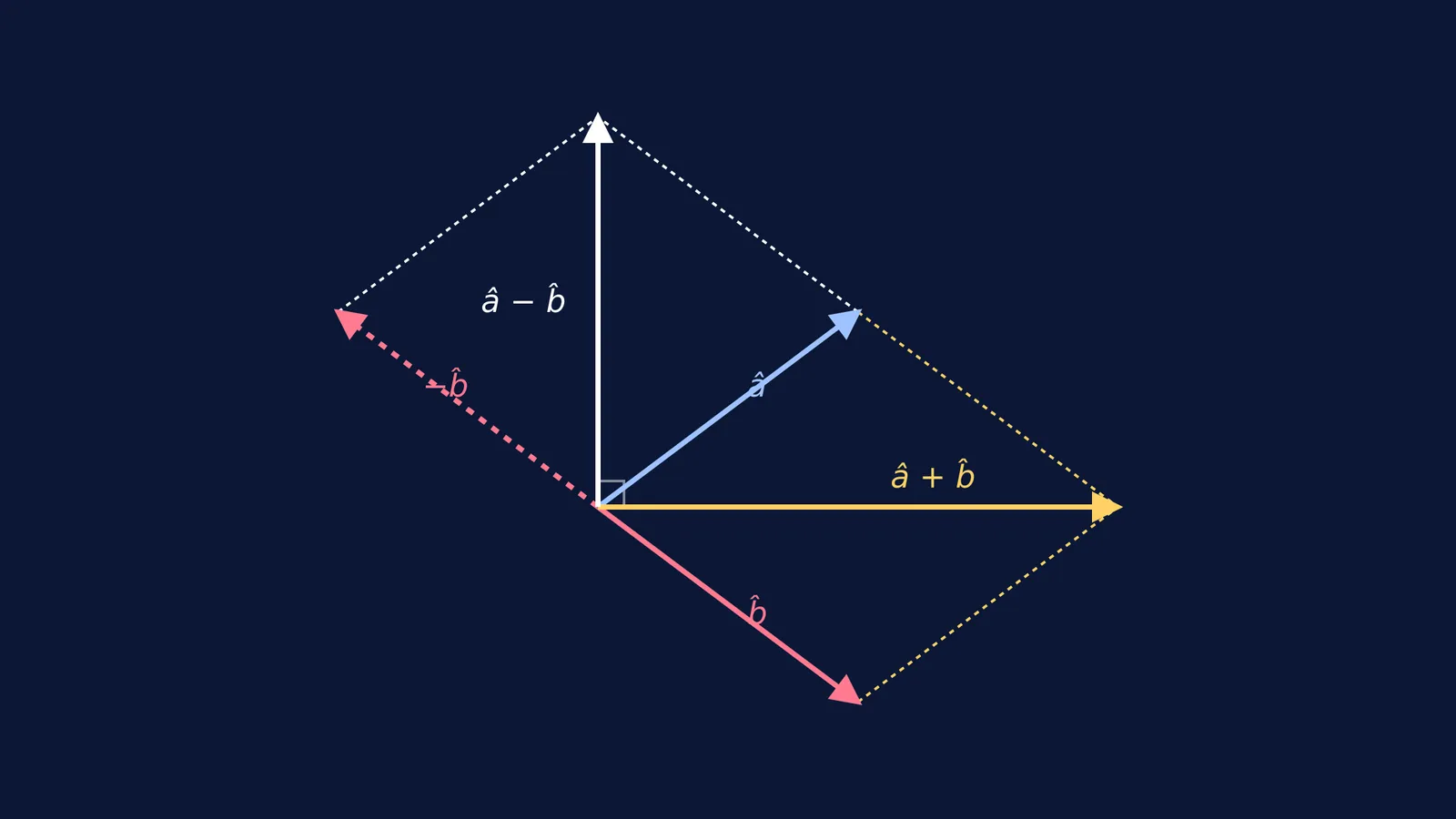
If you have two vectors a and b, adding them as a + b gives the diagonal of a parallelogram. However, a parallelogram's diagonal only bisects its corner angle if all four of its sides are equal in length. A parallelogram with equal sides is called a rhombus.
To force the sides to be equal, we divide each vector by its own magnitude to create unit vectors, written as â and b̂. Adding these unit vectors together, â + b̂, builds a rhombus with side lengths of 1. The diagonal of this rhombus points precisely along the internal angle bisector of a and b.
This visual logic is why vector algebra is so powerful; it turns angle problems into simple addition. It is a technique that comes up often in the Fermi Problem Library when working through coordinate geometry and ray optics problems.
What is the formula for the internal and external angle bisector?
The direction of the internal angle bisector of two vectors a and b is proportional to the sum of their unit vectors:
Direction of internal bisector = â + b̂
The external angle bisector divides the supplementary angle, which is the angle formed by extending one of the vectors backwards. Since the external bisector bisects the angle between â and −b̂, its direction is given by their difference:
Direction of external bisector = â − b̂
Because â and b̂ have the exact same length of 1, their sum and difference represent the two diagonals of a rhombus. The diagonals of a rhombus always cross at exactly 90°, which means the internal and external bisectors of an angle are always perpendicular to each other.
How do you find the direction of the angle bisector of two vectors a and b?
Here is a worked example to show the step-by-step framework. Suppose you need to find a vector pointing along the internal bisector of a = 3i + 4j and b = 8i + 6j.
Find the magnitudes: |a| = √(3² + 4²) = √25 = 5 and |b| = √(8² + 6²) = √100 = 10
Write the unit vectors: â = (3/5)i + (4/5)j and b̂ = (8/10)i + (6/10)j = (4/5)i + (3/5)j
Add them for the internal bisector: â + b̂ = (3/5 + 4/5)i + (4/5 + 3/5)j = (7/5)i + (7/5)j
The resulting vector direction is proportional to i + j. Because we only care about the direction, you can scale this by any positive number. A vector like i + j or 5i + 5j is a valid internal bisector direction.
If you instead needed the external bisector, you would subtract the unit vectors:
â − b̂ = (3/5 − 4/5)i + (4/5 − 3/5)j = (−1/5)i + (1/5)j
This gives a direction proportional to −i + j. If you take the dot product of (i + j) and (−i + j), you get −1 + 1 = 0, proving that the two bisectors are perpendicular.
How does this apply to lines and complex numbers?
Once you have the direction of the bisector, finding the full equation of the bisecting line is straightforward. If the two vectors start at a common point with position vector r₀, the equation of the internal angle bisector line is r = r₀ + λ(â + b̂), where λ is any scalar.
Because vectors and complex numbers share the same 2D geometry, this exact same logic applies when solving equations in complex numbers by putting z = x + iy. The bisector of the angle between two complex numbers z₁ and z₂ can be found by adding their unit vectors z₁/|z₁| and z₂/|z₂|. Similarly, you can apply these principles to test for straight lines using the collinear points with vectors method.
If you are ever unsure how these vector proofs connect to classical geometry, Fermi's AI tutor can draw the figure on its board and talk you through the proof step by step. You can also explore the proofs on your own inside the Concept Library, which connects every concept in mathematics and physics on a single map.


