

On this page
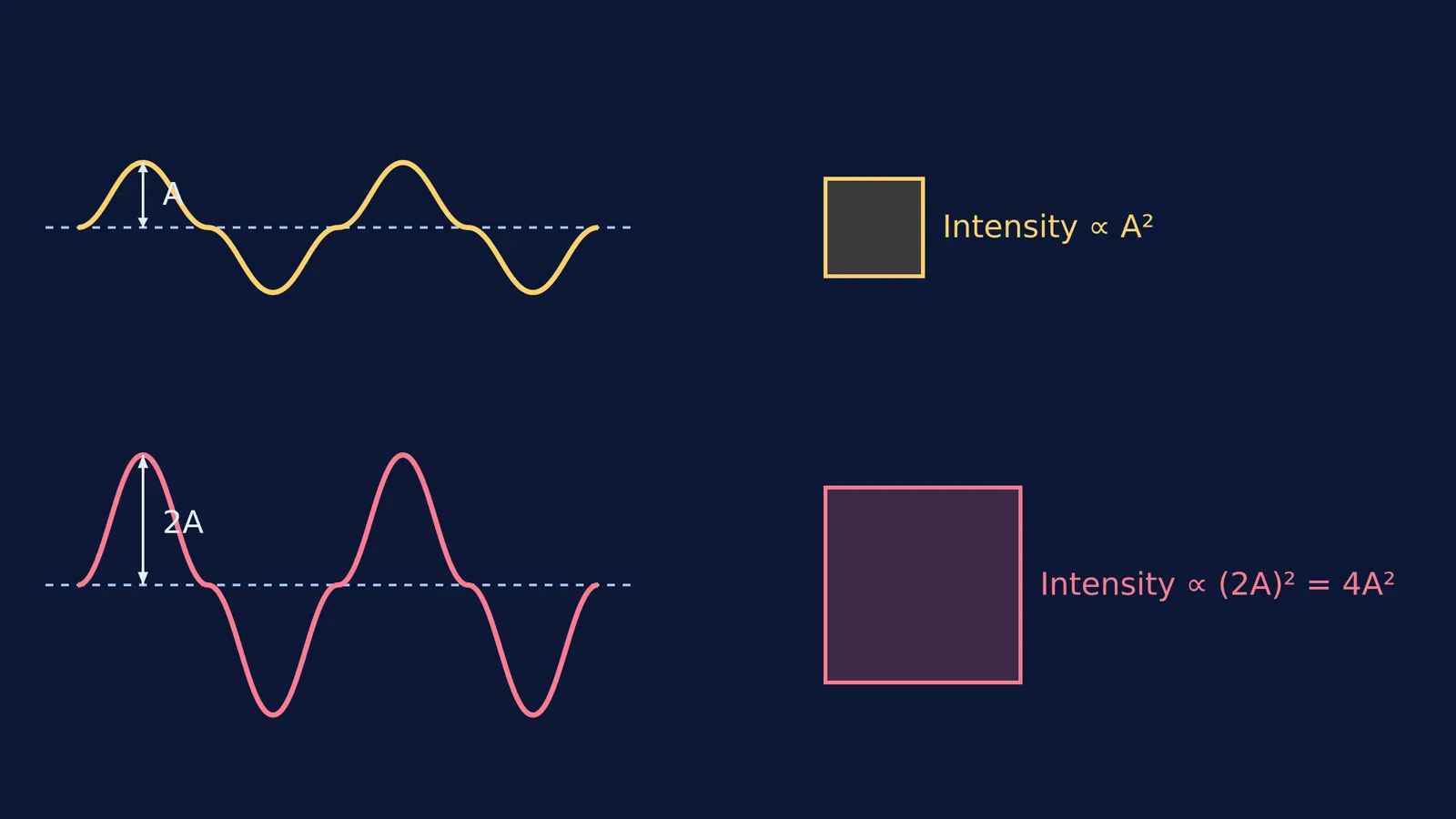
When you pluck a guitar string harder, the sound that reaches your ear is much more intense. This quadratic relationship between amplitude and intensity appears everywhere in physics, from ripples in a pond to the glare of a laser.
The underlying reason comes down to the energy of the particles making up the wave.
Why does energy scale with the square of the amplitude?
A wave is a disturbance that travels through a medium, transferring energy without transferring matter. As the wave passes, it sets local particles into simple harmonic motion.
To find the energy of these oscillating particles, look at the work required to displace them. If you pull a mass on a spring, the restoring force increases the further you pull. The total work done to stretch the spring to a maximum displacement A is given by U = 1/2 kA².
When you consider a single particle on a stretched string, it oscillates back and forth. The kinetic energy is maximum when the particle passes through its equilibrium position, and the potential energy is maximum when it reaches its maximum displacement, the amplitude A. The total energy remains constant and depends only on that maximum displacement. Because the potential energy formula is proportional to the square of the displacement, the total mechanical energy of any simple harmonic oscillator—and therefore the energy of the particles in a wave—goes as A². As the wave propagates, this energy is handed off from one particle to the next, meaning the power transmitted also follows the square of the amplitude.
According to OpenStax's *University Physics*, this applies to power and intensity as well: "In general, the energy of a mechanical wave and the power are proportional to the amplitude squared and to the angular frequency squared."
What is the difference between power and intensity?
While energy is the total capacity to do work, power is the rate at which that energy is transferred. Intensity goes one step further: it is the power delivered per unit area.
If a wave has an intensity I and an amplitude A, the relationship is simply I ∝ A².
If you double the amplitude (2A): The intensity increases by 2² = 4 times.
If you halve the amplitude (A/2): The intensity drops to (1/2)² = 1/4 of its original value.
This rule holds across the spectrum. For sound waves in air, the intensity is proportional to the square of the pressure amplitude. For light, the energy density of the electromagnetic field and its resulting intensity are proportional to the square of the electric field vector.
Why is this important in Young's double slit experiment?
In wave optics, this relationship is the key to understanding interference patterns. When light passes through two narrow slits, the waves spread out and interfere with each other. The bright and dark fringes you see on a screen are direct results of the intensity scaling with the square of the amplitude.
Where the waves meet in phase, the electric fields add up. If two identical slits produce waves of amplitude A, they combine to form an amplitude of 2A. The resulting bright fringe has an intensity proportional to (2A)², which is four times the intensity of a single slit, not just twice. Where they meet out of phase, the fields cancel to zero amplitude, leaving a dark spot with zero intensity.
How to use this in wave interference problems?
In exams like the JEE and NEET, the I ∝ A² relationship is most often tested when two waves overlap and interfere.
When two coherent waves of amplitudes A₁ and A₂ meet in phase (constructive interference), their amplitudes add up directly to a new amplitude of A₁ + A₂. The new maximum intensity is not the sum of their individual intensities, but the square of their combined amplitude: I_max ∝ (A₁ + A₂)²
If they meet completely out of phase (destructive interference), they subtract: I_min ∝ (A₁ - A₂)²
For example, if two waves have amplitudes 3A and A, their individual intensities are proportional to 9A² and A². When they interfere constructively, the new amplitude is 4A, creating an intensity peak proportional to 16A².
If you find yourself stuck on setting up these interference ratios or visualising how the waves add up, try exploring the Fermi Problem Library. Fermi's AI tutor can explain the reasoning step by step and draw the resulting waveforms so you can see exactly where the peaks and troughs align.
Understanding that intensity is driven by A² removes the guesswork from wave optics, alternating current, and acoustics. It is the single most important proportionality to remember when calculating how waves transport energy.


