

On this page
It is tempting to split integrals over multiplication, just as you do over addition. Because the limit of a product is the product of the limits, and the derivative of a sum is the sum of the derivatives, it feels natural that integrals should follow the same pattern. But they do not.
Is the integral of a product the product of integrals?
No, the integral of a product is never simply the product of the integrals. When you are unsure if an algebraic rule works in calculus, you can test it with the simplest possible functions.
Let f(x) = x and g(x) = x.
First, multiply them and then integrate the single resulting term: ∫ (x × x) dx = ∫ x² dx = x³/3 + C
Now, integrate them separately and multiply the two results: (∫ x dx) × (∫ x dx) = (x²/2) × (x²/2) = x⁴/4
Because x³/3 does not equal x⁴/4, the "rule" fails immediately. As Mathcentre.ac.uk (2009) points out in its guide to integration by parts, there is no direct multiplication shortcut for integration.
Why does addition work but multiplication fails?
An integral is effectively a sum of very thin vertical slices of area. When you add two functions to get f(x) + g(x), the height of the combined slice is just the sum of the individual heights. Therefore, the total area under the curve is exactly the sum of the separate areas.
Multiplication behaves entirely differently. When you multiply f(x) and g(x), the height of the new slice is the product of the original heights, creating a completely new shape. The area under this new curve has no simple geometric relationship to the areas under the original curves.
Integration is the reverse of differentiation, meaning the rules of integrals come directly from the rules of derivatives. The derivative of a sum is the sum of the derivatives: (f + g)' = f' + g'. But the product rule for derivatives creates two separate terms: (uv)' = u'v + uv'. Because taking a derivative creates this split, reversing the process cannot possibly give you a neat product of integrals.
How does integration by parts solve this?
Since you cannot just multiply the integrals, how do you integrate a product like x cos(x) or x² eˣ? You use integration by parts, which is the product rule for derivatives run backwards.
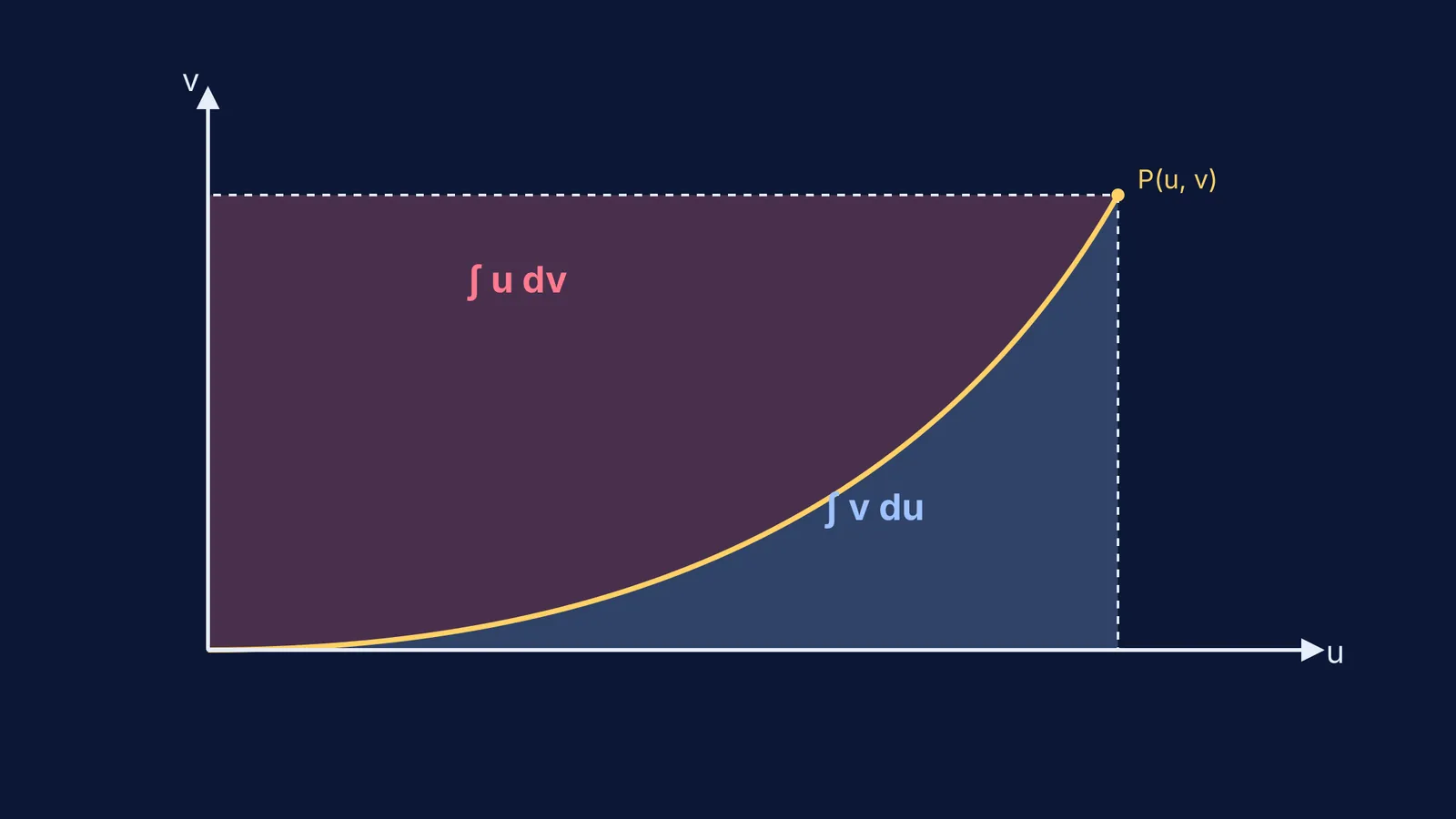
Starting from the product rule (uv)' = u'v + uv', integrating both sides and rearranging the terms gives the standard formula: ∫ u dv = uv - ∫ v du
Instead of taking two integrals and multiplying them, this formula trades your difficult integral (∫ u dv) for a new, simpler integral (∫ v du).
Here is a worked example with ∫ x cos(x) dx:
Choose u = x and dv = cos(x) dx.
Differentiate u to get du = 1 dx.
Integrate dv to get v = sin(x).
Put them into the formula: x sin(x) - ∫ 1 × sin(x) dx.
The remaining integral is just ∫ sin(x) dx, which is -cos(x).
The final answer is x sin(x) + cos(x) + C. This trades a product you could not integrate directly for a basic trigonometric integral that you can.
If you are dealing with a repeating function like an exponential multiplied by a sine wave, you can apply this formula repeatedly using the cyclic integration by parts trick. For other standard forms involving square roots, it saves time to memorise the integrals of √(a² − x²) and √(x² ± a²) rather than deriving them from scratch.
A decision framework for integrating products
When faced with an integral of a product in your JEE or school exams, do not try to multiply the integrals. Instead, use this decision path:
Check for a derivative pair: Is one part of the product the exact derivative of the "inside" of the other part? If you have ∫ 2x cos(x²) dx, you do not need integration by parts. Let u = x², and it becomes a simple substitution. Sometimes, what looks like a complex product is actually a chain rule in disguise, and you can solve it using a u-substitution and changing the end points.
Apply the LIATE rule: If it is a true product of two different function families, use integration by parts. Choose your 'u' using the LIATE order: Logarithmic, Inverse trigonometric, Algebraic, Trigonometric, Exponential. The function that comes first in this list becomes u, and the remaining term becomes dv.
Watch for the hidden 1: If you have a single function that is difficult to integrate, like ln(x) or arctan(x), write it as 1 × ln(x). It is now a product, and you can set u = ln(x) and dv = 1 dx to apply the formula.
Calculus makes much more sense when you can picture what the equations are doing. The Fermi Concept Library contains every concept in physics, chemistry, biology, mathematics and computing, each with its own lesson and its place in the map, so you can trace how abstract rules map to simple geometry.


