

On this page
If you are preparing for exams like JEE Main, NEET-UG, or school boards, saving time on a routine calculation can make a difference. When you see a linear expression inside a function—like (3x + 2)⁵ or cos(4x − 1)—you do not need to do a full u-substitution. Writing out every step for a simple linear substitution breaks your concentration on the larger physics or mathematics problem you are trying to solve.
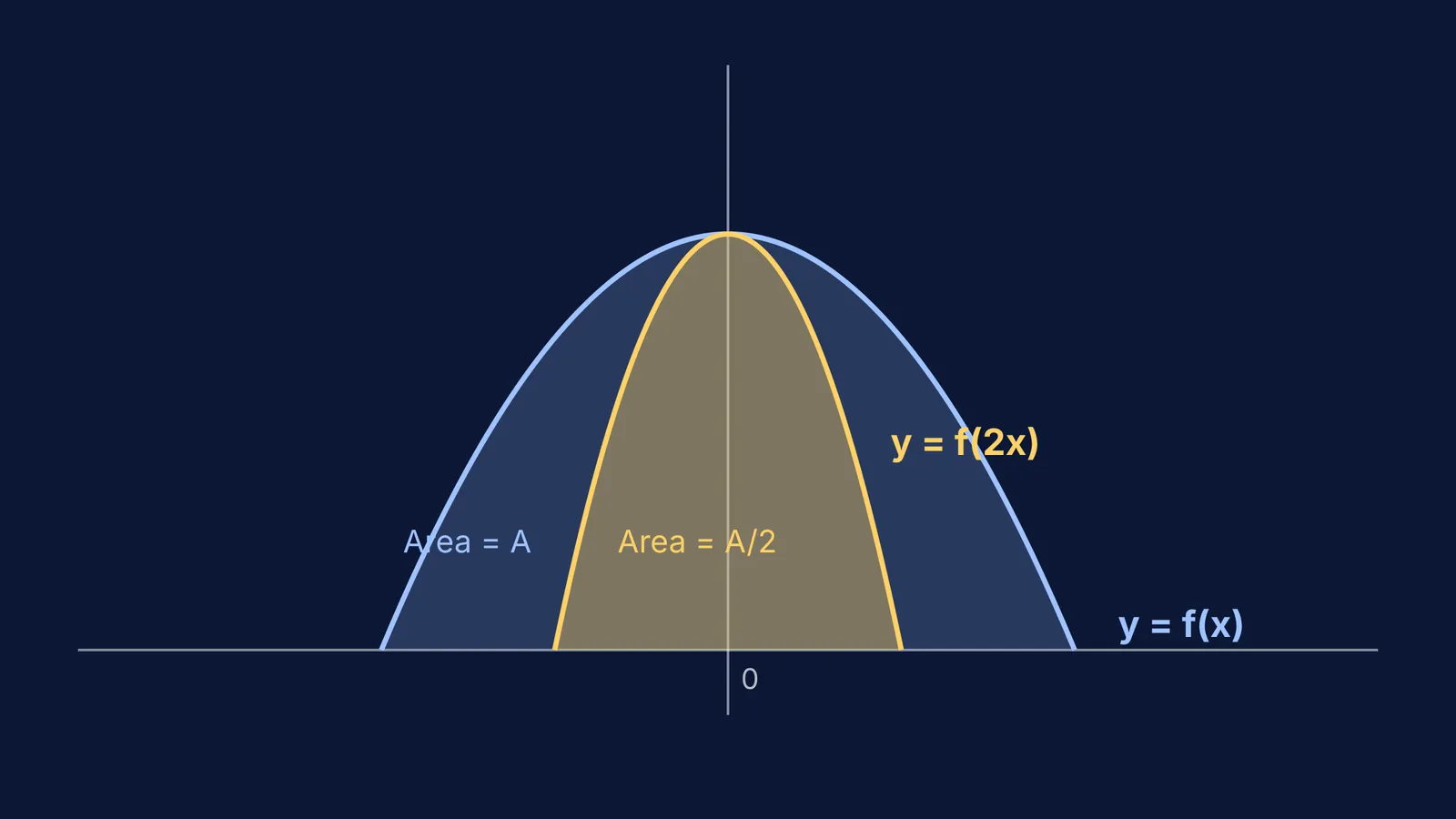
There is a direct mathematical shortcut. According to the mathematics resource mathcentre, applying substitution to an inner function like ax + b results in dividing the standard integral by a (plus the constant of integration).
This rule works because it is the chain rule running in reverse.
What is the integral of f(ax + b) shortcut?
If you have a function where the inner part is a straight line ax + b, you can write down the integral immediately.
The formula is: ∫ f(ax + b) dx = F(ax + b) / a + C
Here, a and b are constants, and F is the standard antiderivative of f. You just integrate the outer function as if the bracket was a single variable x, and then divide by a, the number multiplying x.
If you struggle to remember the standard integrals to begin with, the Fermi Concept Library holds every concept in physics, chemistry, biology, mathematics and computing, each with its own lesson and its place in the map.
How do you apply the shortcut to common functions?
Let us see how this saves time with three common types of functions.
1. The power rule: ∫(3x + 2)⁵ dx The outer function is something to the power of 5. The integral of x⁵ is x⁶ / 6. Here, the inner function is 3x + 2, so a = 3. Using the shortcut, we raise the power to 6, divide by 6, and also divide by 3: ∫ (3x + 2)⁵ dx = (3x + 2)⁶ / (6 × 3) + C = (3x + 2)⁶ / 18 + C.
2. The exponential rule: ∫e^(2x + 1) dx The integral of e^x is just e^x. For e^(2x + 1), the coefficient of x is 2. We keep the function exactly as it is and divide by 2: ∫ e^(2x + 1) dx = e^(2x + 1) / 2 + C.
3. The trigonometric rule: ∫cos(4x − 1) dx The integral of cos x is sin x. Our inner function is 4x − 1, so a = 4. The result is sin(4x − 1) divided by 4: ∫ cos(4x − 1) dx = sin(4x − 1) / 4 + C.
If you make mistakes applying these rules to harder exam questions, the Fermi Problem Library provides worked problems with a step-by-step solver that explains the reasoning rather than printing an answer.
Checklist: Can I use the shortcut?
Before you divide by a, run this quick check to avoid common traps:
Is the inner function exactly of the form ax + b? (Yes for 5x, 2 − x, or x/3. No for x², √x, or 1/x).
Is the outer function a standard integral you know? (Yes for powers, sine, cosine, e^x, or 1/x).
Is 'a' not zero? (If a = 0, the function is just a constant).
What about logarithms and square roots?
4. The logarithmic rule: ∫ 1/(5x − 3) dx The integral of 1/x is ln|x|. Here, a = 5. ∫ 1/(5x − 3) dx = ln|5x − 3| / 5 + C.
5. The square root rule: ∫ √(2x + 7) dx A square root is a power of 1/2. The integral of x^(1/2) is x^(3/2) / (3/2), which is (2/3) x^(3/2). Here, a = 2. ∫ (2x + 7)^(1/2) dx = (2/3) (2x + 7)^(3/2) / 2 + C = (2x + 7)^(3/2) / 3 + C.
Why does dividing by a work?
This rule is a fast-forward of integration by substitution.
If you did the first example the long way, you would set u = 3x + 2. Then, you differentiate it to get du/dx = 3. Rearranging this gives dx = du / 3. When you substitute this back into the original integral, you replace dx with du / 3, which means the fraction 1/3 moves to the front of the integral sign. You then integrate u⁵ to get u⁶ / 6, multiply by the 1/3, and substitute 3x + 2 back in for u.
The shortcut simply skips these repetitive algebraic steps. Because the derivative of ax + b is always just the constant a, the substitution will always result in replacing dx with du / a. By memorising the shortcut, you are automatically pulling out 1/a every time without having to write the substitution out.
Once you are comfortable with this shortcut, you can learn to change the end points directly in u-substitution or master the standard results for square root integrals to speed up your calculus even more. You can also explore integrating eᵃˣ sin bx for more advanced cyclic integration tricks.


