

On this page
When a student first meets integers in Class 6, the rules can look like a maze of arbitrary signs. "Minus and minus is plus," "keep, change, change" — these rote mnemonics often crumble under exam pressure because they rely on memory rather than logic. Adding integers on a number line gives those abstract rules a physical, visual meaning. By treating numbers as steps in a specific direction, you can literally map out your sums.
This is more than just a beginner's trick. A 2018 meta-analysis of over 10,500 children found a robust average correlation (r = .443) between number line estimation accuracy and broader mathematical achievement. A solid grasp of the number line is a crucial foundation for everything from algebra and coordinate geometry to physics vectors later on.
Why use a number line for integers?
When adding integers, you are combining two movements on a scale.
The first number is your starting position.
The second number tells you how far to move and in which direction.
This spatial approach prevents the most common mistake: mixing up a negative number's sign with the operation of subtraction. A negative sign on the second number simply means "face left." If you have gaps in these foundational basics, the Fermi Concept Library gives every concept in mathematics its own lesson and its place in the map, showing you exactly how these spatial concepts connect to later algebraic equations.
How do you add a positive integer?
Adding a positive integer means moving forward, or to the right on a standard horizontal number line.
Let's model the sum -3 + 5:
Find your starting point: Locate -3 on the number line. Place your pencil there.
Determine your direction: The number you are adding is +5. Because it is positive, your direction is to the right.
Make the jumps: Move 5 equal spaces to the right.
Count as you go: You will pass -2, -1, 0, 1, and 2.
Find the result: You land on 2. Therefore, -3 + 5 = 2.
If you struggle with calculating these mentally, drawing the physical jumps bridges the gap between a physical quantity and an abstract symbol. Getting this right early on is one of the best ways to avoid common Class 10 CBSE maths mistakes in board answers.
How do you add a negative integer?
Adding a negative integer means moving backward, or to the left. The negative sign is an instruction about your direction of travel.
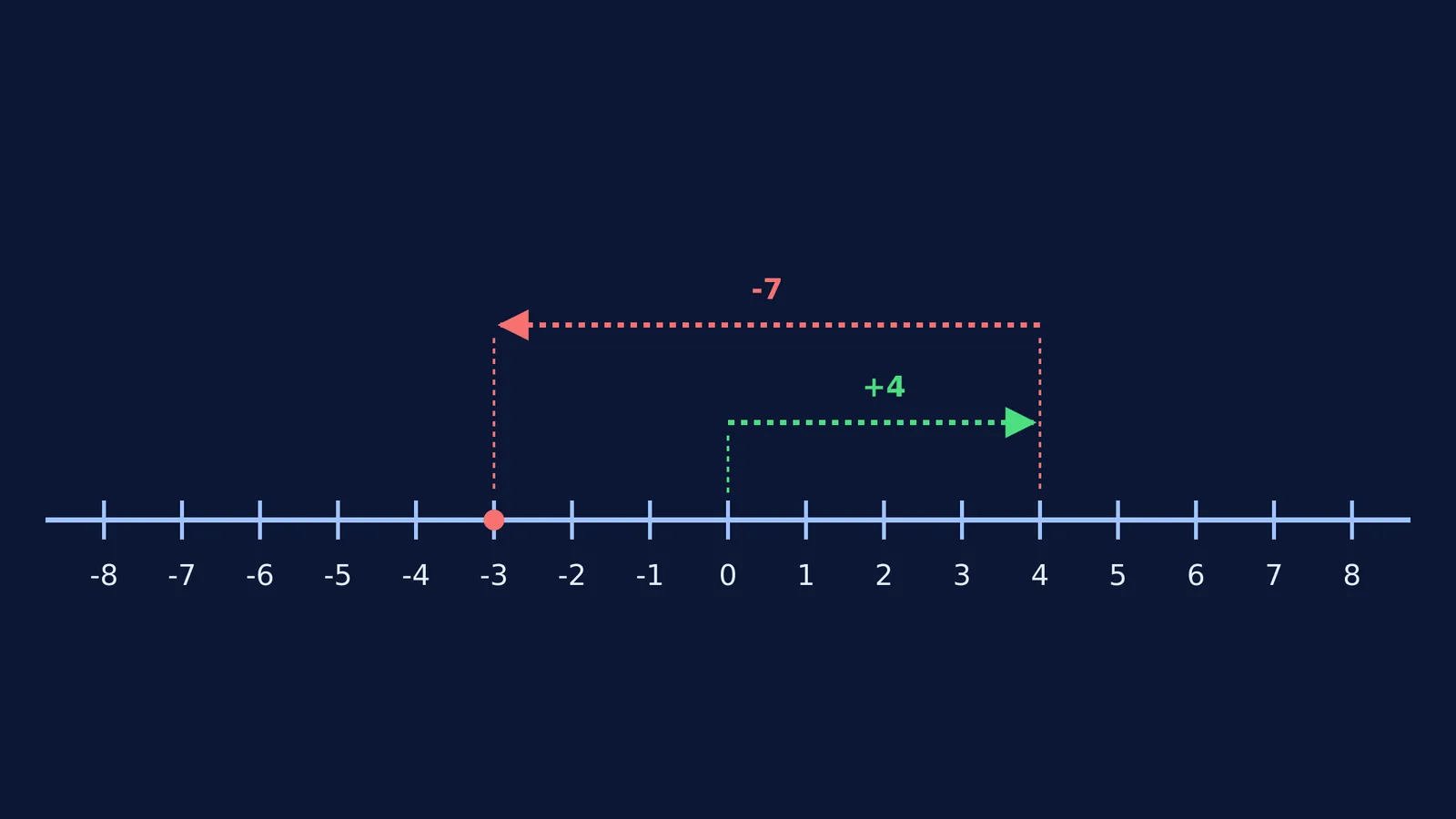
Let's model 4 + (-7), as shown in our diagram above:
Find your starting point: Start at positive 4.
Determine your direction: The number being added is -7. The negative sign means your direction is left.
Make the jumps: Move 7 spaces to the left from 4.
Count as you go: Passing through zero along the way, you count down: 3, 2, 1, 0, -1, -2, and finally -3.
Find the result: You land on -3. Therefore, 4 + (-7) = -3.
How do you add two negative integers?
One of the most confusing operations for Class 6 students is adding two negative integers, such as (-2) + (-4). The number line makes this intuitive:
Start at -2.
You are adding -4, so you must move 4 spaces to the left.
Moving left from -2, you count: -3, -4, -5, -6.
You land on -6. Therefore, (-2) + (-4) = -6.
Because both your starting position and your movement are on the negative side of zero, your result becomes "more negative."
Building on the basics
Once the directional logic clicks, it becomes much easier to handle a longer string of operations. If you are stuck on a longer problem involving negative numbers, the Fermi Problem Library has worked problems with a step-by-step solver that explains the reasoning rather than printing an answer. It breaks down the addition step by step, drawing the logic out so you can see where your signs or directions went wrong.
Getting comfortable with these left and right shifts on a number line makes later topics much simpler. By mastering this foundational technique in Class 6, you build the essential spatial reasoning needed for graphing linear functions, solving complex algebraic equations, and understanding concepts like real numbers in Class 10 with complete confidence. Once you can visualise the math, the rules finally make sense.


