

On this page
When students first meet integer word problems, everyday arithmetic rules suddenly seem to break. In whole-number maths, subtraction always makes a number smaller and addition always makes it larger. But when an elevator descends into a sub-basement or a winter night drops below freezing, subtracting a negative quantity increases the value, and adding a negative integer reduces it.
Why do integer word problems cause sign errors?
Students often struggle with integer word problems because the minus sign carries multiple meanings at once. In a 2014 study of 61 students published in the *Journal for Research in Mathematics Education*, researcher Laura Bofferding found that children frequently confuse the unary role of a negative sign with the binary operation of subtraction (Bofferding, 2014). A minus sign can designate a negative state (such as −5 °C), an operation (such as subtracting 5), or the opposite of a quantity.
Further research by Joëlle Vlassis in *Learning and Instruction* showed that students need conceptual flexibility to separate the operation of taking away from the existence of directed quantities (Vlassis, 2004). In a 2002 study in *Educational Studies in Mathematics*, researcher Aurora Gallardo observed that 12- to 13-year-old pupils solve word problems accurately when they progress from treating the minus sign purely as an operation to interpreting integers as directed relative numbers (Gallardo, 2002). In our earlier guide on Class 6 integers and the token model, physical counters help build this intuition by pairing positive and negative units to make zero.
How do you model temperature rise and fall across zero?
Temperature word problems use a vertical scale where the freezing point of water represents 0 °C. Temperatures warmer than freezing are positive integers, and temperatures colder than freezing are negative integers. A temperature rise corresponds to adding a positive change, while a temperature fall corresponds to subtracting a positive quantity or adding a negative change.
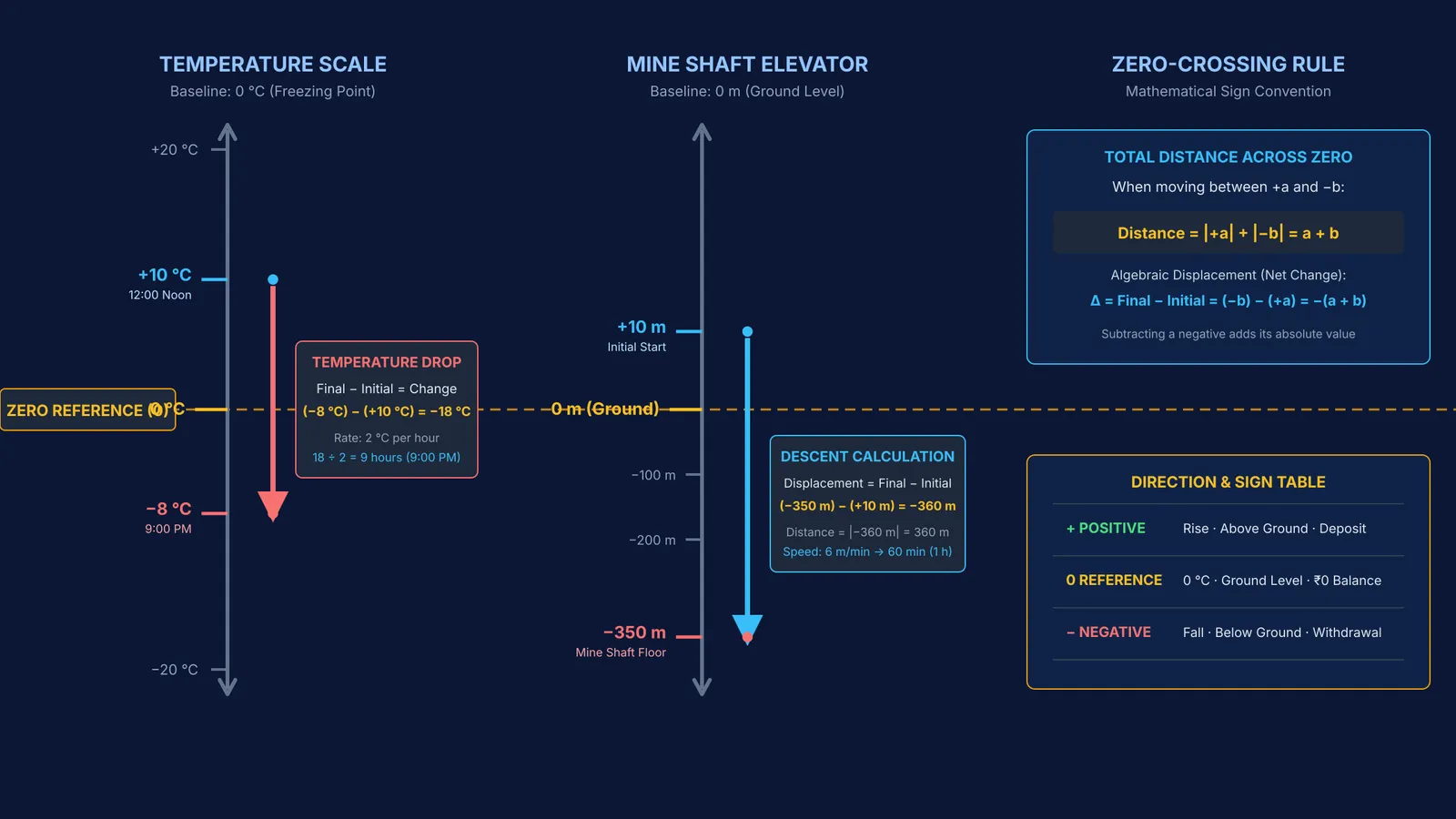
A common pitfall occurs when a temperature drop crosses zero. A standard problem in the Class 7 syllabus on the NCERT Textbook Portal tracks a noon temperature of 10 °C that drops at a rate of 2 °C per hour, requiring 9 hours to reach −8 °C at 9:00 PM. Students who simply subtract 8 from 10 arrive at 2 °C, missing the fact that the drop spans two separate regions of the number line.
To solve this systematically, write the change formula as Final Temperature − Initial Temperature = Net Change: (−8 °C) − (+10 °C) = −18 °C. Because the net fall is 18 °C and the temperature drops by 2 °C every hour, the elapsed time is 18 / 2 = 9 hours. Adding 9 hours to 12 noon gives 9:00 PM.
How do elevator and mine shaft problems work with integers?
Elevator and mining problems translate vertical motion into directed numbers. Ground level serves as the reference point at 0 metres. Floors, elevations, or platforms above the ground take positive values (+h), while basements, underground parking levels, and mine shafts take negative values (−h). Ascending means moving in the positive direction, and descending means moving in the negative direction.
According to the Class 7 curriculum from the NCERT Textbook Portal, a standard benchmark problem models an elevator descending into a mine shaft at a rate of 6 m/min from an initial elevation of 10 m above ground level to a final depth of −350 m, spanning a total distance of 360 m over 60 minutes.
To determine the travel time, calculate the total vertical displacement: Displacement = Final Position − Initial Position = (−350 m) − (+10 m) = −360 m. The total distance travelled is the absolute magnitude |−360 m| = 360 m. Moving at a speed of 6 m/min, the elevator takes 360 / 6 = 60 minutes, or exactly 1 hour.
When encountering multi-step word problems involving several consecutive ascents and descents, students often lose track of intermediate signs. The Fermi Problem Library provides worked problems with a step-by-step solver that explains the reasoning rather than printing an answer.
How do bank balances and debts translate into positive and negative numbers?
Financial transactions provide a concrete model for signed numbers. In 628 CE, Indian mathematician Brahmagupta established the arithmetic of positive and negative numbers in the *Brahmasphutasiddhanta*, explicitly treating fortunes as positive (*dhana*) and debts as negative (*rina*) (MacTutor History of Mathematics).
In modern banking problems, money deposited or earned is represented by positive integers (+₹), while money withdrawn or owed is represented by negative integers (−₹). An account balance represents the net algebraic sum of all transactions: Net Balance = Initial Balance + Deposits − Withdrawals.
Consider an account with an initial balance of ₹2,500. A student deposits ₹1,200 (+₹1,200), withdraws ₹3,000 (−₹3,000), and incurs a ₹150 service charge (−₹150). The updated balance is: 2500 + 1200 − 3000 − 150 = 3700 − 3150 = +₹550. If the student then pays an ₹800 fee, the transaction becomes 550 − 800 = −₹250, indicating an overdrawn balance of ₹250.
To see how directed numbers connect across physical systems, coordinate frames, and vectors, the Fermi Concept Library holds every concept in physics, chemistry, biology, mathematics and computing, each with its own lesson and its place in the map.
What is a reliable step-by-step checklist for integer word problems?
Before writing down equations, apply this five-step checklist to avoid dropped signs:
Identify the zero reference point: name the datum line clearly, whether it is ground level, 0 °C, or a zero bank balance.
Assign signs to directions: designate upward movement, temperature increases, and deposits as positive (+); designate downward movement, temperature drops, and withdrawals as negative (−).
Distinguish position from distance: a position has a sign (such as −350 m), whereas distance is always a positive magnitude (|−350 m| = 350 m).
Sketch a vertical line to check zero crossings: if moving from positive to negative, check that your total change equals the sum of the absolute distances from zero.
Set out each calculation with units: as detailed in our guide to neat working to prevent maths errors, showing signs on every line prevents careless slips. Parents can reinforce this habit during homework by asking diagnostic questions rather than fixing errors directly, following the strategy in helping children with word problems.


