

On this page
When you study coordination chemistry for JEE or NEET, you often meet two pairs of words that sound similar but mean different things: stable versus unstable, and inert versus labile. Mixing them up is a common mistake.
What is the difference between inert and labile complexes?
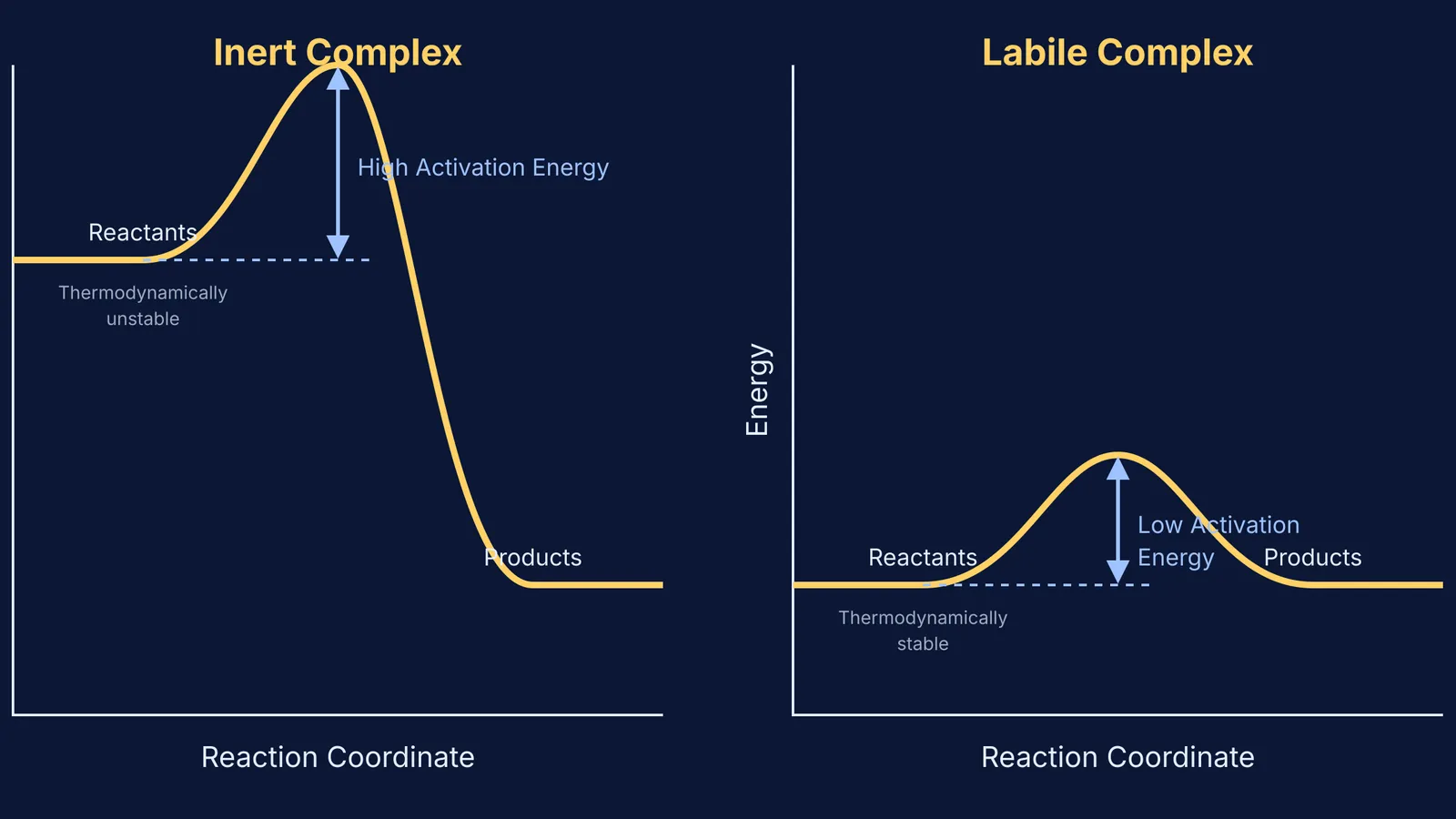
In 1952, the chemist Henry Taube proposed a simple rule of thumb for coordination complexes based on how fast they react (Chem. Rev. 1952). He classified them by the rate at which they swap one ligand for another at room temperature:
Labile complexes exchange ligands rapidly, typically completing the reaction in under one minute.
Inert complexes exchange ligands slowly, taking minutes, hours or even days.
This classification is purely kinetic. It tells you nothing about whether the complex "wants" to form in the first place, only how long it takes to change once it has formed.
Why is lability not the same as thermodynamic stability?
Thermodynamic stability is measured by the formation constant. A large formation constant means the complex is energetically favourable and will not fall apart on its own.
However, a complex can be highly stable yet still swap its parts rapidly if another ligand is available. The classic example is the tetracyanidonickelate(II) ion, [Ni(CN)₄]²⁻. It is thermodynamically very stable, but if you add radioactive carbon-14 labelled cyanide to the solution, the new cyanide ions swap with the old ones almost instantly. It is stable, but labile.
If you struggle to picture how a stable complex can still swap parts so easily, the Fermi Concept Library maps out every concept in chemistry, each with its own lesson and its place in the map.
Why is [Co(NH₃)₆]³⁺ inert but [Ni(CN)₄]²⁻ labile?
The hexaamminecobalt(III) ion, [Co(NH₃)₆]³⁺, is the textbook example of an inert complex. If you dissolve it in acid, thermodynamics says it should fall apart into [Co(H₂O)₆]³⁺ and ammonium ions. It is thermodynamically unstable in acidic conditions. Yet, you can leave it in a beaker of acid for days and nothing happens. The reaction is so slow that the complex appears perfectly happy.
Why does this happen? The answer lies in the d-electron count. Cobalt(III) is a d⁶ ion. In an octahedral field with strong-field ammonia ligands, all six electrons sit in the lower-energy d-orbitals, leaving the higher-energy antibonding orbitals empty. This low-spin d⁶ arrangement has a huge ligand field stabilisation energy. To swap a ligand, the complex must go through a transition state that forces an electron into a higher energy level, which requires a massive activation energy.
In contrast, Ni²⁺ in a square planar complex like [Ni(CN)₄]²⁻ has empty p and d-orbitals that give incoming ligands an easy path to attack without breaking the existing bonds first.
When you prepare for exams, mastering the d-electron rules for lability saves time (Wikipedia). Instead of just memorising which complexes react fast, you can see the pattern directly from their valence bond theory for complexes and crystal field splitting diagrams. Knowing how to read these configurations is just as important as understanding Werner complexes and ionisable chlorides or denticity and the chelate effect.
The mechanism: associative versus dissociative pathways
The speed of a ligand exchange depends on how the reaction actually happens. There are two main ways a complex can swap a ligand:
Dissociative mechanism: The complex drops one ligand first, leaving a gap, and then the new ligand attaches. This is like letting go of one trapeze before grabbing the next. Inert complexes like [Co(NH₃)₆]³⁺ struggle with this because breaking the first bond requires too much energy.
Associative mechanism: The new ligand attaches to the complex before the old one leaves, temporarily expanding the coordination number. Labile complexes like [Ni(CN)₄]²⁻ often use this route because they have empty orbitals ready to accept an extra bond.
How this appears in your exams
In JEE and NEET, examiners love to test the boundary between thermodynamics and kinetics. A typical multiple-choice question might ask you to identify which complex will not react with an acid, or which complex exchanges isotopic ligands the fastest.
To tackle these problems, follow a simple checklist:
Find the oxidation state of the central metal ion.
Count the d-electrons.
Determine if the ligand is a strong-field or weak-field ligand.
Draw the electron configuration to see if it is high-spin or low-spin.
Apply Taube's rules: octahedral d³ and low-spin d⁴, d⁵, d⁶ complexes are typically inert. Most others are labile.
By combining this checklist with your knowledge of crystal field theory, you can confidently answer lability questions without second-guessing yourself. For worked problems with a step-by-step solver that explains the reasoning, try the Fermi Problem Library.


