

On this page
How to check if two events are independent?
Two events, A and B, are considered independent if the knowledge that one occurred does not affect the chance that the other occurs (OpenStax).
To prove independence mathematically, you must show that the probability of both events happening together, known as their intersection P(A ∩ B), equals the product of their individual probabilities. This gives us the standard multiplication rule: P(A ∩ B) = P(A) × P(B) (OpenStax). If this equation balances perfectly, your events are independent. If the two sides are unequal, the events are dependent.
Setting up these problems correctly from given numbers requires you to first identify the total sample space and then count the favourable outcomes for each separate event. When preparing for exams, it is helpful to master this multiplication rule alongside related counting concepts. You can read more about Independent vs mutually exclusive events in Class 12 probability and the three-step method for Conditional probability and Bayes' theorem.
Are rolling an even number and a multiple of 3 independent?
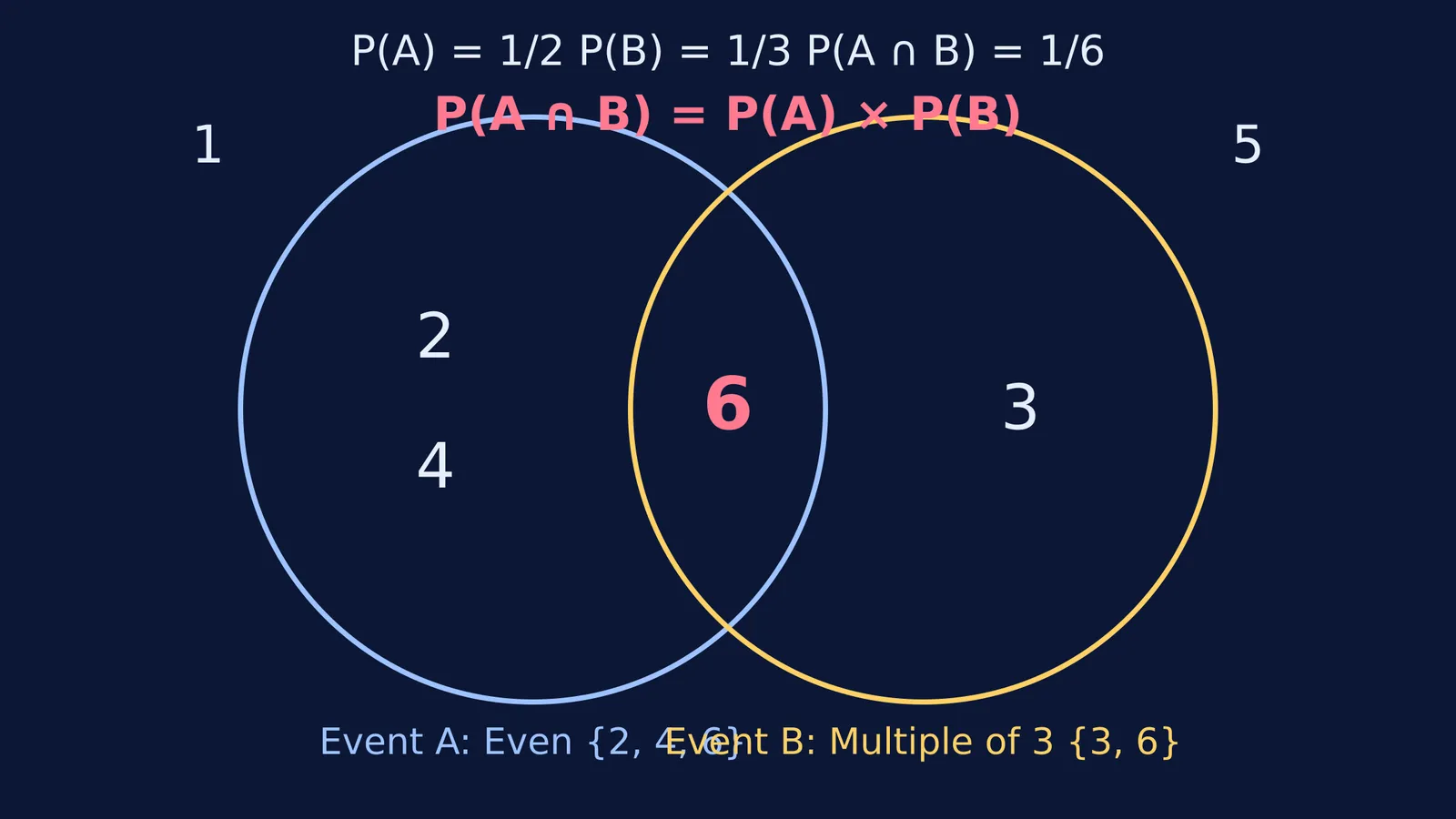
Let's apply this rule to a single roll of a fair six-sided die, which has a sample space of {1, 2, 3, 4, 5, 6}. Many students assume that if two events are defined on the very same die roll, they must be dependent. Let's test this intuition with two events:
Event A: rolling an even number {2, 4, 6}. The probability P(A) = 3/6 = 1/2.
Event B: rolling a multiple of 3 {3, 6}. The probability P(B) = 2/6 = 1/3.
Next, we find the intersection of A and B, which means rolling a number that is both even and a multiple of 3. Looking at our sets, the only number they share is 6.
Event A ∩ B: {6}. The probability P(A ∩ B) = 1/6.
Finally, we multiply the individual probabilities to see if they match the intersection's probability.
P(A) × P(B) = 1/2 × 1/3 = 1/6.
Because P(A ∩ B) equals P(A) × P(B), getting an even number and getting a multiple of 3 are completely independent events. This often surprises people, but the logic holds up: knowing that a rolled number is even leaves the proportion of multiples of 3 unchanged. Exactly one out of three even numbers is a multiple of 3, just as two out of six total numbers are.
Independent vs mutually exclusive: what is the difference?
A common mistake in probability is confusing independent events with mutually exclusive events (OpenStax). They measure entirely different relationships between events.
Mutually exclusive events cannot occur at the same time, meaning their intersection is empty and P(A ∩ B) = 0 (OpenStax). Because they can never happen together, they are almost always highly dependent; if you know event A happened, you know for certain that event B did not. For example, rolling a 1 and rolling a 2 on the same die are mutually exclusive.
Independent events, on the other hand, can and often do happen together, as seen with our even number and multiple of 3 example. The occurrence of one simply has no bearing on the mathematical odds of the other. You can find more foundational examples of these rules in our guide to Probability in Class 10.
When do dependent events show up?
Events become dependent when the outcome of the first changes the sample space or the favourable outcomes of the second. This happens frequently in probability problems involving drawing cards, picking marbles from a bag, or selecting students from a class.
If you sample with replacement by putting the object back before the next draw, the events remain independent (OpenStax). If you sample without replacement, the total number of objects decreases, which fundamentally changes the probabilities for all subsequent picks and makes the events dependent (OpenStax). To check this mathematically, you simply apply the same multiplication rule: if P(A ∩ B) no longer equals P(A) × P(B), the dependence is confirmed.
If you are unsure where to begin with word problems like these, Fermi's AI tutor can work out what you already know and build a plan for the session. Rather than just giving you the final probability, the tutor holds a line of reasoning across a whole session and decides whether to explain, ask, or show. For more complex exam scenarios where you need to check formulas, the Fermi Problem Library has worked problems with a step-by-step solver that explains the reasoning rather than printing an answer.


