

On this page
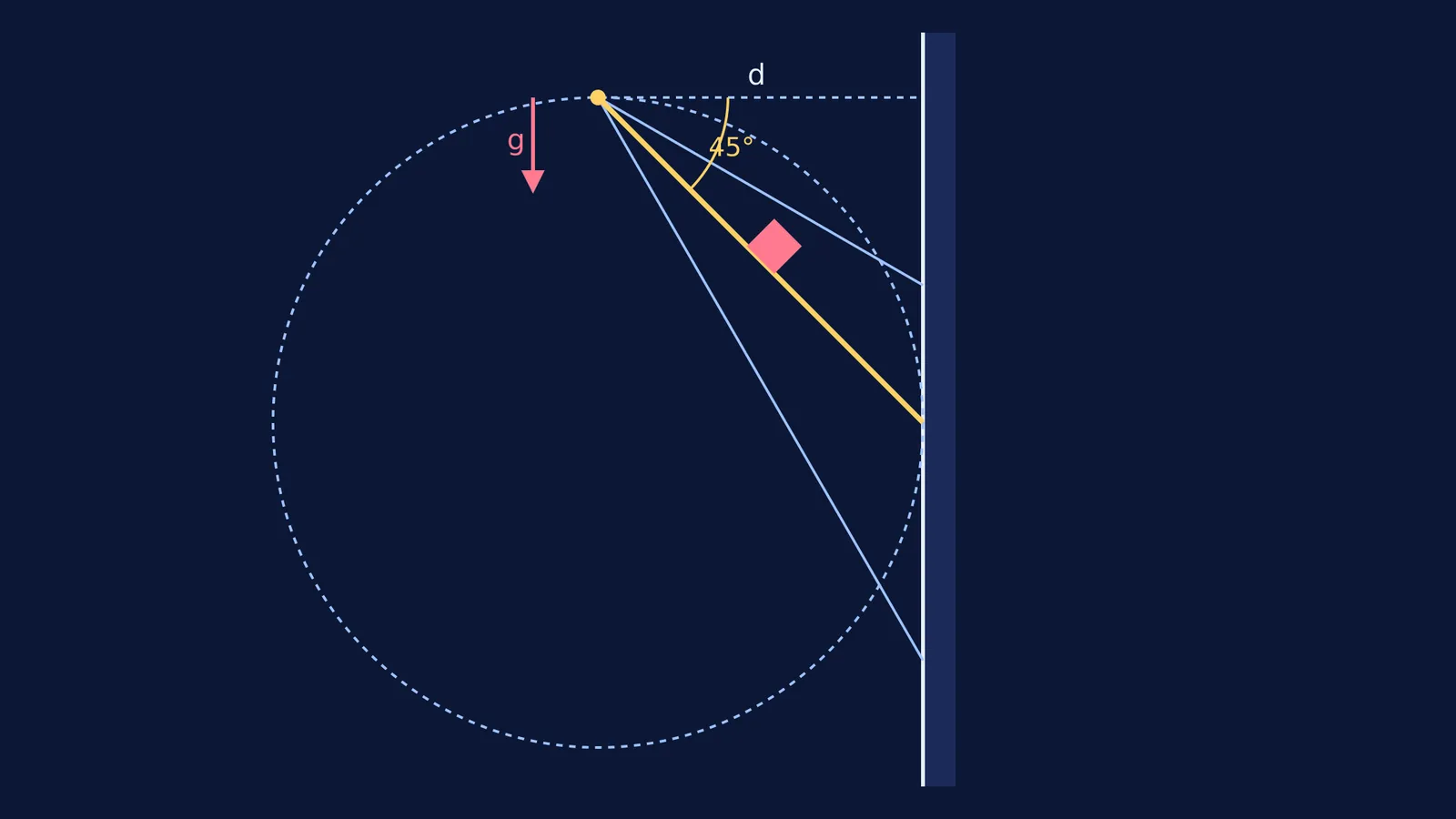
Why is my JEE score stuck on physics optimization problems? Often, it is because these questions combine two distinct concepts: motion in a plane—such as calculating a horizontal projectile from a cliff—and finding a mathematical maximum or minimum. A classic example asks: if you want to slide a block from a starting point to a vertical wall over a set horizontal distance, what angle of incline yields the shortest time?
You might assume that a steeper slope is always faster, but a steeper slope also means a much longer path to reach a wall at a fixed horizontal distance. Balancing these two factors reveals an exact mathematical sweet spot.
Think about the two extreme cases. If you choose an extremely shallow angle, like 1 degree, the path to the wall is very short—almost exactly equal to the horizontal distance d. However, the component of gravity pulling the block along the incline is nearly zero, meaning the block barely accelerates and takes a very long time to traverse even that short distance. On the other hand, if you choose a very steep angle, like 89 degrees, the block falls with almost the full acceleration of free fall (g). But because the incline is nearly vertical, the physical length of the ramp required to cover the horizontal distance d becomes incredibly long, and the block still takes a long time to reach the wall. The minimum time must lie somewhere in between, where you get a good fraction of gravitational acceleration without making the ramp excessively long.
What is the time to slide to a vertical wall?
Let us build the time equation step by step. Imagine a block starting from rest. It slides down a smooth, frictionless inclined plane that makes an angle θ with the horizontal. The wall is located at a horizontal distance d from the starting point.
First, we need the distance the block travels along the slope. Using basic geometry, the length of the incline L is: L = d / cos θ
Next, we find the acceleration. Gravity pulls straight down, but the block is constrained to move along the incline. The component of acceleration along the slope is: a = g sin θ
Because the block starts from rest, we can use the standard kinematic equation for position to find the time of descent. The Wikipedia guide to inclined planes shows how resolving the gravitational vector gives this constant acceleration. L = 1/2 a t²
Substitute L and a into the equation: d / cos θ = 1/2 (g sin θ) t²
Now, isolate t²: t² = 2d / (g sin θ cos θ)
Using the trigonometric double-angle identity (2 sin θ cos θ = sin 2θ), this simplifies to: t² = 4d / (g sin 2θ)
This means the sliding time t is exactly: t = √(4d / (g sin 2θ))
How do you find the angle of incline for minimum time?
To make the descent time as small as possible, we must make the denominator in our fraction as large as possible. The only variable in the denominator that we can change is sin 2θ.
The maximum possible value of the sine function is 1. This mathematical limit occurs when the angle inside the sine function is exactly 90°. 2θ = 90° θ = 45°
Therefore, the angle of incline for the minimum time to slide to a wall is 45°. At this specific angle, the balance between maintaining a short physical path to the wall and achieving a strong downhill acceleration is perfectly optimized.
How should you approach this in exams?
Optimization questions like this appear frequently in competitive tests. The National Testing Agency mandates "Motion in a Plane" as a core topic under Unit 2 in the JEE Main syllabus, testing not just rote memory of formulas but the ability to build and minimize them under pressure.
If you struggle to set up the geometry, whether for a straight incline or finding the radius of curvature of a projectile's path, Fermi Concept Library holds lessons on every physics concept, plotting how kinematics connects to mathematical optimization.
When you get stuck on a tricky homework variation—such as a block sliding with friction (see this worked example for the time a block takes to slide down a rough incline)—the Fermi Problem Library has worked problems with a step-by-step solver that explains the reasoning rather than printing an answer. Fermi's AI tutor works out what you already know and builds a plan for the session, so you sit down to a clear next step.
A checklist for sliding optimization
When you face a "minimum time" or "maximum range" question in kinematics, use this reliable method:
Draw the setup and clearly label the fixed constants (like horizontal distance d) and the variable you can change (like angle θ).
Write the path length in terms of your variable.
Write the acceleration along the path in terms of your variable.
Plug them into the s = ut + 1/2 at² equation.
Isolate the time t, and look for a trigonometric identity that collapses two terms into one.
Practising this framework ensures you do not just memorize the 45° rule, but can derive the optimal angle for any surface and any constraint.


