

On this page
Every year, students across Class 12 and competitive exams like JEE Main stumble into the same classic trap. Given the definite integral of 1/x² from −1 to 1, many write down the power-rule antiderivative, −1/x. Substituting the limits gives (−1/1) − (−1/(−1)) = −1 − 1 = −2.
The algebra looks neat and routine. But it is completely wrong.
Why does blindly integrating 1/x² from −1 to 1 yield −2?
A quick check reveals why −2 cannot be right. For any non-zero real x, x² is positive, so f(x) = 1/x² > 0 everywhere on its domain.
Because a definite integral measures net area under the curve, a strictly positive function cannot bound a negative area. Getting −2 indicates that the algebraic shortcut has failed.
Students often treat integration as an unconditional instruction to plug numbers into an antiderivative. In the *Asian Journal of University Education*, Voon Li Li, Nor Hazizah Julaihi, and Tang Howe Eng studied 147 calculus students (EJ1207815) and found improper integrals produced an error rate of 63.1%—the highest among all topics—as students repeatedly bypassed limits and missed vertical asymptotes.
What condition of the fundamental theorem of calculus is violated?
The evaluation formula ∫ₐᵇ f(x) dx = F(b) − F(a) is the Second Fundamental Theorem of Calculus. Crucially, the theorem requires f(x) to be continuous across the entire closed interval [a, b].
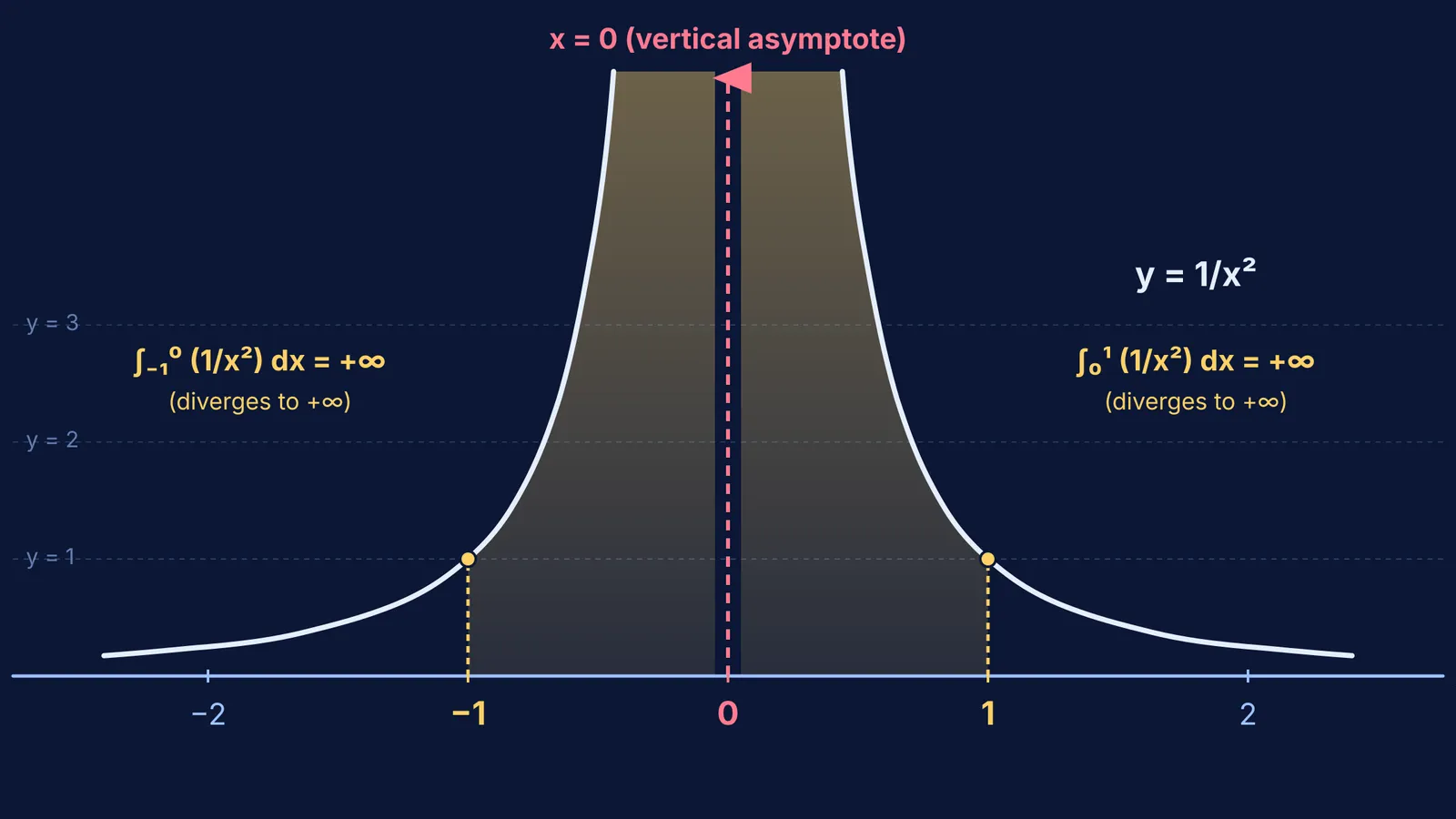
At x = 0, f(x) = 1/x² has an infinite discontinuity. As x approaches zero from either side, 1/x² blows up to +∞. Because this vertical asymptote sits inside [−1, 1], the fundamental theorem does not apply.
In his 1823 text *Résumé des leçons données à l'École royale polytechnique sur le calcul infinitésimal*, Augustin-Louis Cauchy established that definite integrals are limits of sums for continuous functions, warning that interior singularities require separate limits.
Skipping this requirement lets −1/x jump across zero from +∞ to −∞. Evaluating endpoints ignores this infinite gap and creates the false result −2. As David M. Bressoud showed in *The American Mathematical Monthly* (2011), treating calculus purely as mechanical antidifferentiation hides the accumulation process and blinds students to violated conditions.
How do you evaluate an improper integral with an interior asymptote?
An integral with an interior asymptote is an improper integral of the second kind. You must split the interval at the discontinuity and evaluate one-sided limits.
For ∫₋₁¹ (1/x²) dx, split at x = 0: ∫₋₁¹ (1/x²) dx = lim_{t → 0⁻} ∫₋₁ᵗ (1/x²) dx + lim_{s → 0⁺} ∫ₛ¹ (1/x²) dx.
Evaluate each side:
Left side: [−1/x]₋₁ᵗ = −1/t − 1. As t → 0⁻, −1/t → +∞, so the limit diverges.
Right side: [−1/x]ₛ¹ = 1/s − 1. As s → 0⁺, 1/s → +∞, so the limit diverges.
Because both parts diverge, the integral ∫₋₁¹ (1/x²) dx diverges to +∞. It has no finite value.
The Fermi Problem Library provides worked problems with a step-by-step solver that explains the reasoning rather than printing an answer, helping you master improper integrals and limit setups.
How can you spot hidden discontinuities in exam questions?
You can protect yourself against disguised asymptotes with a four-step check before integrating:
Scan denominators: Set denominators to zero. If any root falls inside the limits, the integral is improper.
Check discontinuities: Rational functions and negative powers hide asymptotes. Classify removable and jump discontinuities to know if an integrand must be split.
Split at singularities: Divide the integral at every vertical asymptote. Like splitting definite integrals with modulus or step functions, each interval needs its own setup.
Apply limits carefully: Replace the break with a parameter and take the limit after integrating. Remember this discipline when updating integration bounds during substitutions.
In the Fermi Concept Library, which covers every concept in physics, chemistry, biology, mathematics and computing, each with its own lesson and its place in the map, you can explore the topological and analytical foundations of integration before exam day.


