

On this page
When an equation mixes x and y together, finding the slope (or derivative) can seem like a trap. The equation for a circle of radius 5, written as x² + y² = 25, is the classic example. You cannot easily isolate y on one side without bringing in a ± square root, which splits the circle into a top half and a bottom half.
Instead of forcing the equation into an awkward explicit form, you can differentiate it exactly as it is written. This method is called implicit differentiation, and it relies heavily on the chain rule. According to Math is Fun, implicit differentiation is a technique used to find the derivative when a relationship is expressed in terms of both x and y, rather than as an explicit y = ... function. It saves time and avoids the messy algebra of radicals.
Why does the chain rule matter here?
The secret to implicit differentiation is remembering that y is not just a letter; it is a stand-in for some unknown function of x. If you were taking the derivative of [f(x)]², the chain rule would tell you to write 2[f(x)] × f'(x).
The exact same logic applies to y². When you differentiate y² with respect to x, you cannot just write 2y. You must multiply by the derivative of the "inside" function, which is dy/dx. This extra factor is the entire reason implicit differentiation works, because it forces the dy/dx term to appear in the equation so you can solve for it.
How to find the implicit derivative of x² + y² = 25?
The goal is to find the derivative of y with respect to x, which we write as dy/dx or y'. Because y is a function of x, every time you take the derivative of a term with y in it, you must attach a dy/dx.
Here is the step-by-step method to solve x² + y² = 25:
Differentiate both sides with respect to x:
Take the derivative of each piece: d/dx(x²) + d/dx(y²) = d/dx(25).
Apply the power rule and the chain rule:
The derivative of x² is simply 2x. For the y² term, the power rule gives 2y, but because of the chain rule, you multiply by dy/dx. The derivative of a constant (25) is 0. This leaves you with: 2x + 2y(dy/dx) = 0.
Move the x terms to the other side:
Subtract 2x from both sides to isolate the y' term: 2y(dy/dx) = −2x.
Divide to solve for dy/dx:
Divide both sides by 2y: dy/dx = −2x / 2y. The 2s cancel out, leaving the final derivative: dy/dx = −x/y.
This result tells you that the slope of the tangent line at any point (x, y) on the circle depends on both the x and y coordinates of that point.
If you get lost applying the chain rule to mixed variables, the Fermi Problem Library has worked problems with a step-by-step solver that explains the reasoning rather than printing an answer.
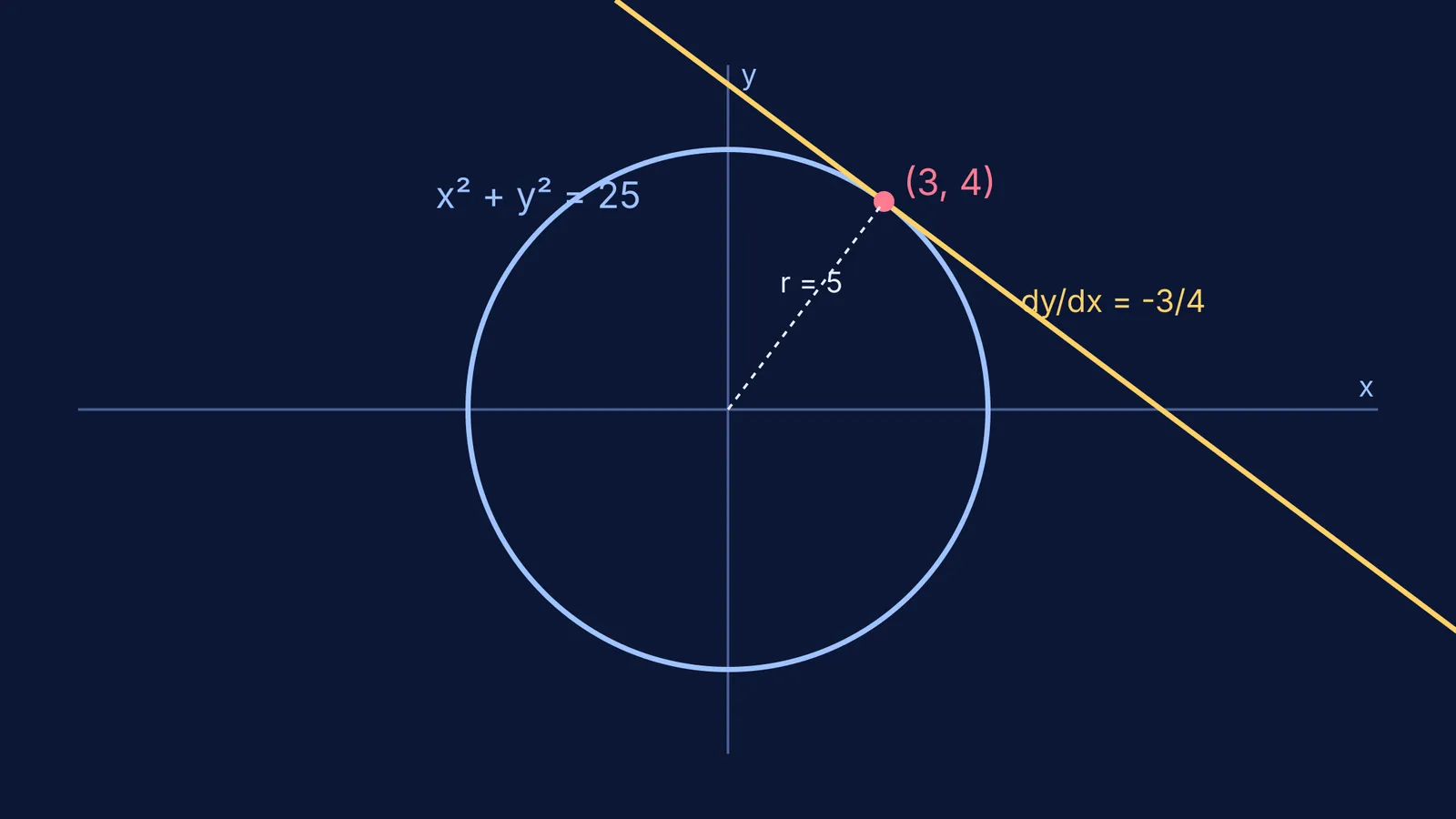
What is the slope of x² + y² = 25 at the point (3, 4)?
Once you have the implicit derivative, finding the slope at a specific spot is just a matter of substitution.
To find the slope at the point (3, 4), plug x = 3 and y = 4 into your derivative formula: dy/dx = −x/y dy/dx = −3/4
The slope of the tangent line at (3, 4) is −3/4. If you were asked to write the equation of that tangent line, you would use the point-slope form (y − y₁ = m(x − x₁)): y − 4 = −¾(x − 3).
This same process applies everywhere on the circle. At (4, 3), the slope is −4/3. At (0, 5), the top of the circle, the formula gives −0/5 = 0, confirming the tangent line is perfectly horizontal. At (5, 0), the rightmost edge, you get −5/0, which is undefined, meaning the tangent line is perfectly vertical. The geometry of the circle perfectly matches the algebra of the derivative.
When should you use explicit vs implicit differentiation?
You use explicit differentiation when y is isolated on one side, such as y = 3x² + 2x.
You use implicit differentiation when x and y are mixed together. While you could technically rearrange x² + y² = 25 into y = ±√(25 − x²) and use the explicit chain rule, doing so creates two separate equations to juggle. The positive root covers the top semicircle, and the negative root covers the bottom. Implicit differentiation sidesteps this completely, getting you the single, universal formula dy/dx = −x/y in just a few lines of algebra.
This technique also opens the door to more complex calculus where isolating y is mathematically impossible. For example, differentiating one expression with respect to another, handling second-order derivatives, or taking the derivative of parametric functions all rely on a solid grasp of how the chain rule treats variables.
If you struggle to know which rule to apply when, Fermi's AI tutor can help. It notices where a student is stuck, and decides whether to explain, ask, or show.


