

On this page
If you have ever left a fresh batch of idli or dosa batter on the kitchen counter overnight, you know the magic that awaits the next morning. The dense mixture of ground rice and urad dal (black gram) transforms into a frothy, expanded batter.
Why does idli batter rise?
This expansion happens because the batter acts as a trap for gas. According to a landmark 1965 study by S. K. Mukherjee and colleagues published in Applied Microbiology, the leavening of idli batter is driven almost entirely by carbon dioxide (CO₂) gas produced during fermentation.
As microbes digest the sugars in the rice and dal, they exhale CO₂. The ground urad dal provides mucilaginous proteins that create a sticky matrix, trapping these gas bubbles and causing the whole mixture to rise.
What is the difference between yeast and lactic acid bacteria?
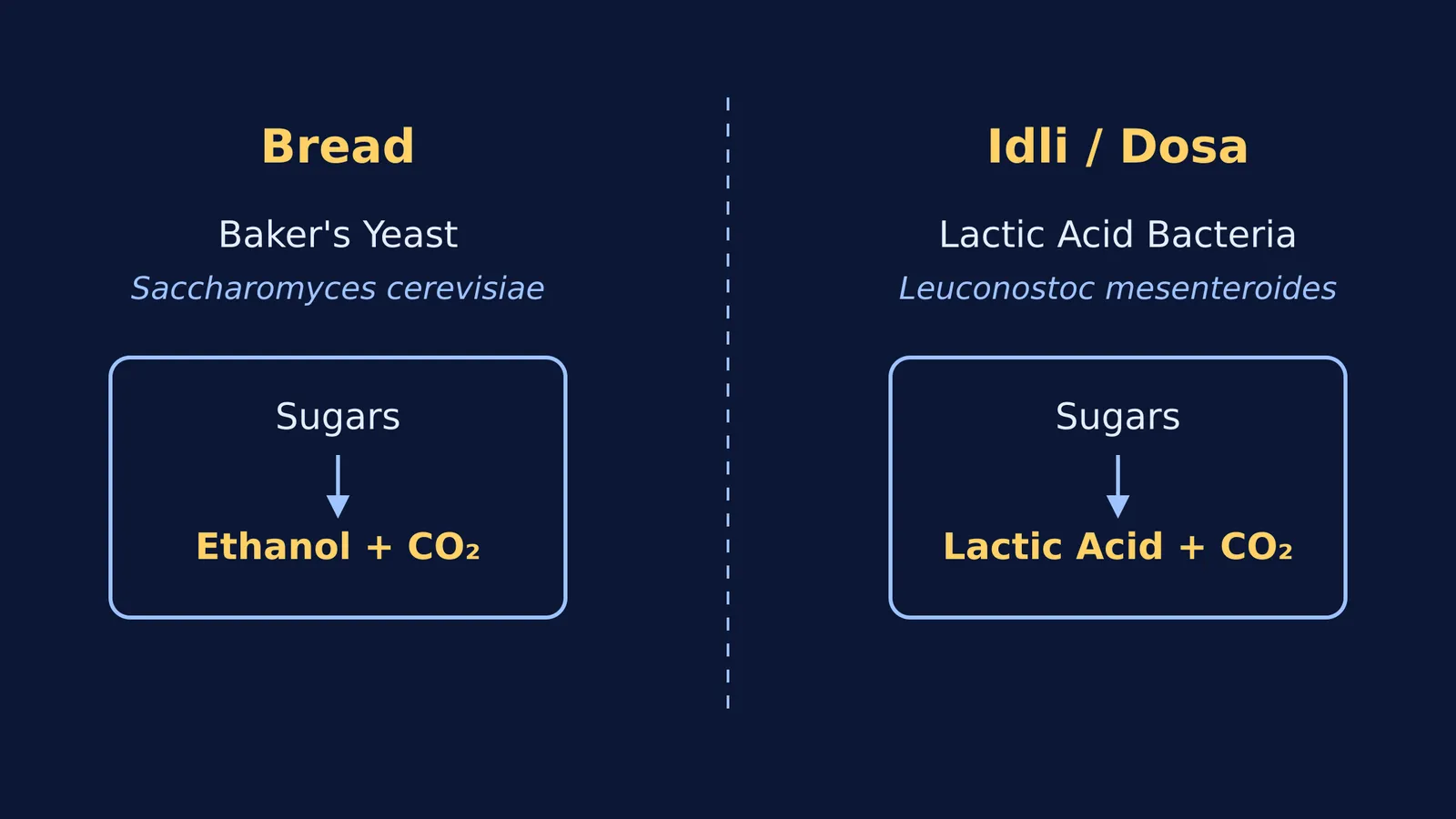
When we think of rising dough, we usually think of bread. Bread relies on baker's yeast (*Saccharomyces cerevisiae*), a single-celled fungus. Yeast performs alcoholic fermentation, breaking down sugars into CO₂ and ethanol, which later evaporates during baking. The discovery that this process is driven by chemical enzymes rather than just a living "vital force" was famously proven by Eduard Buchner and the yeast juice that fermented sugar.
Idli and dosa batter, however, is a completely different chemical environment. It relies on an exclusively bacterial leavening process. The star player is a lactic acid bacterium called *Leuconostoc mesenteroides*. Naturally present on the urad dal, this microbe dominates the early hours of fermentation. Like most bacteria in biology, its broader family structure can be classified using techniques dating back to Hans Christian Gram and the stain that sorts bacteria.
*Leuconostoc mesenteroides* is heterofermentative, meaning it produces multiple by-products at once. It breaks down carbohydrates to produce:
Carbon dioxide (CO₂): This gas creates the airy, spongy texture of the batter.
Lactic acid: This drops the pH of the batter and provides the characteristic tangy, sour flavour.
This dual action of leavening and souring by a single bacterium is what makes the idli fermentation process scientifically unique. Later in the process, other bacteria like *Enterococcus faecalis* take over to produce even more acid, further lowering the pH.
How does temperature affect fermentation?
Fermentation is a biological process powered by enzymes, and like all enzyme-driven reactions, it is highly sensitive to temperature. The enzymes in the lactic acid bacteria responsible for idli batter work best at warm temperatures. In the 1965 Mukherjee study, the batter was incubated at 30 °C and reached its maximum volume in about 18 to 20 hours.
However, in colder climates or during winter, the bacterial metabolism slows down. The enzymes lose their kinetic energy, and the production of CO₂ drops drastically. This is why a batch of batter that rises perfectly in July might stay stubbornly flat in December.
If you are studying biology or chemistry, this is a perfect real-world example of how temperature governs reaction rates. If you need help visualising how molecules and enzymes interact at different temperatures, the Fermi Simulation Lab provides interactive simulations for the ideas that are easier to see than to read.
Why is my batter not rising?
If your batter is not rising properly, the science of fermentation offers clear troubleshooting steps. Use this checklist to diagnose the problem:
Check the dal-to-rice ratio: The dal is crucial because it carries the wild *Leuconostoc mesenteroides* bacteria and provides the protein network needed to trap the CO₂.
Use unpolished dal: The natural bacteria live on the outer layers of the lentil. Heavily processed or old dal might have a depleted microbial population.
Manage the temperature: Keep the batter in a warm spot, ideally near 30 °C, the temperature used in the Mukherjee study. In winter, you can leave the vessel inside an oven (turned off) with the interior light turned on to provide gentle, consistent heat.
Do not over-wash: Washing the urad dal too vigorously can wash away the wild lactic acid bacteria needed for fermentation.
Avoid chlorinated water: High levels of chlorine in tap water can inhibit bacterial growth. Using filtered or boiled-and-cooled water helps protect the microbes.
Understanding the biology of your food does not just help you in exams; it makes you a better cook. The next time you enjoy a fluffy idli, you can thank the microscopic respiration of *Leuconostoc mesenteroides*. If you are curious to explore more biological mechanisms, from cellular respiration to genetics, the Fermi Concept Library contains every concept in physics, chemistry, biology, mathematics and computing, each with its own lesson and its place in the map.


