

On this page
Before finding an eccentricity, you need to know which curve you have. Two numbers built from the coefficients tell you the type; completing the square tells you where it sits.
What do h² − ab and Δ mean in the general equation?
Write the equation as ax² + 2hxy + by² + 2gx + 2fy + c = 0. In 9x² + 4y² − 36x + 24y + 36 = 0, a = 9, b = 4, h = 0, g = −18, f = 12, c = 36.
The determinant Δ has rows (a, h, g), (h, b, f) and (g, f, c), as set out in the LibreTexts notes on the general conic section/02:_Conic_Sections/2.06:_The_General_Conic_Section). Expanded, Δ = abc + 2fgh − af² − bg² − ch².
The second number, h² − ab, uses only the second-degree terms. The Wikipedia article on conic sections writes it as B² − 4AC for Ax² + Bxy + Cy²; with B = 2h that is 4(h² − ab), so the sign is the same.
How do you tell a circle, parabola, ellipse or hyperbola apart?
Read off a, h, b, g, f and c, halving where needed.
Compute Δ. If Δ = 0, the conic is degenerate: a pair of straight lines, real or imaginary (x² + y² = 0 is a single point), as the classification table in Wolfram MathWorld's entry on quadratic curves shows.
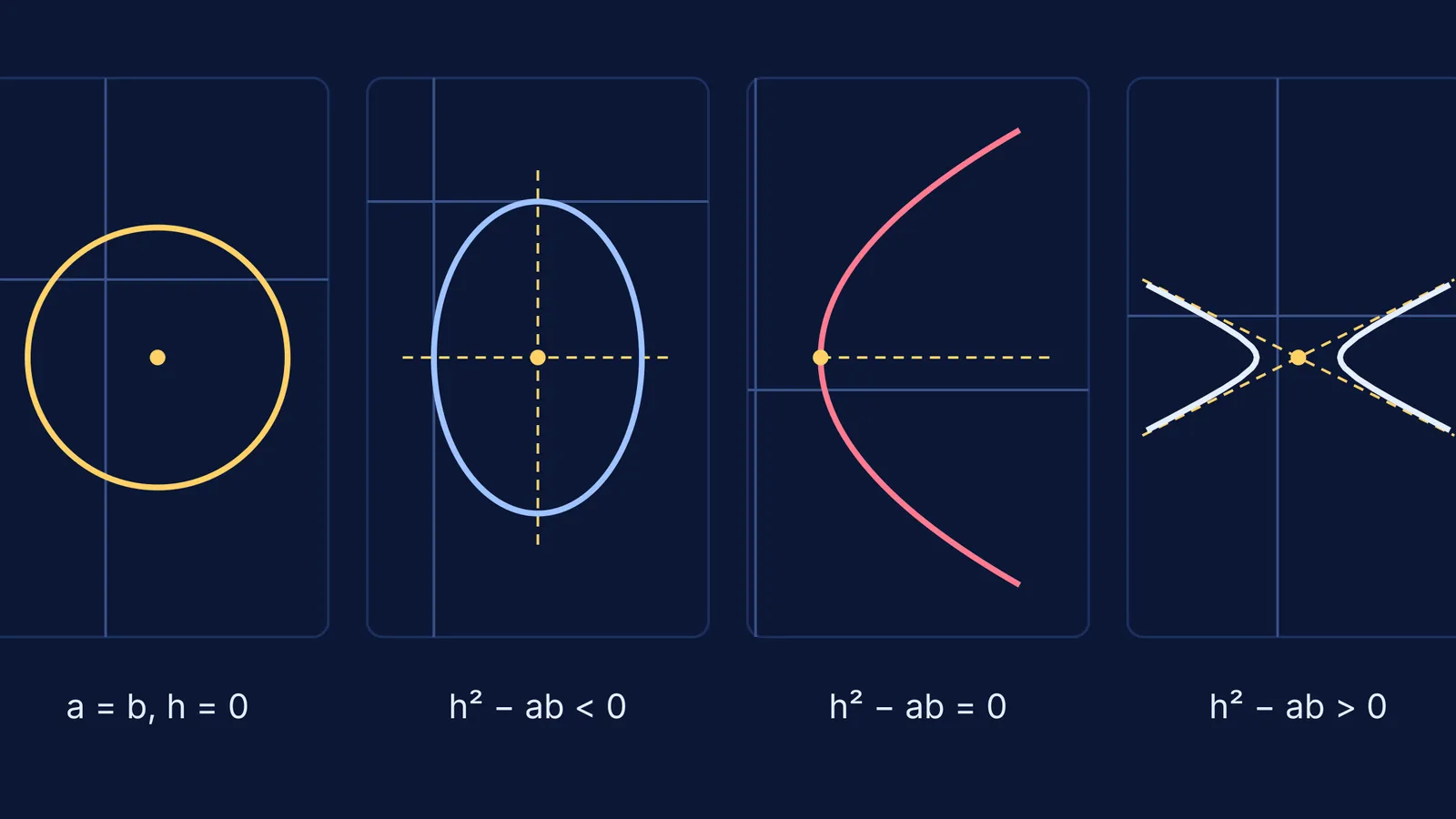
If Δ ≠ 0, compute h² − ab. The Underground Mathematics glossary gives the rule: h² − ab < 0 is an ellipse (or circle), h² − ab = 0 is a parabola, h² − ab > 0 is a hyperbola.
An ellipse with a = b and h = 0 is a circle; a hyperbola with a + b = 0 is rectangular (Wikipedia gives both conditions).
MathWorld lists an imaginary ellipse when Δ has the same sign as a + b: x² + y² + 1 = 0 has no real points.
Worked example: which conic is 9x² + 4y² − 36x + 24y + 36 = 0?
Here h² − ab = −36, so it is an ellipse, and not a circle because a ≠ b. With h = 0, Δ = abc − af² − bg² = 1296 − 1296 − 1296 = −1296. It is non-zero with the opposite sign to a + b = 13, so the ellipse is real.
Now complete the squares:
Group: 9(x² − 4x) + 4(y² + 6y) + 36 = 0.
Complete: 9(x − 2)² + 4(y + 3)² − 36 = 0.
Divide by 36: (x − 2)²/4 + (y + 3)²/9 = 1.
The centre is (2, −3). The larger denominator, 9, sits under y, so the major axis is vertical, along x = 2, with length 6; the minor axis lies along y = −3 with length 4. The eccentricity is √(1 − 4/9) = √5/3, and the foci are (2, −3 ± √5). For tangents and normals, see our guide to ellipse eccentricity, tangents and the auxiliary circle.
Quick checks on a circle, a parabola and a hyperbola
Circle: x² + y² − 4x + 6y − 12 = 0 has a = b = 1, h = 0, Δ = −25, and becomes (x − 2)² + (y + 3)² = 25: centre (2, −3), radius 5.
Parabola: y² − 2y − 8x + 17 = 0 has h² − ab = 0 and Δ = −16, and becomes (y − 1)² = 8(x − 2): vertex (2, 1), focus (4, 1). Next, read about parabola focal chords, tangents and normals.
Hyperbola: x² − 4y² − 2x − 16y − 19 = 0 has h² − ab = 4 and Δ = 16, and becomes (x − 1)²/4 − (y + 2)² = 1: centre (1, −2), asymptotes y + 2 = ±(x − 1)/2. More in hyperbola asymptotes and the rectangular hyperbola.
If your Δ keeps disagreeing with the answer key, the Fermi Problem Library has worked problems with a step-by-step solver that explains the reasoning rather than printing an answer, so you can see which coefficient you misread.
What if the equation has an xy term?
When h ≠ 0 the conic is tilted, so completing squares alone will not give the axes; the tilt θ satisfies tan 2θ = 2h/(a − b), as the LibreTexts notes derive. The type test still works without rotating. For xy = 4, a = b = 0, h = 1/2 and c = −4, so h² − ab = 1/4 and Δ = −ch² = 1: a hyperbola, and rectangular, because a + b = 0.
If the idea behind the test feels hazy, the Fermi Concept Library gives every mathematics concept its own lesson.
Try it: run the five steps on three conic questions from your last mock.


