

On this page
Why does the standard calorimetry formula fail for ice and steam?
In standard calorimetry numericals, the first instinct is to equate heat lost to heat gained. When dropping a hot copper block into cool water, you write m₁c₁ΔT₁ = m₂c₂ΔT₂, solve for the equilibrium temperature, and obtain a reliable answer. However, when mixing ice and steam, applying that formula blindly frequently produces nonsensical values. A student who assumes all ice melts and all steam condenses into liquid water may compute a final temperature of 280 °C or −15 °C. Neither temperature can physically exist for liquid water in an open calorimeter at standard atmospheric pressure.
This breakdown occurs because phase changes introduce energetic plateaus where heat transfers without changing temperature. In an investigation of student reasoning published in the *American Journal of Physics*, researcher David E. Meltzer (2004) examined how 653 students across introductory calculus-based physics courses approached heat and thermal processes. Fewer than 20% of students could correctly apply first-law reasoning to thermal processes after instruction, often conflating heat transfer with direct temperature change. As explored in our guide to temperature-time graphs of phase change, latent heat alters molecular potential energy—rearranging intermolecular hydrogen bonds—rather than increasing molecular kinetic energy.
The Fermi Problem Library provides worked problems with a step-by-step solver that explains the reasoning rather than printing an answer, preventing students from skipping intermediate phase checks. Before calculating temperature change, you must first balance the latent heat budgets to determine which phase boundary traps the system.
How do you compare heat budgets step by step?
Water has exceptionally high latent heats due to extensive hydrogen bonding between polar molecules. According to standard thermophysical data in NCERT Class 11 Physics, the specific latent heat of fusion of ice at 0 °C is L_f = 80 cal/g (3.33 × 10⁵ J/kg), while the specific latent heat of vaporisation of water at 100 °C is L_v = 540 cal/g (2.26 × 10⁶ J/kg). The specific heat capacity of liquid water is c_w = 1.0 cal/(g·°C) or 4186 J/(kg·K). Standard thermodynamic properties compiled by the NIST Chemistry WebBook record water's molar enthalpy of fusion at 6.01 kJ/mol and molar enthalpy of vaporisation at 40.65 kJ/mol.
Because L_v (540 cal/g) is 6.75 times larger than L_f (80 cal/g), condensing steam releases vastly more thermal energy than melting ice absorbs. To determine what happens when mass m_ice of ice at 0 °C meets mass m_steam of steam at 100 °C, compare the maximum heat requirements against the maximum heat releases:
Heat required to melt all ice: Q_melt = m_ice × 80 cal.
Heat required to bring melted ice from 0 °C to 100 °C: Q_warm = m_ice × 1.0 × (100 − 0) = 100 × m_ice cal.
Total heat required to turn all ice into water at 100 °C: Q_ice_to_100 = 80 m_ice + 100 m_ice = 180 m_ice cal.
Heat released by condensing all steam at 100 °C: Q_condense = m_steam × 540 cal.
Total heat released if all steam condenses and cools to 0 °C: Q_steam_to_0 = 540 m_steam + m_steam × 1.0 × (100 − 0) = 640 m_steam cal.
Notice the key ratios: 540 / 180 = 3, and 640 / 80 = 8. Just 1 g of condensing steam releases 540 cal—enough energy to melt and warm 3 g of ice completely to 100 °C. Furthermore, that same gram of steam cooling to 0 °C releases 640 cal, which can melt 8 g of ice at 0 °C.
What are the three possible equilibrium states?
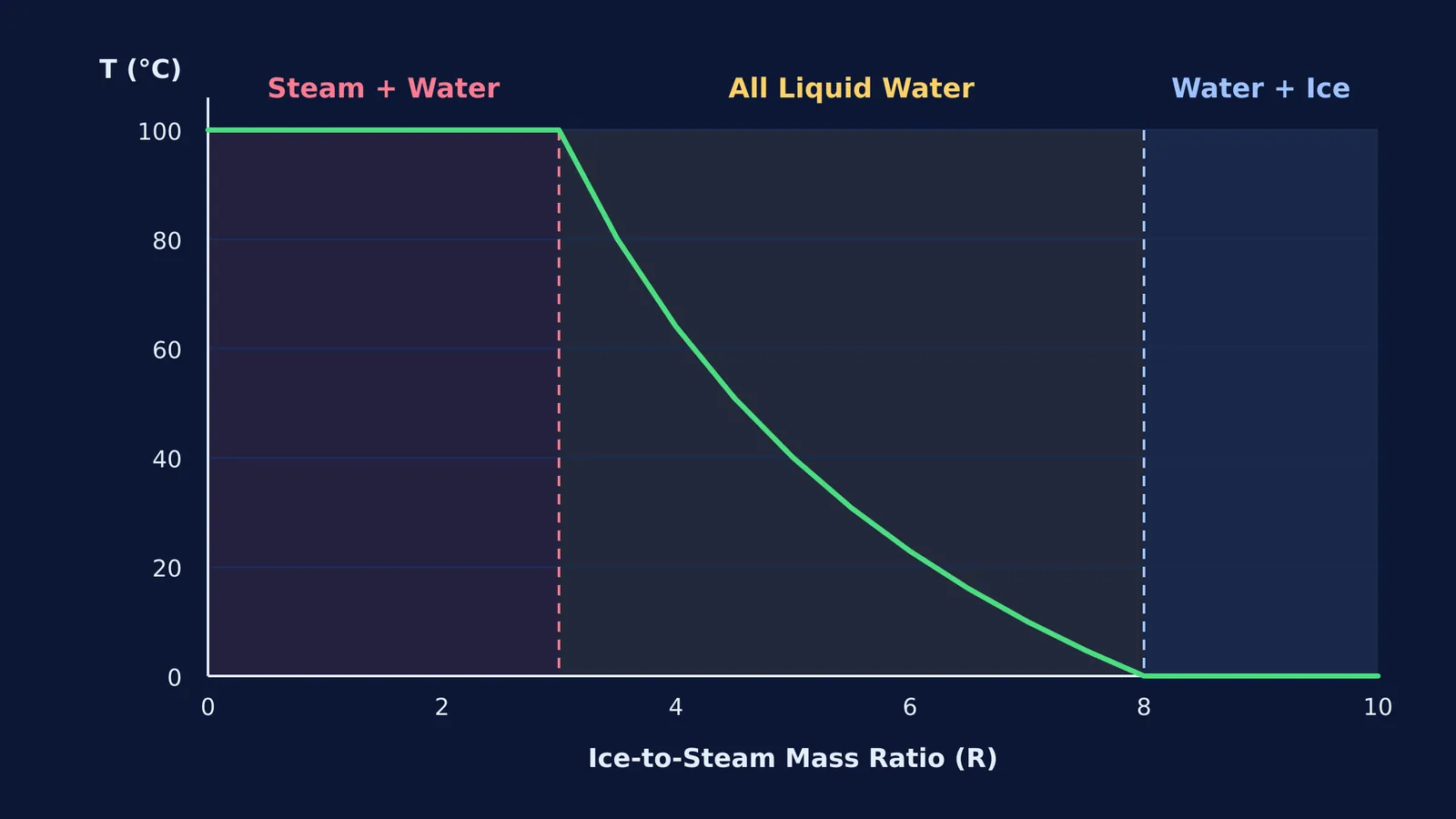
Evaluating the mass ratio R = m_ice / m_steam immediately reveals the final state of the mixture, as grounded in NCERT Class 11 Physics calorimetry principles:
Regime 1 (R ≤ 3): Excess steam keeps the mixture at 100 °C. Here, Q_condense (540 m_steam) exceeds the total energy needed to heat all ice to boiling water (180 m_ice). All ice melts and reaches 100 °C, but only a fraction of the steam needs to condense. The condensed steam mass is m_condensed = (180 m_ice) / 540 = m_ice / 3. The remaining steam stays gaseous, and the final equilibrium temperature is exactly 100 °C. The mixture contains liquid water and steam.
Regime 2 (3 < R < 8): All contents become liquid water. Here, condensing all steam provides enough energy to melt all ice and warm the mixture above 0 °C, but not enough to sustain steam at 100 °C. Every gram of steam condenses and every gram of ice melts. Equating heat lost by condensing and cooling steam to heat gained by melting and warming ice gives: 540 m_steam + m_steam × 1.0 × (100 − T_f) = 80 m_ice + m_ice × 1.0 × (T_f − 0), so T_f = (640 m_steam − 80 m_ice) / (m_ice + m_steam). The final temperature lies strictly between 0 °C and 100 °C, and the system contains only liquid water of mass m_ice + m_steam.
Regime 3 (R ≥ 8): Excess ice keeps the mixture at 0 °C. Even if all steam condenses and cools all the way down to 0 °C, it releases only 640 m_steam calories. When R exceeds 8, this energy is insufficient to melt all the ice (80 m_ice > 640 m_steam). The final equilibrium temperature is locked at 0 °C. The mass of ice that melts is m_melted = 640 m_steam / 80 = 8 m_steam. The system finishes as a mixture of unmelted ice and liquid water at 0 °C.
This structured comparison reflects the historical insight of Joseph Black's discovery of latent heat, which showed that phase transformations absorb massive thermal energy without registering on a thermometer. For students practicing multi-step thermal numericals, our guide on calorimetry and heat transfer details similar mixing problems involving water and ice.
How does this framework solve a classic exam numerical?
Consider a standard numerical from JEE Main and NEET physics: a thermal container holds 10 g of ice at 0 °C, and 2 g of steam at 100 °C is piped into the vessel. According to standard calorimetry assumptions in NCERT Class 11 Physics, assume negligible heat capacity for the container and no heat loss to the environment:
Calculate the mass ratio: R = m_ice / m_steam = 10 / 2 = 5.
Identify the regime: Because 3 < 5 < 8, the system falls squarely into Regime 2. All ice will melt, all steam will condense, and the final mixture will be entirely liquid water between 0 °C and 100 °C.
Formulate the energy balance: Heat released by steam: Q_lost = 2 × 540 + 2 × 1.0 × (100 − T_f) = 1280 − 2 T_f cal. Heat absorbed by ice: Q_gained = 10 × 80 + 10 × 1.0 × (T_f − 0) = 800 + 10 T_f cal.
Solve for equilibrium temperature: 1280 − 2 T_f = 800 + 10 T_f, which gives 12 T_f = 480, so T_f = 40 °C.
State the final contents: The container holds exactly 12 g of liquid water at 40 °C.
By contrast, if the vessel held 10 g of ice and only 1 g of steam, R = 10. Because 10 > 8, the system hits Regime 3: the final temperature is immediately 0 °C. The 1 g of steam releases 640 cal, melting 640 / 80 = 8 g of ice. The final mixture consists of 2 g of ice and 9 g of liquid water at 0 °C.
For students revising thermodynamics across physics and chemistry, the Fermi Concept Library contains every concept in physics, chemistry, biology, mathematics and computing, each with its own lesson and its place in the map.


