

On this page
The standard equation of a horizontal hyperbola centred at the origin is x²/a² − y²/b² = 1. To write this equation, you need the values of a² and b². If an exam problem gives you the foci and the eccentricity instead, you have to work backwards to find them.
How to find the equation from foci and eccentricity?
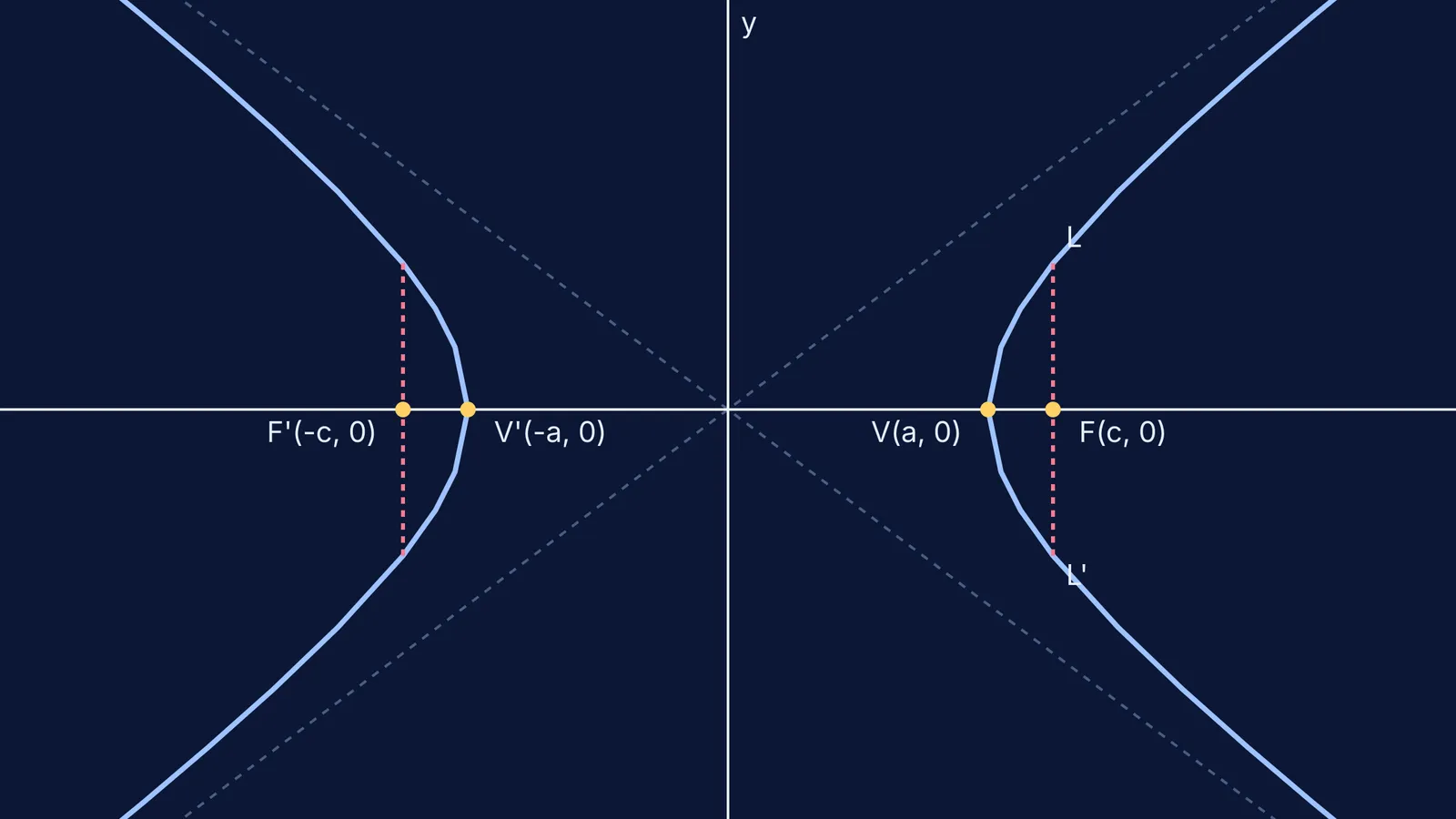
The foci of a standard horizontal hyperbola are at (±c, 0). This immediately gives you the value of c. According to Cuemath, the eccentricity e is defined as the ratio c/a. Since you know c and e, you can rearrange c = ae to find a:
a = c / e
Once you have a, you need b. The fundamental relationship between the three lengths in a hyperbola is c² = a² + b². Rearranging this gives:
b² = c² − a²
For example, if the foci are at (±5, 0) and the eccentricity is 5/4:
Read c from the foci: c = 5.
Use e = c/a to find a: 5/4 = 5/a, which means a = 4. So, a² = 16.
Find b²: b² = 5² − 4² = 25 − 16 = 9.
The equation is x²/16 − y²/9 = 1.
If the foci are on the y-axis at (0, ±c), the hyperbola is vertical. The steps to find a and b are identical, but the final equation takes the form y²/a² − x²/b² = 1.
What if you are given vertices and foci?
Sometimes a question skips the eccentricity and gives the vertices and foci directly. The vertices of a standard horizontal hyperbola are at (±a, 0).
This is the easiest variant. The foci give you c, and the vertices give you a directly. You do not need to calculate the eccentricity at all. Simply use b² = c² − a² and write the equation.
If you struggle to remember which formula belongs to which conic section, Fermi's AI tutor can work out what you already know and build a plan for the session, so you sit down to a clear next step.
Finding the equation when the latus rectum is known?
Another common NCERT variant provides the foci and the length of the latus rectum. The latus rectum is the line segment perpendicular to the transverse axis, passing through a focus.
According to Cuemath, the length of a hyperbola's latus rectum is 2b²/a. (This is closely related to the formulas for latus rectum lengths in other conic sections).
If a problem states that the foci are at (±5, 0) and the latus rectum length is 9/2:
The foci give c = 5.
The latus rectum formula gives 2b²/a = 9/2, meaning b² = 9a/4.
Substitute this into c² = a² + b²: 25 = a² + 9a/4.
Multiply by 4 to get a quadratic equation: 4a² + 9a − 100 = 0.
Solving this quadratic yields a = 4 (ignoring the negative root since a is a positive distance).
Finally, b² = 25 − 16 = 9, leading back to the equation x²/16 − y²/9 = 1.
Setting up the quadratic equation can be a stumbling block. If you get stuck, the Fermi Problem Library has worked problems with a step-by-step solver that explains the reasoning rather than printing an answer.
Just as you use the property PS + PS' = 2a to find ellipse focal distances, understanding the core geometry of the hyperbola — that c is the distance to the focus, a to the vertex, and c² = a² + b² — frees you from having to memorise every variation of the problem.


