

On this page
The magic of hydraulic systems lies in their ability to multiply force. By applying a small push on one side of a sealed fluid, you can lift a heavy load on the other. But when you are faced with a textbook problem or a real-world design, how much oil pressure is actually required to push a car off the ground?
We can find the answer by working backwards from the load.
How do you find the pressure needed in a hydraulic car lift?
To calculate the required pressure, you only need to look at the side of the lift holding the car. According to Pascal's law, a confined fluid transmits pressure equally in all directions. If you know the pressure supporting the car, you know the pressure throughout the entire hydraulic system.
The fluid must exert an upward force equal to the downward weight of the car. Pressure is defined as force divided by the area over which it is applied:
Calculate the force (W): Multiply the mass of the car by standard gravity. This converts the mass in kilograms into a downward force in newtons.
Calculate the area (A): Find the cross-sectional area of the large lifting piston using the mathematical formula for the area of a circle.
Find the pressure (P): Divide the downward force by the cross-sectional area. The result will be the pressure in pascals.
What is the pressure needed in a hydraulic car lift numerical?
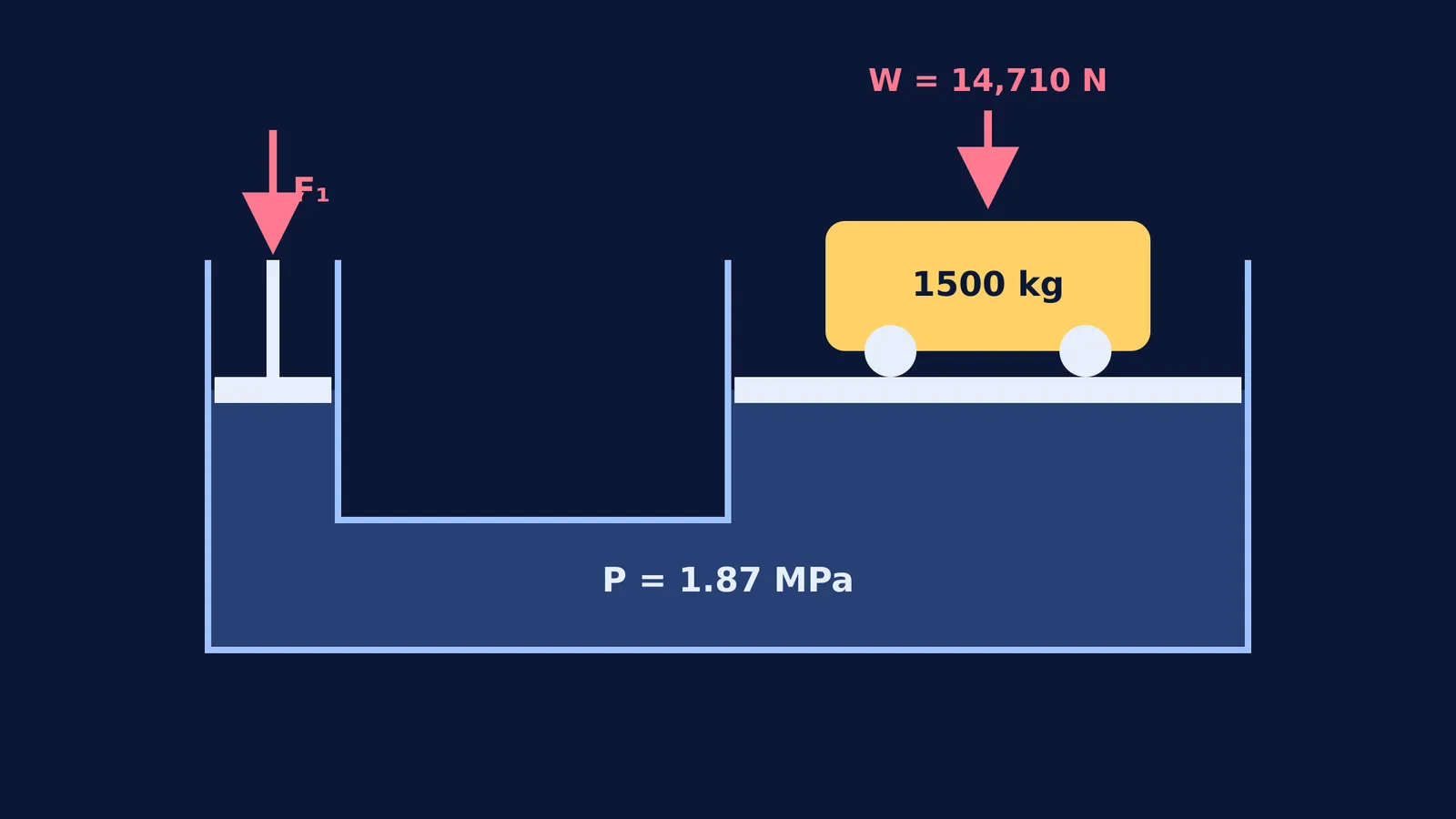
Let us walk through a standard numerical example. Suppose you need to lift a 1500 kg car using a hydraulic lift. The large piston supporting the car has a diameter of 10 cm (which means a radius of 5 cm, or 0.05 m).
First, we find the force. Standard gravity is exactly 9.80665 m/s², a value established by the 3rd General Conference on Weights and Measures (CGPM) in 1901 (Wikipedia). This constant was adopted to provide a standard value for the standard weight of a mass, avoiding discrepancies caused by variations in local gravity across the Earth.
Force = 1500 kg × 9.80665 m/s² = 14,710 N.
Next, we calculate the area of the 10 cm piston using the value of pi:
Area = 3.14159 × (0.05 m)² = 0.007854 m².
Finally, we find the pressure required to support this load by dividing the total force by the area we just calculated:
Pressure = 14,710 N / 0.007854 m² = 1,872,931 Pa.
Rounded to significant figures, the oil pressure inside the hydraulic lift is approximately 1.87 MPa (megapascals).
How does this compare to standard atmospheric pressure?
When we calculate 1.87 MPa, the number can feel abstract. To make sense of it, engineers often compare fluid pressure to standard atmospheric pressure—the weight of the air pushing down on us at sea level.
In 1954, the 10th CGPM adopted exactly 101,325 Pa as the standard atmospheric pressure (Wikipedia)). Prior to this decision, the unit was defined by the pressure exerted by a 760 mm column of mercury at 0 °C. The newer definition was established to make the unit completely independent of the properties of any particular substance.
To see how many atmospheres of pressure our hydraulic lift requires, we divide our calculated result by this standard baseline:
1,872,931 Pa / 101,325 Pa ≈ 18.48.
The hydraulic oil is under roughly 18.5 atmospheres of pressure. While this might sound immense, industrial hydraulic fluids and steel cylinders are built to handle pressures far beyond this in commercial garages.
If you are working through similar fluid mechanics problems, the Fermi Problem Library has worked problems with a step-by-step solver that explains the reasoning rather than printing an answer.
Practising fluid mechanics
Understanding pressure boundaries is just the start of fluid mechanics. You can explore how these principles extend to other devices by studying Pascal's law in hydraulic machines: lifting a car with a small push or see how pressure balances out in Two immiscible liquids in a manometer: finding the unknown density.
When you hit a block in your physics revision, Fermi's AI tutor can work out what you already know and build a plan for the session, so you sit down to a clear next step.


