

On this page
When you place your smartphone on a wireless charging pad, the screen lights up and the battery indicator begins to fill without a single cable plugged in. It feels effortless, but beneath the glass surfaces lies a direct application of Class 12 physics: mutual induction. A changing magnetic field from one coil drives current through an adjacent, independent coil.
What happens inside a wireless charging pad?
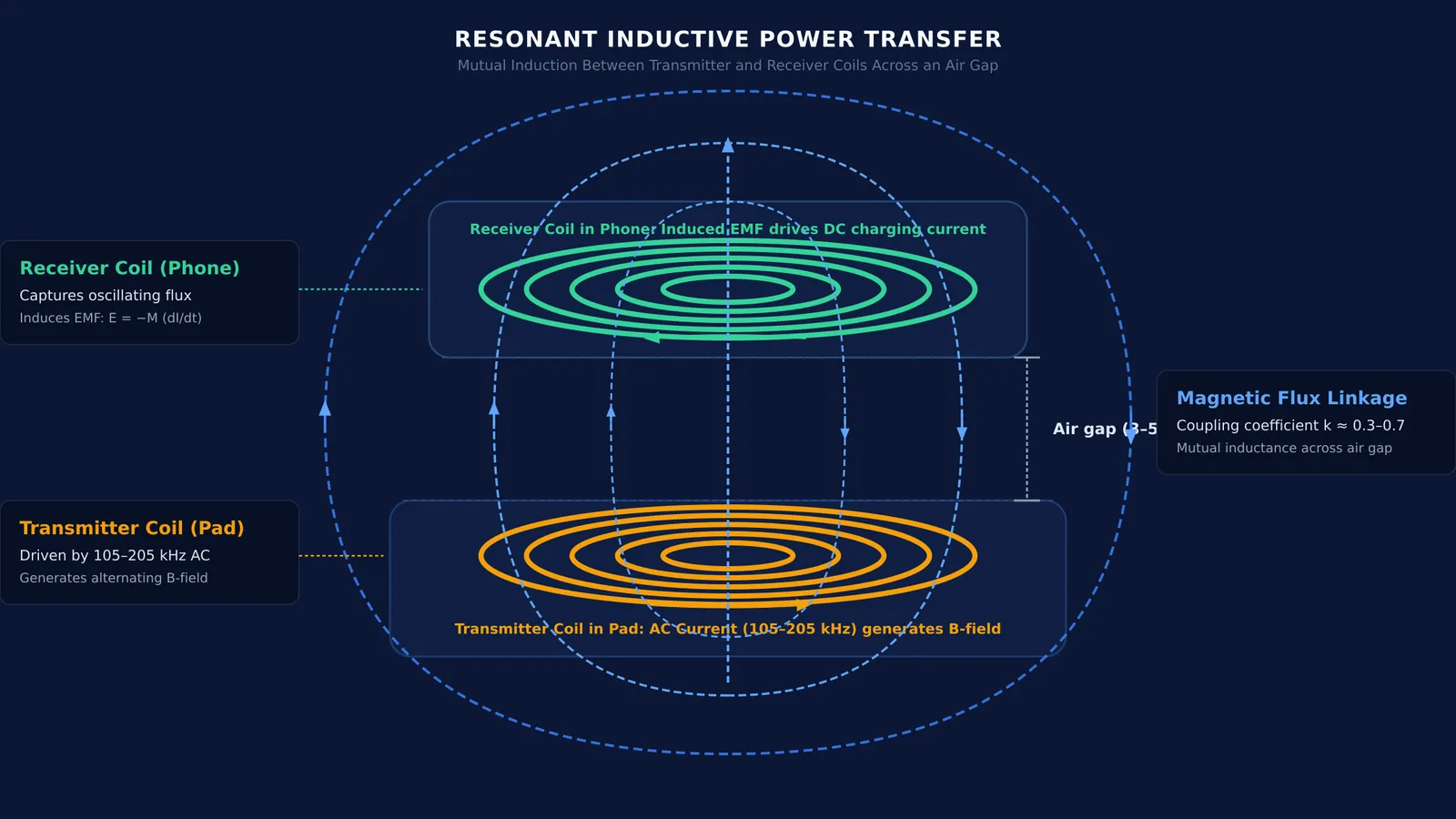
Underneath the pad's surface lies a flat, spiral coil of copper wire called the transmitter coil. When connected to a power outlet, the pad's internal circuitry converts direct-current electricity into a high-frequency alternating current (AC).
As alternating current surges through the transmitter coil, Ampère's law dictates that it generates an accompanying magnetic field. Because the current alternates continuously, the magnetic field expands, collapses, and reverses polarity hundreds of thousands of times every second. Under the Qi standard governed by the Wireless Power Consortium, charging pads operate at frequencies between 105 kHz and 205 kHz (105,000 to 205,000 cycles per second). This rapid oscillation transfers substantial magnetic energy across the air gap using compact planar coils.
How do phones charge on a wireless pad coil?
Inside the back of your smartphone sits a matching component: the receiver coil.
When you place the phone onto the pad, oscillating magnetic flux from the transmitter coil passes through the receiver coil. Under Faraday's law of induction—the same principle behind circulating electric fields inside a solenoid—time-varying magnetic flux through a closed loop induces an electromotive force (EMF).
Because the primary current alternates at up to 205 kHz, the magnetic flux changes rapidly. The induced EMF drives an alternating current through the receiver coil. The phone's internal rectifiers convert this AC into stable direct current to charge the battery.
This process of inducing an EMF in an adjacent circuit through a shared magnetic field is mutual induction. It shares the identical physics behind electrical transformers and traces back to the 1830s work of Nicholas Callan and the induction coil.
Why does coil alignment and spacing matter?
For mutual induction to transfer power efficiently, magnetic flux from the transmitter must link through the receiver coil. In transformer theory, this is quantified by the magnetic coupling coefficient (k), ranging from 0 (no linkage) to 1 (perfect linkage). While closed iron-core transformers achieve k near 0.98, air-coupled planar coils typically operate with k between 0.3 and 0.7.
Distance is the primary limiter. Magnetic flux density from a flat coil drops off rapidly with axial distance. According to the Wireless Power Consortium, standard Qi inductive power transfer is designed for air gaps of 3 to 5 millimetres. If a phone case is thicker than 5 millimetres, the magnetic field weakens significantly before reaching the receiver coil, causing power transfer to plunge.
Lateral alignment is equally critical. If the phone is off-center by even 10 millimetres, magnetic field lines miss the receiver coil, reducing mutual inductance (M). Newer standards like Qi v2.0 (Qi2) solve this by embedding rings of permanent magnets that automatically snap the coils into coaxial alignment.
The Fermi Simulation Lab provides interactive simulations for ideas that are easier to see than to read, allowing you to visualize how magnetic field lines diverge across an air gap and how coupling efficiency changes as coils shift out of alignment.
Why does your phone get warm on a wireless charger?
Wireless charging is less efficient than a direct cable connection. In an IEEE study on smartphone charging efficiency, Bekaroo and Seeam (2016) demonstrated that wireless charging consumes significantly more electrical energy than wired charging, with commercial Qi systems typically operating at 60% to 80% DC-to-DC efficiency. Between 20% and 40% of the energy drawn from the wall outlet never reaches the battery, dissipating directly as heat.
This heat stems from two primary electromagnetic mechanisms:
Joule heating (I²R losses): Alternating current flowing through the copper coils encounters electrical resistance, generating heat.
Parasitic eddy currents: Oscillating magnetic fields penetrate conductive phone components, inducing circulating eddy currents that dissipate heat in the chassis.
When phone temperatures rise above 35 °C to 40 °C, internal battery management software automatically throttles charging speed to protect the lithium-ion battery.
Tips for efficient wireless charging:
Remove thick cases: Keep the gap between pad and phone under 5 millimetres.
Center the coils: Ensure the phone sits centered over the pad's active coil.
Keep it cool: Avoid charging in direct sunlight or on soft surfaces that trap heat.
Next time your phone chimes on a charging pad, you know what is happening: a 200 kHz oscillating magnetic field is driving electrons across an air gap, demonstrating Class 12 mutual induction in your hand.


