

On this page
Whether you are walking through a freezing winter morning or playing sports on a sweltering summer afternoon, your internal body temperature barely changes. Your body operates like a biological furnace equipped with a highly sensitive thermostat, constantly adjusting to keep your internal environment stable.
This stability is known as homeostasis, and the specific process of managing temperature is called thermoregulation.
Why does the body need to stay at 37°C?
The human body maintains a core temperature in a narrow range, typically between 36.5 and 37.5°C (OpenStax). This specific target is the optimal set point for the critical metabolic enzymes that keep your cells alive.
If your core temperature rises too high, the delicate proteins and enzymes inside your cells begin to denature, unravelling and losing their shape. Once they lose their shape, they stop working, which can lead to cellular damage and heatstroke. Conversely, if your temperature drops too low, metabolic reactions slow down to a crawl.
To prevent this and maintain a stable environment, your body acts as a constant heat generator. In fact, about 60% of the energy produced by your cells during ATP production is deliberately released as heat (OpenStax).
How does the body stay close to 37 degrees?
The control centre for thermoregulation is a small, almond-sized region at the base of the brain called the hypothalamus. It functions exactly like a thermostat set to 37°C.
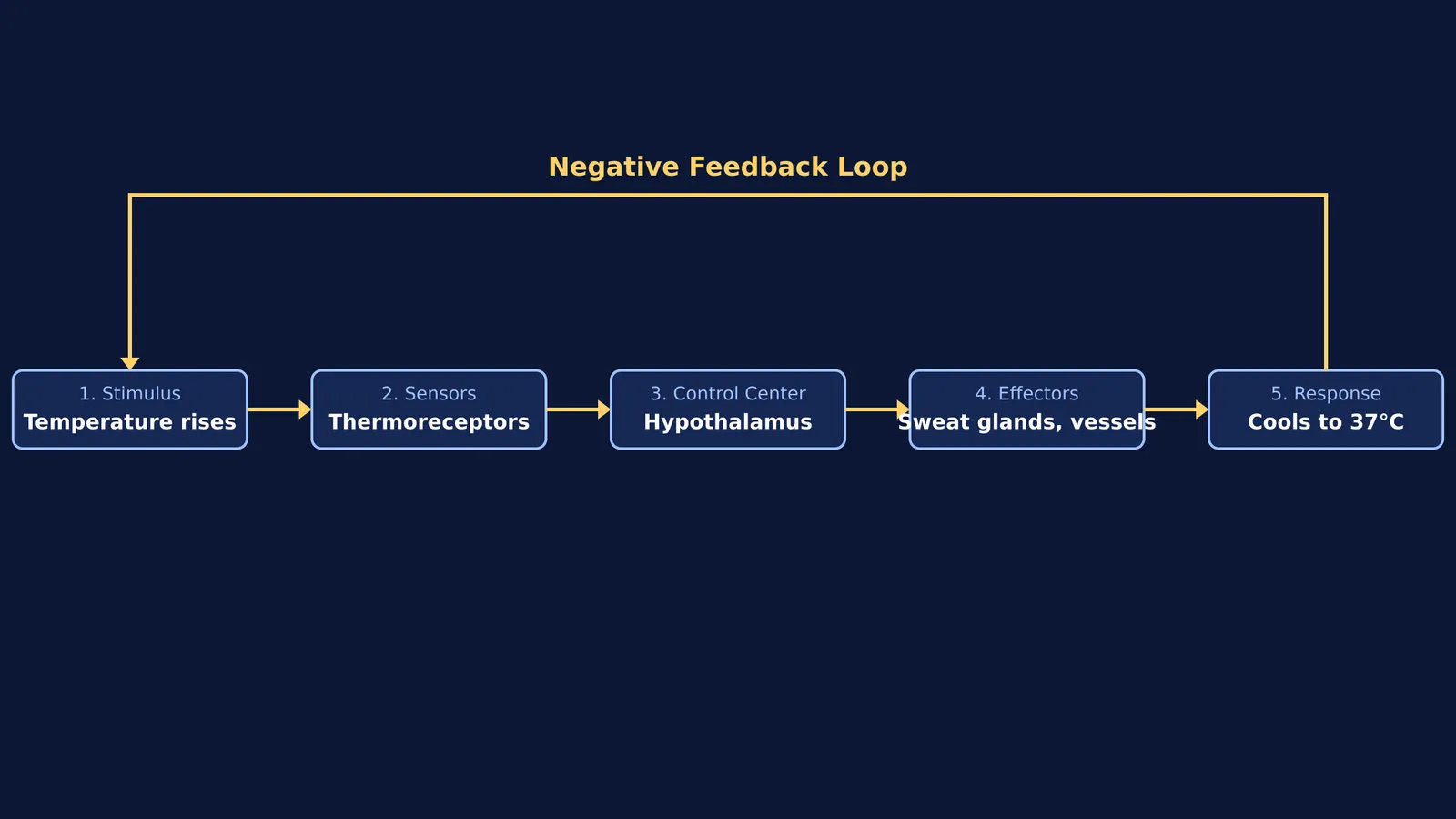
The hypothalamus relies on a negative feedback loop to monitor and adjust your temperature:
Sensors: Thermoreceptors in your skin monitor the outside temperature, while central receptors in the brain monitor the temperature of your blood.
Control centre: The hypothalamus receives this temperature data and compares it to the 37°C set point.
Effectors: If the temperature deviates from the set point, the hypothalamus sends signals to the blood vessels, sweat glands, and muscles to reverse the change.
Because it is a *negative* feedback loop, the body's response always opposes the initial stimulus. If you get too hot, the body initiates cooling; if you get too cold, the body initiates warming.
How do sweating and shivering regulate temperature?
When the hypothalamus detects that you are too hot, it triggers two primary cooling effectors:
Vasodilation: The blood vessels near the surface of your skin widen. This allows more warm blood from your core to flow near the skin, where the heat can radiate away into the air.
Sweating: Your sweat glands release water onto the skin. Because water has a high heat capacity, it absorbs a massive amount of body heat as it evaporates. This evaporative cooling is remarkably powerful and helps maintain your temperature during intense exertion.
When the hypothalamus detects that you are too cold, it triggers warming effectors to conserve and generate heat:
Vasoconstriction: The blood vessels near your skin narrow, trapping warm blood deep in your body's core to protect your vital organs.
Shivering: The hypothalamus forces your skeletal muscles to rapidly and involuntarily contract. This increased muscular activity burns energy and generates internal heat.
How can you study feedback loops for biology exams?
Thermoregulation is one of the most common examples of homeostasis tested in biology exams. If you are preparing for a biology exam, the most effective active learning strategy is to draw the feedback loop yourself rather than just reading about it.
Here is a checklist for drawing any biological feedback loop:
Map the Stimulus (e.g., body temperature rises).
Draw the Sensors that detect the change.
Place the Control Center in the middle (e.g., the hypothalamus).
Identify the Effectors (e.g., sweat glands and blood vessels).
Draw the Feedback arrow showing the response reversing the stimulus.
If you struggle to picture how these systems connect, the Fermi Concept Library maps out biological processes so you can see how homeostasis links directly to cellular respiration and enzyme function. For ideas that are easier to see than to read, you can adjust environmental variables and watch vasodilation happen in real time in the Fermi Simulation Lab.
When you understand the mechanics behind the hypothalamus, a hot day or a cold shiver stops being just an uncomfortable sensation—it becomes a window into the body's incredible engineering.


