

On this page
When you hold your debit card near a payment terminal, the transaction takes less than a second. But underneath the plastic, the card is performing a complex cryptographic handshake using the same physics you study in Class 12 electromagnetism.
The most surprising fact about a tap-to-pay card is what it lacks. It contains a powerful microchip, but it has no battery to turn it on. So, how does the chip wake up to authorize your payment?
How do contactless tap to pay cards work?
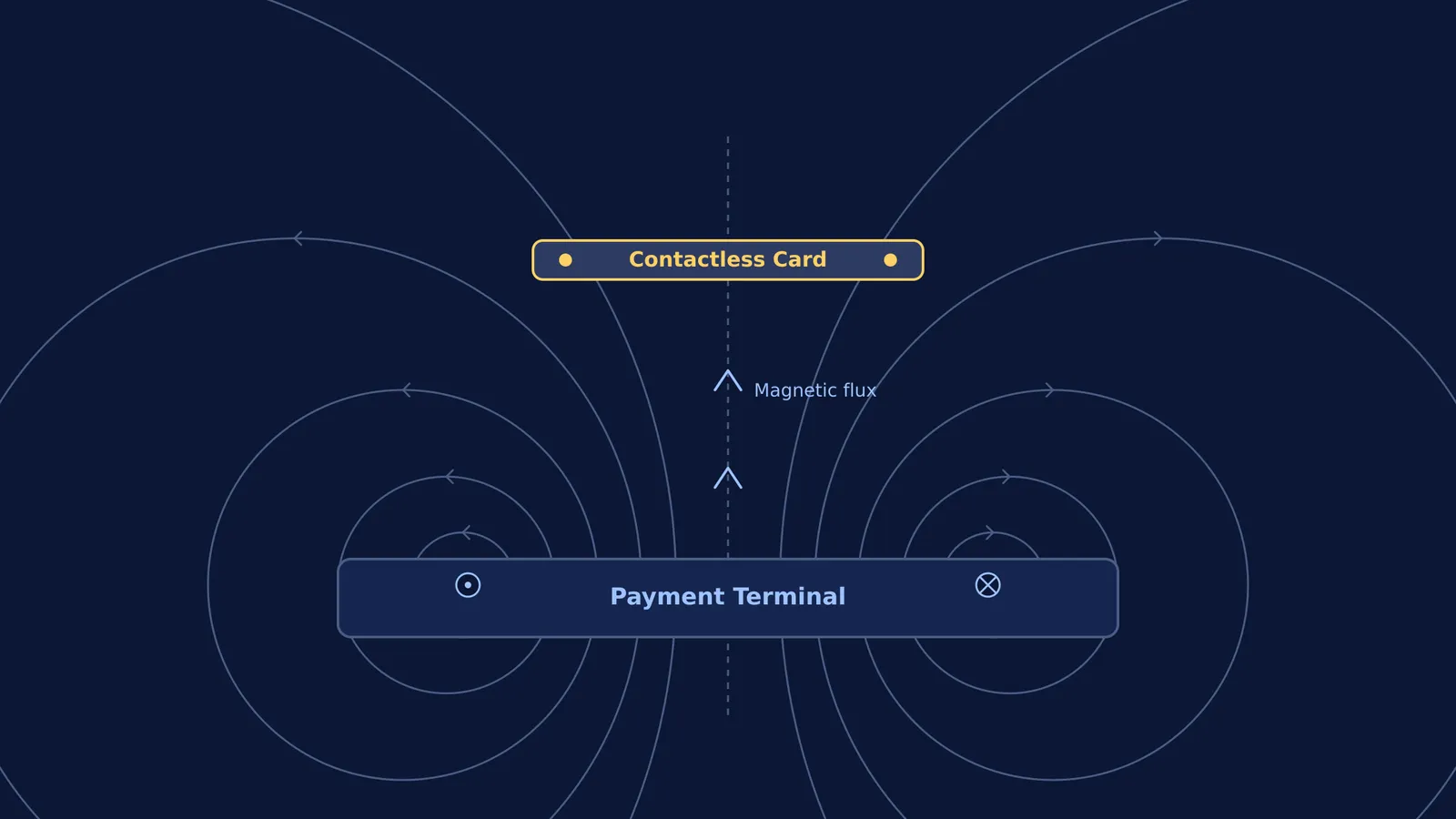
The answer lies in electromagnetic induction. A contactless card and a payment terminal act like two halves of a very flat, loosely coupled transformer.
Inside the terminal is a primary coil of wire. Inside your card, hidden within the plastic and usually running around the perimeter, is a secondary coil of thin copper wire.
The transaction happens in three physical steps:
The oscillating field: The payment terminal constantly emits a radio-frequency electromagnetic field. According to the international ISO/IEC 14443 standard for proximity cards, this carrier field oscillates at exactly 13.56 MHz.
The changing flux: When you bring the card within a few centimetres of the terminal, the terminal's magnetic field lines pass through the area enclosed by the card's loop.
Powering the chip: Because the magnetic field is oscillating 13.56 million times per second, the magnetic flux through the card's loop is constantly and rapidly changing. Faraday's law of induction states that this changing magnetic flux induces an electromotive force (emf) in the card's coil. This induced alternating current is then rectified into direct current, providing just enough power to wake up the card's microchip.
You might have studied Faraday's law for a changing B in the context of a long solenoid, but the fundamental principle is identical here. The idea of using a primary coil to induce a voltage in a secondary coil goes back to pioneers like Nicholas Callan and the induction coil, though today the concept has been miniaturised to fit inside your wallet.
If you struggle to picture how invisible field lines from one loop pass through another, set up two coils in the Fermi Simulation Lab to see how changing their distance affects the induced current.
Why don't contactless cards need a battery?
Including a battery would make a debit card bulky, expensive, and prone to expiring after just a few years. By harvesting energy directly from the terminal, the card only powers up when it is exactly where it needs to be—within the reader's magnetic field.
This design choice also builds in a crucial layer of security. Because the card relies on near-field inductive coupling rather than broadcasting a traditional radio wave, it cannot be accidentally triggered from across a room. The strength of the reader's magnetic field drops off sharply with distance (proportional to 1/r³), meaning the card receives enough power to turn on only when it is within a very strict range, typically limited by design to less than 10 centimetres.
How does the card talk back?
Once the microchip is awake, it needs to send its encrypted account data back to the terminal. But the tiny amount of harvested power is not enough for the card to broadcast a strong radio signal of its own.
Instead, the card communicates using a clever technique called load modulation. The card's microchip rapidly switches a tiny resistor in and out of its own antenna circuit. This switches the electrical load on the card's coil, which in turn slightly changes how much energy the coil draws from the terminal's overarching magnetic field.
The payment terminal, which is still generating the primary field, is sensitive enough to detect these tiny fluctuations in its own power draw. It reads these slight "tugs" on its magnetic field as a stream of binary 1s and 0s.
A framework for exam questions on induction
When you encounter exam problems involving two coils, you can apply the same logic that makes your bank card work. Use this simple checklist:
Identify the source of the change. Is the current in the primary coil changing, or is the secondary coil physically moving into the field? In the case of the tap-to-pay card, the primary current is oscillating at 13.56 MHz, creating a time-varying field.
Check the orientation. The induced emf depends on the dot product of the magnetic field vector and the area vector. If you hold your card perfectly perpendicular to the reader (edge-on), no field lines pass through the loop, the flux is zero, and the transaction will fail. The card must be held parallel to the reader's surface for maximum flux.
Apply Lenz's Law. The induced current will flow in a direction that creates its own magnetic field opposing the change in flux. This opposing field is exactly what the terminal detects during load modulation.
Understanding this process bridges the gap between abstract textbook physics and the everyday technology in your pocket. The next time you tap your card to buy a coffee, remember that your payment is authorised by the very same principles of magnetic flux that Michael Faraday discovered nearly two centuries ago.


