

On this page
Swing bowling is one of the most beautiful and deceptive arts in cricket. A fast bowler releases the ball, it travels straight for most of the pitch, and then suddenly curves sideways in the air, leaving the batsman grasping at thin air.
While it looks like magic or dependent entirely on the weather, the secret lies purely in fluid mechanics. A shiny side, an upright seam and the speed of the delivery all work together to manipulate the air pressure around the ball.
What is the boundary layer?
As a cricket ball flies through the air, a microscopically thin layer of air sticks to its surface. This is called the boundary layer. According to fluid dynamics, this layer of air can exist in two very different states:
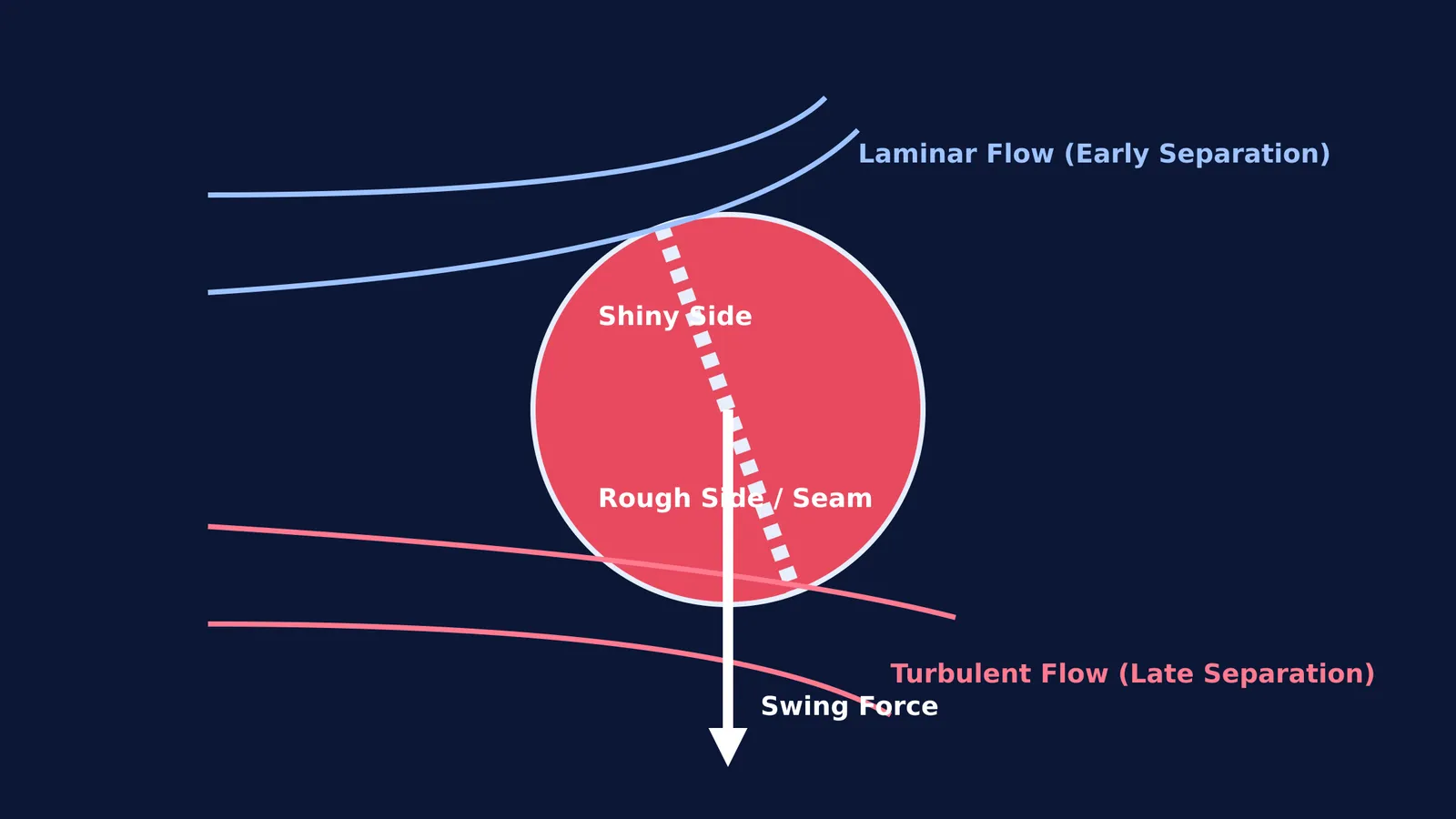
Laminar flow: The air moves smoothly in neat, orderly and parallel layers. It has low kinetic energy and separates from the ball's curved surface quite early.
Turbulent flow: The air is chaotic and swirling. Because it carries more kinetic energy, it can fight the changing pressure around the curve of the ball and stay attached much longer.
The entire art of swing bowling is about purposefully creating laminar flow on one side of the ball and turbulent flow on the other.
How does conventional swing work?
When a new ball is used, bowlers vigorously polish one side to a high shine and leave the other side to naturally roughen. They then grip the ball with an upright seam, angled at about 20° toward the direction they want the ball to swing.
As the ball travels forward, the air flowing over the shiny side remains smooth and laminar, separating early. On the other side, the angled seam acts as a "trip wire." When the air hits the raised stitches of the seam, it is forced into a turbulent state.
Because the turbulent air stays attached to the ball's surface for longer, it wraps further around the back of the ball. This delayed separation means the air on the turbulent side moves faster for a longer period of time. According to Bernoulli's principle, faster-moving air creates lower pressure.
With higher pressure on the shiny side and lower pressure on the seam side, a side-force is generated. This pressure differential literally pushes the ball towards the lower pressure zone, causing it to swing in the air.
Why does a cricket ball reverse swing?
As a cricket match goes on, the ball becomes older, softer and heavily scuffed on one side. When this rough ball is bowled at very high speeds (usually above 108 km/h or 67 mph for an old ball), the aerodynamics flip. This phenomenon was extensively studied and explained by NASA aerodynamicist Dr. Rabindra Mehta.
At extreme speeds, the rough surface is so degraded that the air flowing over it becomes a thick, chaotic turbulent layer that separates surprisingly early. Meanwhile, the shiny side (tripped by the seam) forms a thinner, more efficient turbulent layer that actually stays attached longer than the flow on the rough side.
Because the flow on the shiny side now separates later, the lower pressure zone switches sides. The ball swings *towards* the shiny side, completely opposite to conventional swing. This sudden, late movement at high speeds is what makes reverse swing so lethal.
If you want to visualise how air wraps around a curved surface, separates and creates pressure differences, the Simulations lab lets you adjust flow speeds and see these forces change in real time.
Does cloudy weather actually make the ball swing more?
Cricket folklore insists that heavy, overcast or humid conditions cause the ball to swing more aggressively. However, wind tunnel testing has shown that humidity has almost no direct effect on the "stickiness" of the boundary layer. In fact, humid air is slightly less dense than dry air.
The weather effect is largely indirect. A damp pitch might preserve the shine of the ball longer, or players might naturally polish the ball more effectively when the air is cool. The physics of the swing force itself, however, is entirely dictated by the state of the ball's surface and the angle of the seam.
What is a bowler's checklist for swing?
To get the most out of fluid mechanics on the pitch, keep these three factors in mind:
Maintain the ball: Polish one side constantly to keep it smooth, while letting the other side scuff up naturally.
Angle the seam: Release the ball with the seam angled at roughly 20°. If the seam wobbles in flight, the air is tripped on both sides simultaneously, killing the pressure difference.
Control your speed: Conventional swing is most effective between 85 km/h and 115 km/h. If you bowl too fast with a new ball, the air becomes turbulent on both sides anyway, neutralising the swing.
Understanding the flow of air is just one part of fluid dynamics. For more on how pressure and energy interact, see our guide on Fluid mechanics: pressure, buoyancy and Bernoulli mistakes to avoid, or explore the groundbreaking work of Roddam Narasimha and turbulence in fluid flow.


