

On this page
Have you ever wondered how a massive steel submarine can float effortlessly on the surface and then plunge into the ocean depths at will? The answer lies in the elegant physics of Archimedes' principle and the clever engineering of a submarine's hull. It all comes down to managing the delicate balance between two fundamental forces: the downward pull of gravity and the upward push of the water.
How does a submarine dive and come back up?
When an object is placed in a fluid, it experiences an upward force. Buoyancy, or upthrust, is the force exerted by a fluid opposing the weight of a partially or fully immersed object. According to Archimedes' principle, the upward buoyant force that is exerted on a body immersed in a fluid is equal to the weight of the fluid that the body displaces.
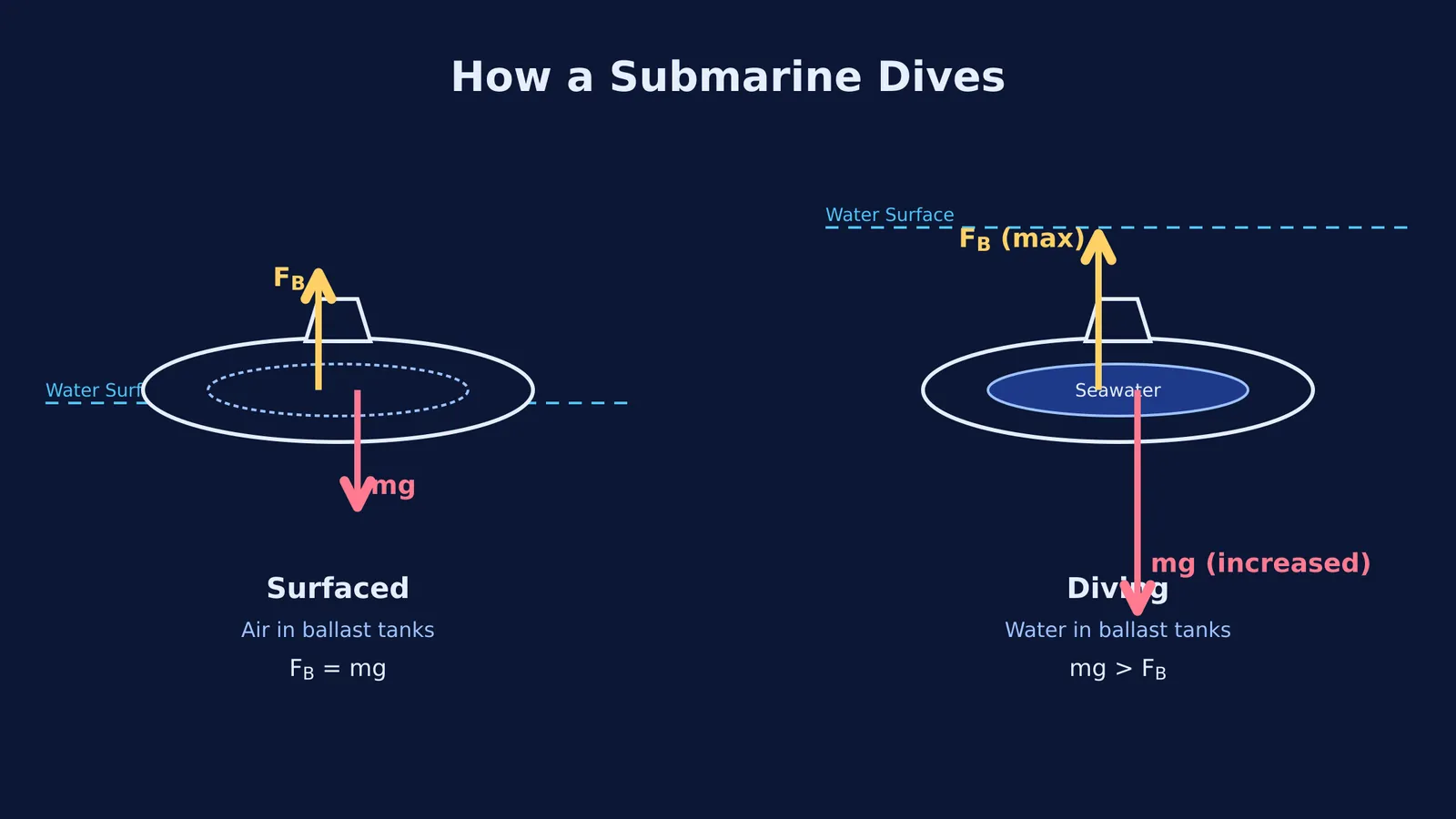
For a submarine to float at the surface, its total downward weight must be perfectly equal to the upward buoyant force provided by the water it displaces when only partially submerged. Because a submarine has a rigid, fixed outer volume, the maximum possible buoyant force it can experience is also fixed—it occurs when the hull is completely submerged. To dive beneath the surface, the submarine must make its overall weight greater than this maximum possible buoyant force.
It accomplishes this remarkable feat using ballast tanks. A ballast tank is a compartment within a boat, ship or other floating structure that holds water, which is used as ballast to provide hydrostatic stability for a vessel, to reduce or control buoyancy. When the crew is ready to dive, they open large valves, called vents, at the top of these tanks. This allows the air inside to escape while surrounding seawater floods in through ports at the bottom. As the tanks rapidly fill with this dense seawater, the submarine's mass increases significantly, while its external volume remains exactly the same. Its average density soon becomes greater than the density of the surrounding water, causing it to sink.
How does compressed air help a submarine surface?
Rising back to the surface requires the precise reversal of this process. The submarine needs to reduce its average density until its total weight is less than the buoyant force pushing it upwards.
To achieve this, the submarine carries heavy-duty flasks of highly compressed air. When it is time to come back up to the surface, this high-pressure air is blown directly into the ballast tanks. The sheer pressure of the air forces the seawater back out through the flooding ports at the bottom of the hull. As the water leaves, it is replaced by the much lighter air, and the submarine's overall mass drops dramatically. The constant buoyant force, which now easily exceeds the submarine's reduced weight, pushes the vessel steadily upwards until it breaches the surface.
Once a submarine reaches its desired depth underwater, it often aims for a state called "neutral buoyancy". In this state, the submarine's weight perfectly matches the weight of the displaced water, allowing it to hover effortlessly without rising or sinking.
How do you calculate a submarine's average density?
To see how this works in practice, let us calculate the average density of a hypothetical submarine. The average density of seawater at the surface is 1.025 kg/L, which is equivalent to 1025 kg/m³.
Suppose a submarine has a total fixed volume of 2000 m³. When it is floating empty of ballast water, its mass is 1,800,000 kg.
First, calculate its average density when surfaced: Average Density = Total Mass / Total Volume Average Density = 1,800,000 kg / 2000 m³ = 900 kg/m³
Because 900 kg/m³ is less than the density of seawater (1025 kg/m³), the submarine naturally floats.
Now, imagine the submarine wants to dive and become completely submerged. To sink, its mass must exceed the mass of 2000 m³ of seawater. Mass of displaced seawater = Volume × Density of seawater Mass of displaced seawater = 2000 m³ × 1025 kg/m³ = 2,050,000 kg
The submarine must therefore increase its mass from 1,800,000 kg to more than 2,050,000 kg. It must take in at least 250,000 kg of seawater into its ballast tanks to begin its descent.
Why does understanding buoyancy matter for exams?
Questions involving Archimedes' principle, apparent weight, and average density appear frequently in competitive physics exams like JEE Main and NEET-UG. Examiners will test your ability to clearly distinguish between an object's raw material density and its average density (which includes any hollow spaces). A solid block of steel sinks immediately, but a steel submarine floats because its large internal volume of air drastically lowers its average density.
Mastering fluid mechanics requires a solid grasp of how pressure, volume, and forces interact in complex ways. If you are practising fluid problems, reviewing Pascal's law in hydraulic machines will help you understand how fluids transmit pressure in closed systems. Similarly, solving manometer problems with two immiscible liquids is excellent practice for balancing pressure and density equations under different conditions.
If you find it hard to picture how changing mass affects an object's position in a fluid, the Fermi Simulation Lab has interactive simulations for the ideas that are easier to see than to read. You can adjust the mass and volume of a submerged object dynamically to watch how the delicate balance of weight and buoyancy dictates whether it floats, sinks, or hovers perfectly suspended in the water.


