

On this page
When a police officer points a speed gun at your car, they are using one of two very different physics principles to find your velocity: the Doppler effect for radio waves, or the time of flight for infrared light.
While both types of devices work by bouncing electromagnetic waves off a moving vehicle, the way they calculate speed is entirely different. Both methods rely on precise constants, whether that is a specific radio frequency or the speed of light itself.
How do radar speed guns work?
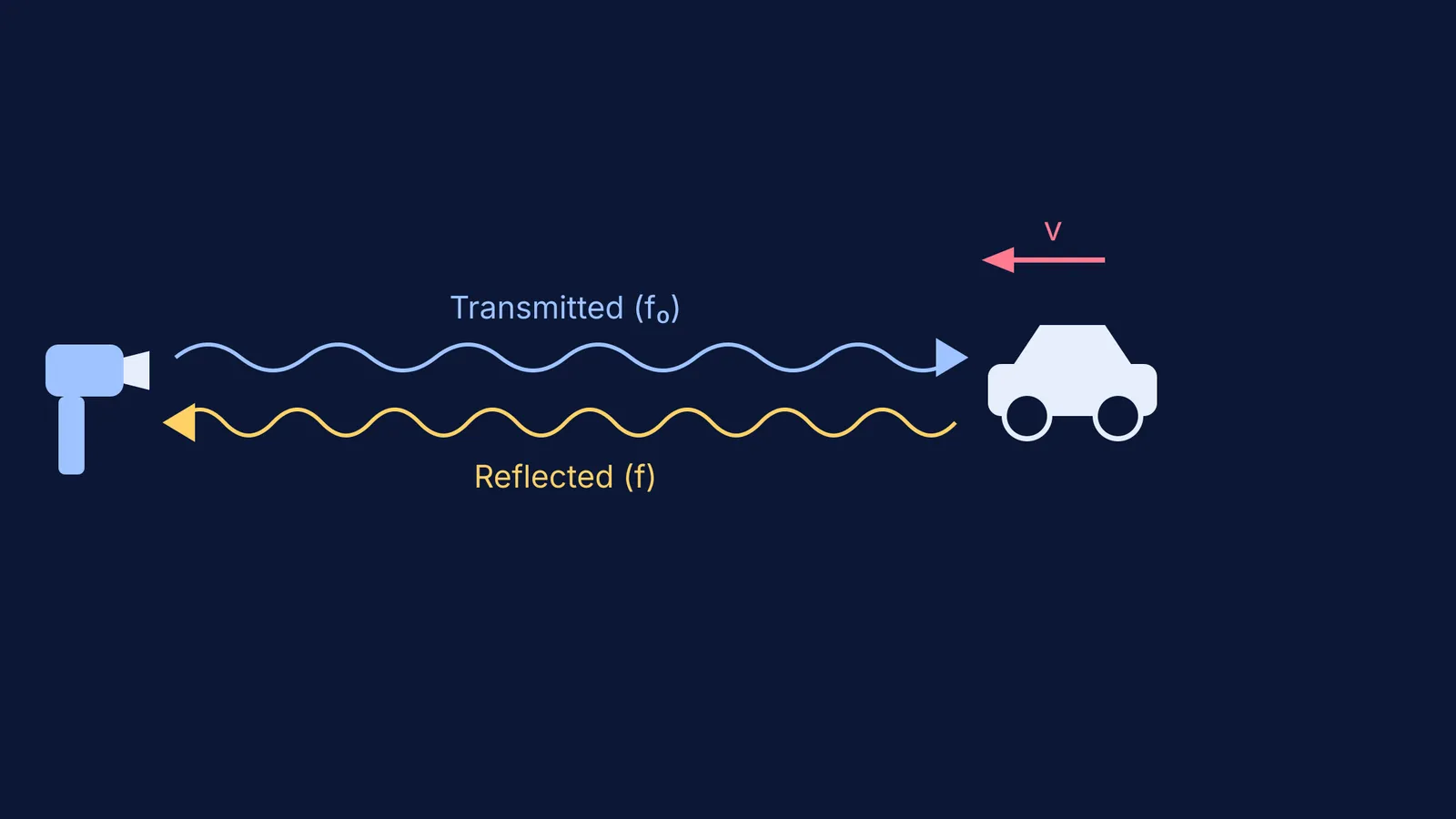
Radar (Radio Detection and Ranging) guns fire a wide beam of radio waves at a specific frequency. When those waves hit a moving car and bounce back, they return at a slightly different frequency. The difference depends entirely on the relative motion between the car and the radar gun. Whether it is a radar pulse bouncing off a car or two projectiles colliding midair, keeping track of the observer's frame makes the maths simpler.
This is the Doppler effect. It is the same reason an ambulance siren sounds higher-pitched as it comes towards you and lower-pitched as it drives away. If you drive towards a radar gun, your car "compresses" the radio waves bouncing off it, raising their frequency.
Let us break down the formula. The shift in frequency, Δf, equals 2 × v × f₀ / c, where v is your speed, f₀ is the transmitted frequency, and c is the speed of light. The factor of 2 is there because the wave makes a round trip—both the outbound and the returning wave are compressed by the car's relative motion. In a typical exam problem, you might be asked to find the speed of the source given the shift, or vice versa.
Most modern police radar guns operate in the K-band or Ka-band frequency ranges, between 18 and 40 GHz (Wikipedia). As you drive towards the gun, the reflected wave returns at a higher frequency than it left. The gun's internal computer measures this difference, known as a beat frequency, and displays your speed on the screen.
How do laser speed guns work?
Instead of radio waves, laser speed guns—known as Lidar (Light Detection and Ranging)—fire a series of very short, invisible infrared laser pulses.
Lidar does not rely on a frequency shift. Instead, it measures the time it takes for each pulse of light to hit the car and return. Because the speed of light is a universal constant of about 300,000,000 metres per second, the time of flight tells the gun exactly how far away the car is (Wikipedia).
The pulses are incredibly fast. A typical Lidar gun emits light at a wavelength of 905 nanometres, which is entirely invisible to the human eye. The gun's internal clock records the exact nanosecond a pulse leaves and the exact nanosecond it returns. Since light travels about 30 centimetres in a single nanosecond, a round-trip time of 2,000 nanoseconds means the car is exactly 300 metres away.
The gun does not just take one measurement. To calculate speed, it emits a rapid succession of pulses—up to several hundred in less than half a second. By measuring the change in the vehicle's distance over the time interval between these pulses, the device calculates the vehicle's velocity with high accuracy.
Because laser beams are very narrow—only about one metre wide at 300 metres away—Lidar allows officers to target a specific vehicle in dense traffic. This is a significant advantage over a radar's wide, spreading cone, which can struggle to pick out one car from a group.
Does the angle of a radar gun affect speed?
Both radar and Lidar guns measure your radial velocity (Wikipedia). This means they only measure how fast you are moving directly towards or directly away from the lens.
If a police officer is standing on the side of the road at an angle to your path, the speed gun does not capture your true forward speed. It measures your speed multiplied by the cosine of the angle between the radar beam and your direction of travel (v × cos θ).
For example, if you are driving at 100 km/h and the radar gun is positioned at a 10-degree angle to your lane, the measured speed will be 100 × cos(10°), which is approximately 98.5 km/h. Because the cosine of any angle greater than zero is less than 1, this "cosine effect" means the gun will always register a speed that is slightly lower than reality. The wider the angle, the lower the speed reading on the display. This built-in error always works in the driver's favour.
If you are preparing for physics exams, understanding relative motion is easier when you can watch the waves compress and stretch in real time. You can experiment with these setups in the Fermi Simulation Lab to see how velocity changes the frequency. When you are ready to test your understanding, step through the maths of a moving source in the Fermi Problem Library.


