

On this page
Food chains are easy to memorise and easy to get wrong in an exam. Chapter 12 of Class 8 science asks for more than "grass, deer, tiger": it wants you to explain how a change in one living thing spreads to others, and why a balanced ecosystem keeps changing. This post explains the chapter's key ideas, works through its counting activity with sample numbers, traces the pond example back to the original research, and ends with a routine for students and parents.
Where is this chapter in the new book?
In the current NCERT book Curiosity, Textbook of Science for Grade 8 (reprint 2026-27), Chapter 12 is "How Nature Works in Harmony". The Chapter 12 PDF opens with elephants entering farms in states such as Odisha, Jharkhand and Assam when their forest habitat shrinks, and the wildlife corridors ecologists have marked to help them move safely.
How do habitat, population, community and ecosystem fit together?
The chapter builds a ladder of terms. Learn them in order:
Habitat: the place where an organism lives. It can be as small as the bark of a tree.
Biotic and abiotic components: the living things and the non-living things (air, water, soil, sunlight, temperature) in a habitat.
Population: a group of the same kind of organism in a habitat at a given time.
Community: all the different populations sharing a habitat.
Ecosystem: the community together with the abiotic components, all interacting.
The book adds that ecosystems can be aquatic (pond, river, lake) or terrestrial (forest, farm, even one large banyan tree), that they overlap, and that farmland is a human-made ecosystem.
Who eats whom?
Producers, or autotrophs, make their own food by photosynthesis. Consumers, or heterotrophs, depend on others: herbivores eat plants, carnivores eat animals and omnivores eat both. A food chain is a simple "who eats whom" sequence, such as the book's grass → grasshopper → frog → snake → eagle. Each position is a trophic level, with producers at the first.
Because most organisms are eaten by more than one kind of predator, food chains link into a food web. Then decomposers, fungi and bacteria, break down dead matter and return nutrients to the soil. In the chapter's words, "In nature, nothing is wasted".
Where does the pond example come from?
Activity 12.3 describes two ponds: one with fish and many flowering plants around it, one without fish and fewer flowers. The explanation is a chain of effects across two ecosystems: fish eat dragonfly larvae, so fewer dragonflies emerge; dragonflies eat bees and butterflies, so more pollinators survive; more pollinators means more flowers are pollinated.
This comes from real research. In Trophic cascades across ecosystems (2005), published in Nature, Tiffany Knight and colleagues studied ponds in Florida and reported that "plants near ponds with fish receive more pollinator visits and are less pollen limited than plants near fish-free ponds". The water and the land around it behaved as one connected system.
How does one change lead to another?
The chapter gives two more cascades.
Polluted pond: plants die, so less oxygen is produced, fish die, insects increase, spread to farms and damage crops, and farmers use more pesticide.
Frog legs: in the 1980s India exported large numbers of Indian bullfrog legs. Fewer frogs meant more crop pests and more synthetic pesticide use, and the government banned the export.
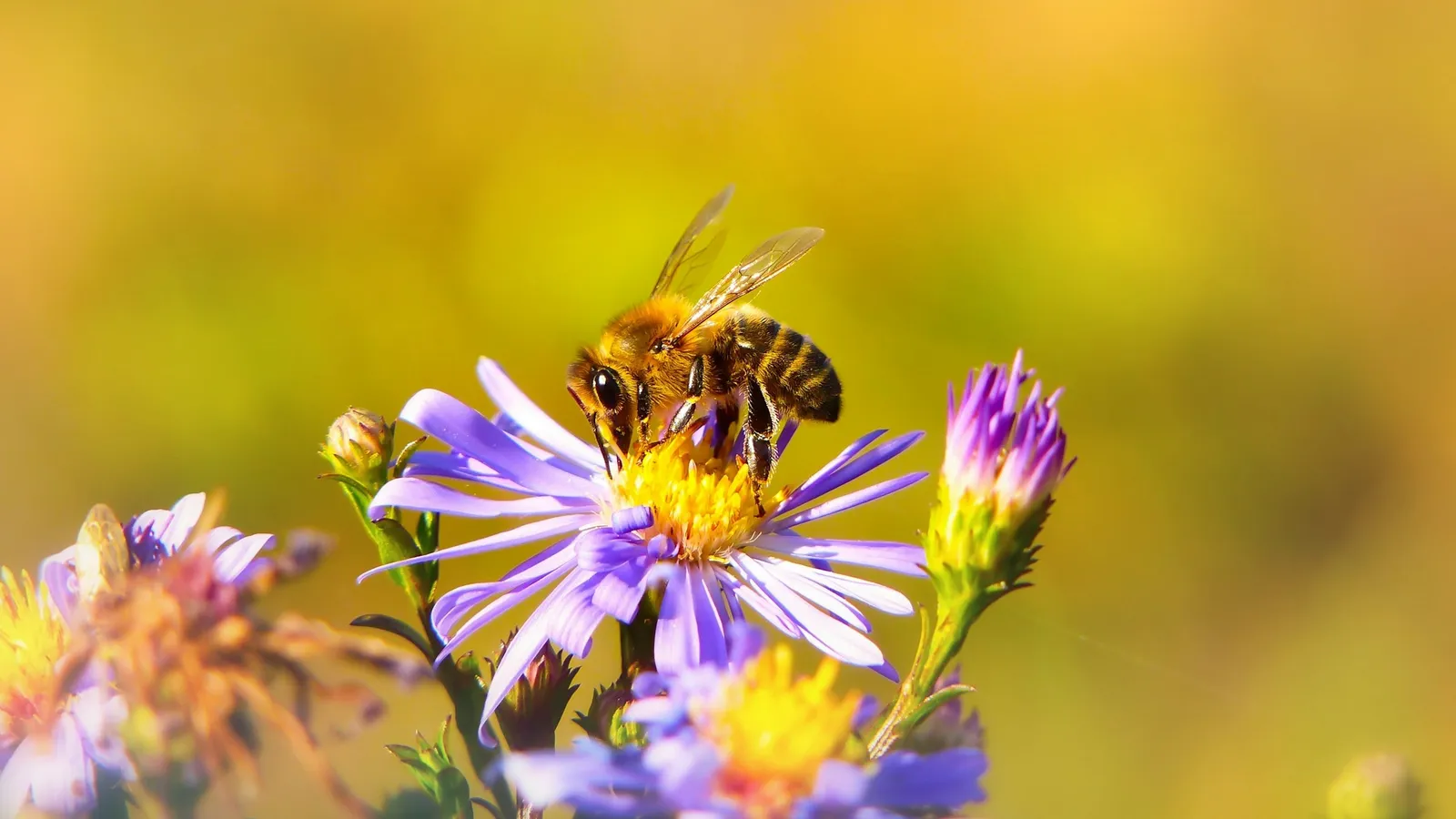
It then names three other relationships: mutualism (bee and flower both benefit), commensalism (an orchid on a tree benefits, the tree is unaffected) and parasitism (a tick benefits, the dog is harmed). It describes balance as "dynamic, not fixed". If you want the history of the word itself, our post on Arthur Tansley and the idea of the ecosystem tells it.
Worked example: counting a population
Activity 12.2 asks you to mark a 1 m × 1 m square in the school garden and count organisms. The book's own example has 20 of one plant and 5 of another in that square. Here is how to take it further with sample numbers for a whole garden:
Step 1. Count in several squares. Suppose four groups count one plant in four squares and find 20, 16, 24 and 20.
Step 2. Average. (20 + 16 + 24 + 20) ÷ 4 = 80 ÷ 4 = 20 plants per square metre.
Step 3. Scale up. If the garden bed is 6 m long and 4 m wide, its area is 6 × 4 = 24 m². Estimated population = 20 × 24 = 480 plants.
Step 4. Compare levels. Now suppose the same bed has an estimated 60 grasshoppers and 4 frogs. Arrange producers, herbivores and carnivores from largest number at the base to smallest at the top, as Activity 12.7 asks, and you get a pyramid: 480, then 60, then 4.
Step 5. Say what the numbers mean. Each level has fewer organisms than the one below, because each eater needs many of what it eats. Using several squares and averaging gives a fairer estimate than one square.
Which mistakes cost marks?
Mixing up population and community.
Leaving decomposers out of a food web question.
Drawing arrows from eater to food.
Calling an orchid on a tree a parasite. It is commensalism.
Writing that a balanced ecosystem never changes.
A practice routine
Explore two habitats, as Activity 12.1 suggests, and list biotic and abiotic components for each.
Draw a food web with at least eight organisms from a place you know, then add a decomposer.
Write one cascade. Pick a change, such as cutting trees near a stream, and write five linked effects.
Answer the end-of-chapter questions from memory and check them against the text.
If you go on to NEET-style biology later, our post on ecosystem productivity and decomposition builds on these ideas.
When a web of arrows gets confusing, Fermi's AI tutor writes on a board and draws the figure as it explains, checking understanding as it goes.
This weekend, mark out a 1 m square in a garden or park, count one kind of plant, and estimate how many grow in the whole patch.


