

On this page
Have you ever wondered how a security light knows to switch on exactly when you walk past, but ignores the wind blowing through the trees? It does not send out laser beams or radar. Instead, it "listens" for a specific kind of light that you are constantly shining into the dark.
These devices use a Passive Infrared (PIR) sensor. To understand how they see you, we first have to look at the physics of your own body heat.
Why does your body glow in the dark?
The wavelength of thermal radiation an object emits depends on its temperature. According to Wien's displacement law, the peak wavelength is inversely proportional to an object's absolute temperature: the hotter the object, the shorter the wavelength.
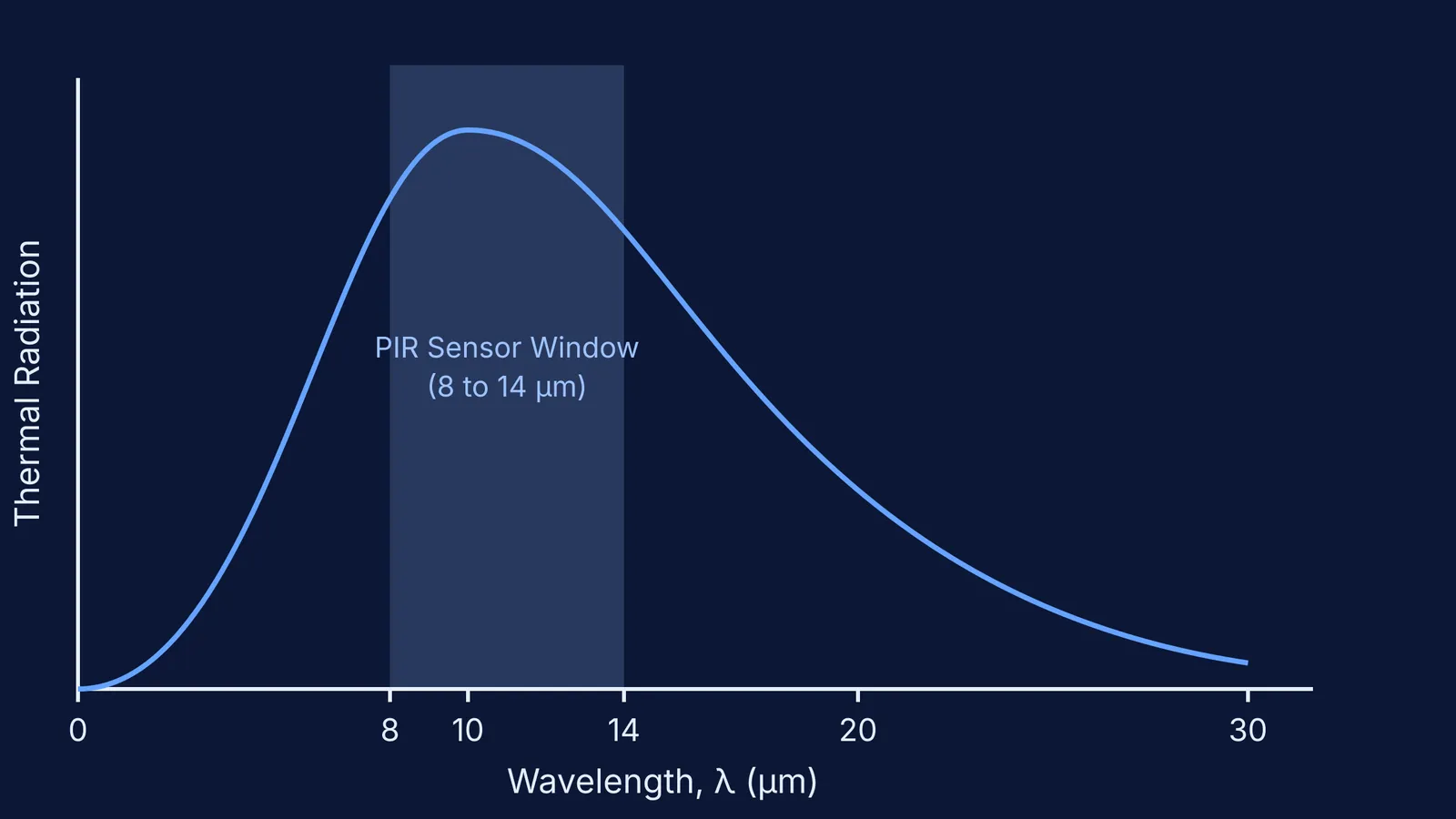
Mammals with a skin temperature of about 300 Kelvin (roughly 27°C) emit their peak thermal radiation at a wavelength of around 10 micrometers. This specific wavelength sits deep within the far infrared part of the electromagnetic spectrum. You cannot see it with your naked eyes because human vision is limited to wavelengths between 400 and 710 nanometers (0.4 to 0.71 micrometers). But to a sensor designed to detect it, you are glowing brightly. If you are curious about the relationship between a wave's physical wavelength and the energy it carries, you can see how to calculate it using the E = 1240/λ photon-energy formula.
How do passive infrared (PIR) sensors work?
The term "passive" means the PIR sensor does not emit any energy of its own for detection purposes. It simply waits to receive the infrared radiation emitted by or reflected from objects.
Inside the motion detector sits a pyroelectric sensor, which generates a small electric charge when exposed to changes in heat. However, if the sensor reacted to absolutely all heat sources, the security light would turn on every time the sun rose, a hot car drove past, or a gust of warm wind blew across the driveway.
To prevent this, the pyroelectric sensor is placed behind a special plastic window. This window acts as an optical filter, carefully engineered to only allow wavelengths between 8 and 14 micrometers to pass through. Because mammalian skin temperature peaks at around 10 micrometers, this window perfectly captures the human infrared signature. It effectively blinds the sensor to visible light, ultraviolet rays, and the much shorter infrared waves emitted by extremely hot objects like engine exhausts or fire.
Furthermore, the curved plastic cover on the outside of the device is not just for protection. It often contains a Fresnel lens. This multi-faceted lens focuses the incoming infrared radiation directly onto the small sensor element, extending its effective range to about 10 meters. The principles governing how these concentrated waves carry power apply across the entire spectrum, which you can explore in our guide on the energy density and intensity of an EM wave.
Why doesn't a hot room trigger the light?
Even with the infrared filter and the focusing lens, a sensor might still get confused if the ambient temperature of the whole driveway naturally rises on a warm summer evening. How does the device distinguish between a general temperature change and a person actually moving?
The secret lies in a differential design. The pyroelectric sensor inside is split into pairs of sensor elements, which are wired as opposite inputs to a differential amplifier.
When the environment slowly warms up or cools down, the paired elements receive the same amount of infrared radiation simultaneously. Because they are wired in opposition, their signals cancel each other out completely, leaving a net electrical signal of zero.
When a warm person walks into the field of view, their concentrated heat signature first hits one sensor element. This creates a sudden positive electrical pulse.
As the person continues to move forward, their heat signature leaves the first element and hits the second element, creating a sharp negative electrical pulse.
The light's internal electronics are programmed to look strictly for this specific, rapid complementary pulse or voltage swing. If the electronics see that characteristic wave, they know a warm body has just walked across the field of view, and they instantly switch the light on.
Visualising how differential signals cancel each other out can be tricky. If you want to build an intuition for how opposite charges and waves interact, the Fermi Simulation Lab lets you experiment with fields and potentials interactively. Seeing the math play out makes the concept much easier to grasp than reading a static explanation.
Where should you place a motion sensor?
To get the most reliable detection and avoid false alarms, use this simple placement checklist when installing a motion sensor:
Mount it sideways: Position the sensor so that people walk across its field of view, rather than directly toward it. The differential sensor needs a heat source to move from one zone to another to trigger the voltage swing.
Avoid heat vents: Do not point the sensor at heating vents or air conditioners. Temperature changes on the plastic window from moving air can trigger the sensor.
Mind the glass: Standard glass blocks long-wave infrared radiation. A PIR sensor cannot "see" you through a closed window, so always mount it outside.


