

On this page
We hear the words "million" and "billion" used interchangeably in the news, as if they are close neighbours on the number line. Human brains did not evolve to visualise numbers this large, making them difficult to grasp intuitively. For most of human history, counting only needed to go up to a few hundred. As a result, our intuition fails us when we encounter orders of magnitude that define the modern scientific world.
But when you convert these massive numbers into everyday time, the gap between them becomes impossible to ignore. A million is a large number, but a billion is a thousand times larger. The difference between them is the difference between a short holiday and a substantial chunk of a human lifespan.
How long is a million seconds?
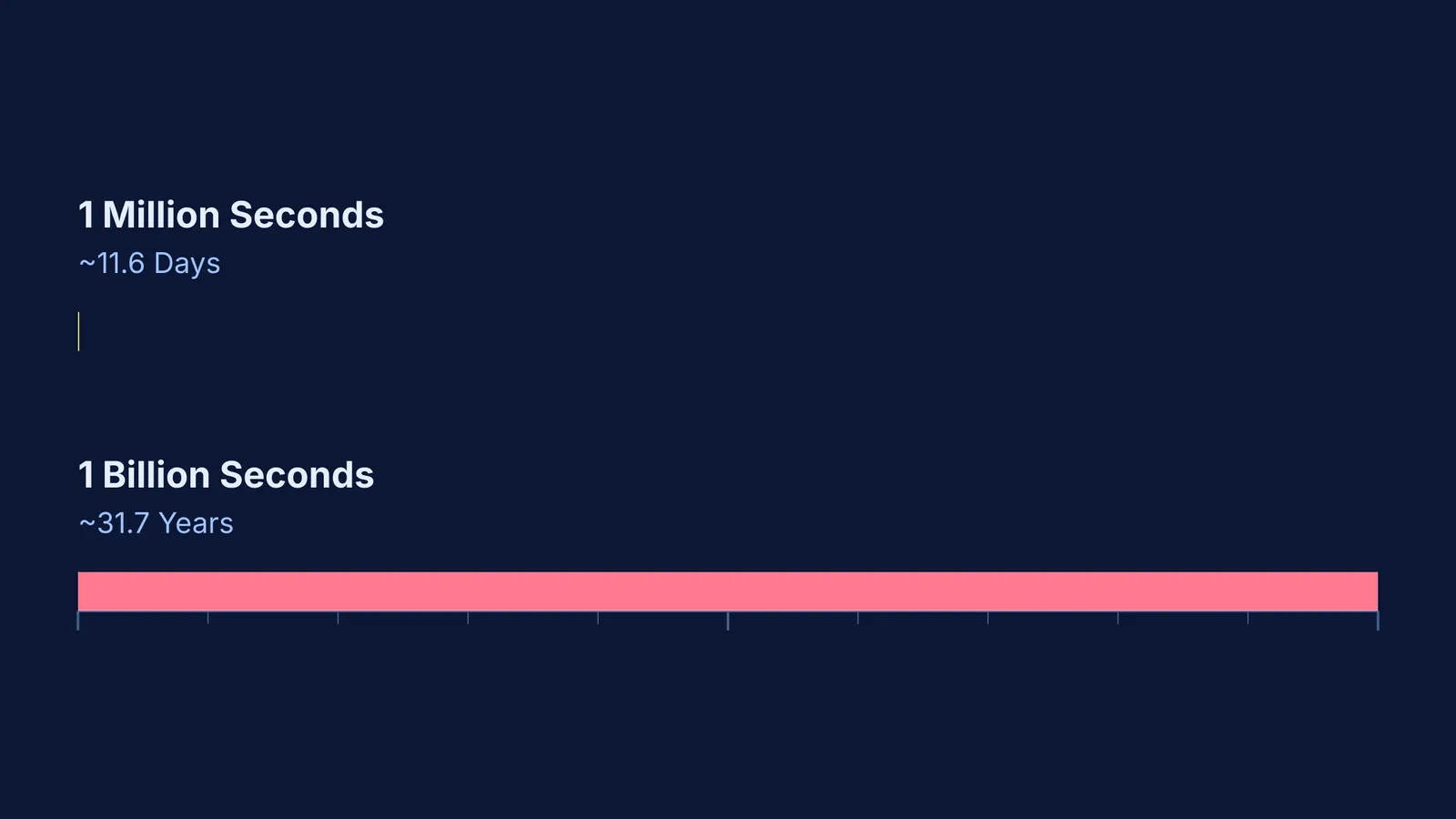
If you start a stopwatch and wait for one million seconds to tick by, you will be waiting for about 11.6 days.
To break that down exactly, there are 60 seconds in a minute, 60 minutes in an hour, and 24 hours in a day. Dividing 1,000,000 by those numbers leaves you with exactly 11 days, 13 hours, 46 minutes and 40 seconds, according to standard orders of magnitude for time.
This means that a million seconds ago, you were likely doing exactly the same routine you are doing today. It is less than two weeks—a very manageable unit of time that we experience dozens of times each year.
How long is a billion seconds?
A billion is a thousand millions. If a million seconds is a short break, a billion seconds is an entire career. Wait one billion seconds, and approximately 31.7 years will pass.
If you celebrated your birth on your first second, your billionth second would happen as you approach your 32nd birthday (specifically, over 31 years and 287 days). Your two-billionth second will arrive as you near your 63rd birthday. In fact, a typical human life expectancy of 79 years is roughly 2.5 billion seconds.
This dramatic jump highlights how powerful multiplying by 1,000 truly is. We often talk about millionaires and billionaires as if they are in a similar financial bracket, but the time equivalent reveals the staggering chasm between those two numbers.
Why estimating with large numbers matters
In physics and chemistry, powers of ten are everywhere. From calculating the mass of an electron to measuring the distance between stars, knowing how to handle these numbers without a calculator saves crucial time and prevents major errors in complex calculations.
When scientists study the universe, they rely on estimation to check their work. For example, Jean Perrin and the proof that atoms exist, grain by grain involved working with the Avogadro number—a value vastly larger than a mere billion. Developing an intuition for scale helps you check whether your final answer makes physical sense, which is just as important as converting a quantity between unit systems using dimensions.
Understanding the relative sizes of these numbers builds a mental map that is essential for advanced science. When a problem asks for the time it takes light to travel across a microscopic distance, expecting a tiny decimal helps you spot arithmetic mistakes immediately. Conversely, when calculating the energy output of a star, you should naturally expect an answer with many trailing zeros. Getting a feel for these scales is what separates rote memorization from true mathematical fluency.
If you find yourself lost in a sea of zeros during a physics or chemistry problem, the Fermi Concept Library holds interactive lessons on scientific notation and orders of magnitude, showing exactly how each concept fits into the wider mathematical map.
A framework for converting large numbers
You can calculate these conversions yourself using a simple step-by-step framework. Here is how to estimate the length of a trillion seconds (a thousand billions):
Start with your base conversion: You already know that a billion seconds is about 31.7 years.
Identify the multiplier: A trillion is a thousand times larger than a billion.
Multiply the time: Multiply 31.7 years by 1,000.
Find the result: A trillion seconds is 31,700 years (or more precisely, 31,688 years).
This simple scaling trick works for any problem involving powers of ten, allowing you to bypass tedious division and arrive at the right scale instantly. By anchoring these vast mathematical concepts to tangible human timeframes, you build an intuition that will serve you throughout any scientific career.


