

On this page
Have you ever wondered what is actually happening when you squeeze a slice of lemon into a pan of hot milk? In an instant, the smooth liquid separates into solid white curds and a watery liquid. This everyday kitchen technique is a live demonstration of physical chemistry, driven by the relationship between proteins, acidity, and electrical charges.
What is inside the milk?
To understand why milk curdles, you have to look closely at what it is made of. Cow's milk is a complex emulsion containing water, fats, carbohydrates, and proteins. The protein content is divided into two main types: casein and whey. According to standard reference data, casein comprises about 80% of the proteins in cow's milk.
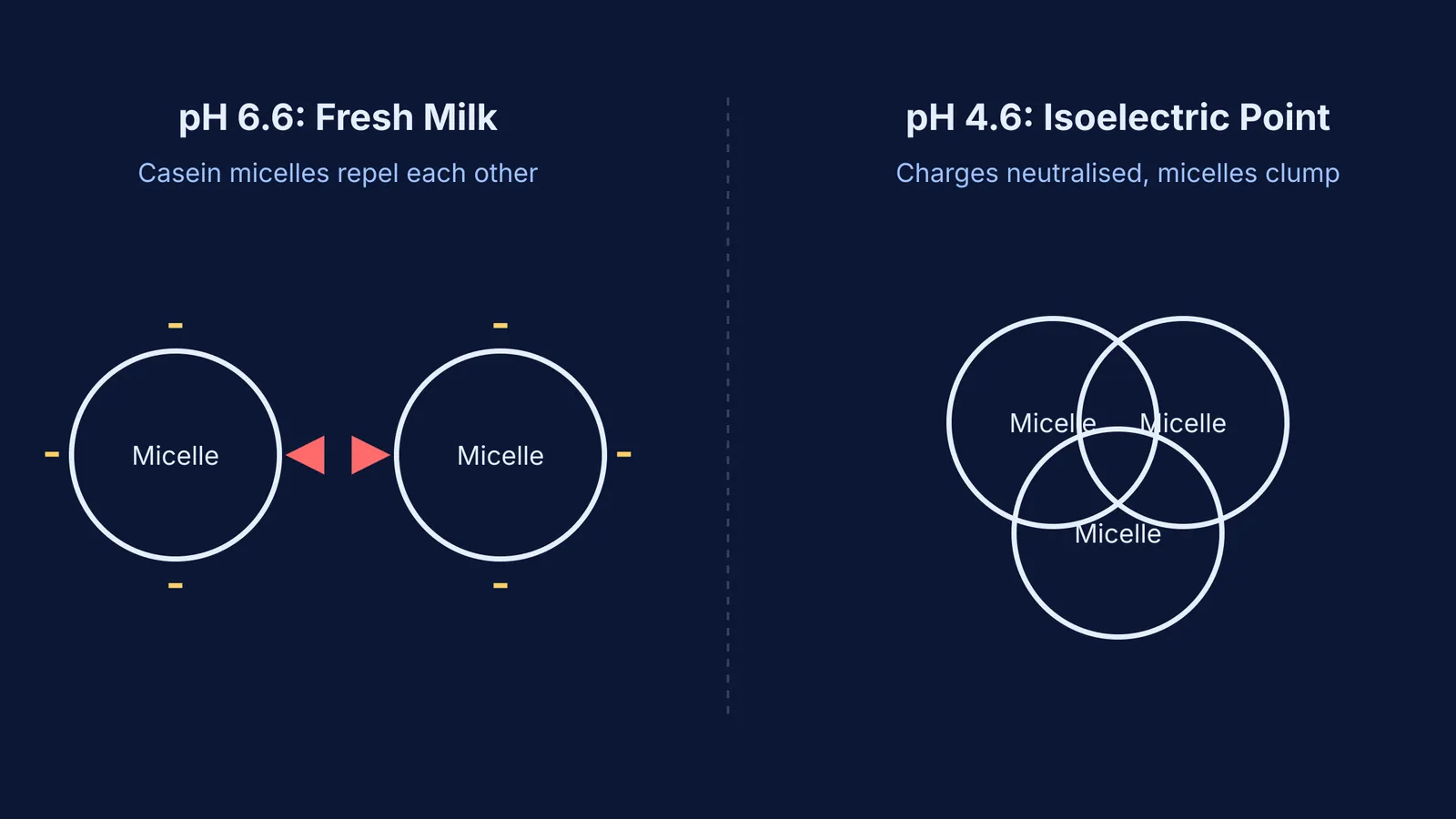
In fresh milk, which has a natural pH of approximately 6.6, these casein proteins group together into large, spherical clusters called micelles. These micelles are held together by tiny clusters of calcium phosphate. Importantly, the outer layer of these micelles carries a net negative electrical charge. Just like two magnets with the same pole pushing away from one another, this negative charge causes the micelles to repel each other. This constant electrostatic repulsion keeps the casein evenly suspended throughout the liquid, preventing it from settling at the bottom or clumping together.
Why does lemon juice make the milk separate?
Lemon juice contains high amounts of citric acid. When you pour it into the milk, you introduce a large number of positively charged hydrogen ions (H⁺) into the liquid. These positive ions immediately begin to attach to the negatively charged surfaces of the casein micelles, effectively neutralising them.
As you add more acid, the overall pH of the milk drops. Eventually, it reaches a pH of 4.6. This specific value is known as casein's isoelectric point. The isoelectric point is the exact pH where the net electrical charge of the protein molecule becomes zero.
Without the negative charges repelling them, the casein micelles crash into each other. Because the electrostatic barrier is gone, the molecules stick together when they collide. They rapidly form a solid, three-dimensional network that traps the milk fats within it, separating completely from the watery liquid known as whey. These solid, aggregated clumps are the curds we press into paneer.
Why do you need to heat the milk?
While the acid does the chemical work of neutralising the electrical charge, temperature plays a crucial role in determining the final texture of the paneer. If you add acid to cold milk, the casein will still coagulate, but it will form a very fine, mushy precipitate that is difficult to gather together.
Heating the milk to a near boil before adding the acid increases the kinetic energy of the molecules. This causes them to collide more rapidly and forcefully. More importantly, the high heat denatures, or unwinds, the whey proteins. Once denatured, these whey proteins bind to the outside of the casein micelles, participating in the network and creating a much firmer, more cohesive curd.
Visualising the chemistry
This entire kitchen process is a perfect real-world example of how molecules interact based on their electrical charge. If you find it hard to picture how ions, proteins, and the pH of an acid influence each other in a solution, the Fermi Simulation Lab provides interactive models. You can add an acid to a virtual solution and watch the electrostatic forces change in real time, making the abstract concepts of repulsion and coagulation easy to see.
Next time you are in the kitchen, you can even use standard tests for carbohydrates, fats and proteins on the leftover whey to see exactly what remains after the casein has been removed.


