

On this page
Everyone has squeezed a drop of white glue onto paper or wood and waited for it to dry. But how does a milky liquid turn into a bond that can be stronger than the material it holds together?
The answer is a mix of physical entanglement and chemical attraction. At its core, white glue is an everyday demonstration of polymer chemistry and intermolecular forces in action.
What is inside a bottle of white glue?
Fevicol and similar white glues are primarily emulsions of polyvinyl acetate (PVA). According to research on wood binders (Kaboorani & Riedl, 2011), PVA is a synthetic polymer made of long, flexible molecular chains.
Inside the bottle, these long polymer chains do not stick to each other because they are suspended in a carrier fluid: water. The water acts as a spacer, keeping the PVA molecules separate and fluid so you can easily squeeze the glue out of the nozzle. Many commercial formulations also add polyvinyl alcohol (PVOH) to keep the emulsion stable and improve its bonding properties.
How does white glue stick things?
For PVA glue to work, you generally need to stick two porous surfaces together, such as wood, cardboard, or paper. The process happens in two distinct phases:
Wetting and penetration: When you apply the glue, the water allows the liquid to flow deeply into the microscopic pores, vessels, and irregularities of the wood.
Coalescence: As the water either evaporates into the air or is absorbed by the porous material, the PVA particles are forced closer together. Deprived of their water spacer, the individual polymer chains tangle and fuse into a continuous, tough plastic film.
This physical aspect of gluing is called mechanical interlocking. The hardened polymer film acts like countless microscopic roots anchoring themselves into the wood's structure.
What is the chemistry behind the bond?
While mechanical interlocking provides a strong physical grip, the true strength of the bond comes from chemistry.
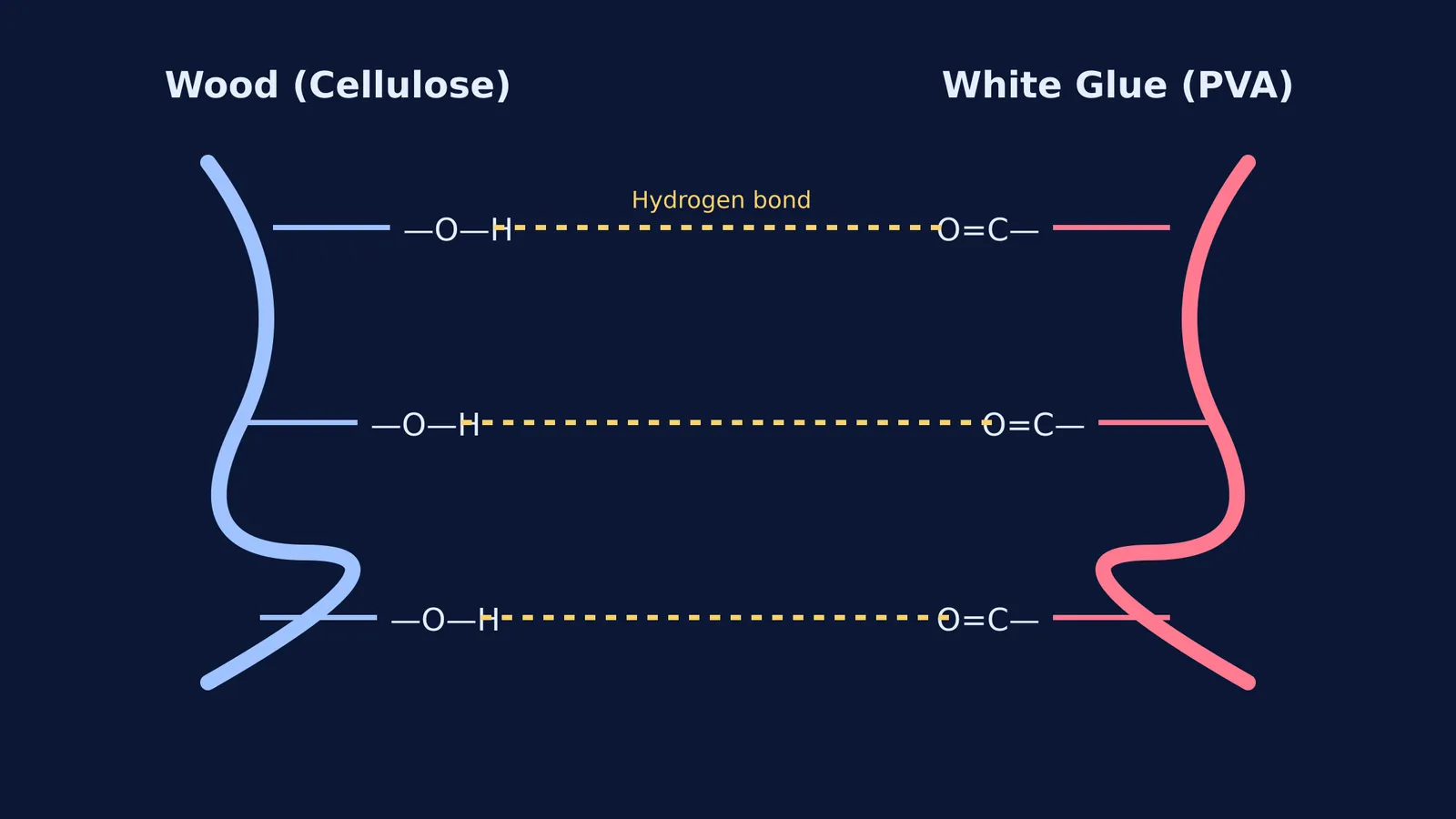
Wood and paper are primarily made of cellulose. Cellulose is a complex carbohydrate whose molecular chains are covered in hydroxyl (–OH) groups. Meanwhile, the PVA polymer chains contain carbonyl groups (C=O), and the stabilizing PVOH contains its own hydroxyl groups.
As the water leaves the joint, the polymer chains align with the cellulose fibers. The oxygen and hydrogen atoms from the glue form strong hydrogen bonds with the hydroxyl groups on the surface of the wood. This intermolecular attraction essentially knits the adhesive and the wood into a single cohesive unit at the molecular level.
Water is not merely a passive carrier in this process. As it soaks into the wood, it slightly swells the cellulose fibers, opening up the microscopic pores and increasing the surface area available for bonding. Furthermore, water facilitates the mobility of the PVA polymer chains, allowing them to twist and orient their polar groups toward the wood for maximum hydrogen bonding before the glue completely sets.
If you find it hard to picture how molecules align and bind, the Fermi Simulation Lab lets you watch how intermolecular forces act as molecules approach each other. Understanding these interactions is central to mastering organic chemistry topics like intramolecular hydrogen bonding.
Why doesn't the glue stick inside the bottle?
The entire curing process depends on the water having a place to go. Inside a tightly sealed bottle, evaporation is blocked. The air inside is saturated, and the water cannot escape the mixture, so the polymer chains remain safely separated in their liquid state.
This is also why white glue struggles to stick two pieces of non-porous plastic or glass together. Without a porous surface to absorb the water or let it evaporate, the emulsion cannot dry properly, and the vital hydrogen bonds never form.
For students preparing for JEE Main or NEET-UG, polyvinyl acetate is a classic example of an addition polymer, formed by the polymerization of vinyl acetate monomers. Recognizing how its functional groups interact with biological polymers like cellulose helps bridge the gap between abstract textbook chemistry and the materials we use every day.
If you feel overwhelmed by how concepts like polymers, hydrogen bonding, and evaporation fit together, Fermi's AI tutor can work out what you already know and build a plan for the session, so you sit down to a clear next step. You can also explore how similar everyday chemistry works, like how soaps clean using micelles.


