

On this page
Have you ever wondered how a toll barrier opens automatically as your car approaches, without you needing to tap a smart card, connect to Bluetooth, or change a battery? The FASTag system in India relies on Radio Frequency Identification (RFID) to quickly identify vehicles in motion. Its widespread adoption has changed highway travel; by the 2021-22 financial year, ₹33,274 crore was collected via FASTag, making thousands of toll plazas largely cashless and paperless (Wikipedia).
The physics behind this everyday convenience is a beautiful, real-world application of electromagnetic waves and energy harvesting.
What is the technology behind FASTag?
Every FASTag affixed to a vehicle’s windshield contains a microscopic silicon chip and a labyrinthine metallic antenna. It is termed a "passive" RFID tag because it contains absolutely no internal power source. There is no battery to leak, drain, or replace.
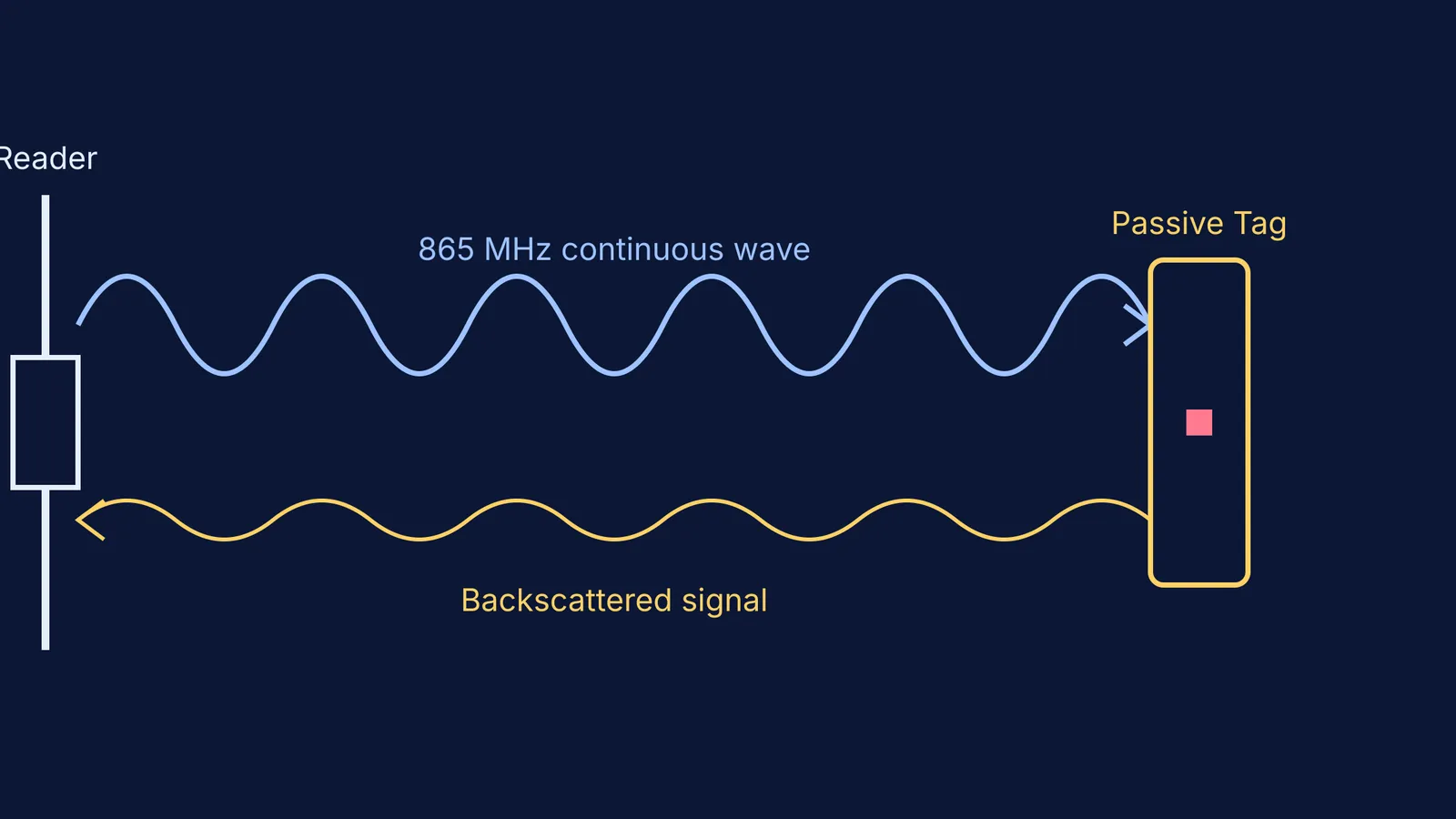
The toll plaza is equipped with a large active reader that constantly emits electromagnetic waves in the Ultra-High Frequency (UHF) range, primarily between 865 and 868 MHz (Wikipedia). These waves radiate outwards, carrying electromagnetic energy through the air. When your car drives into the 1 to 12-metre read zone, the tag's antenna intercepts a fraction of this radiating energy.
How does the tag work without a battery?
When the continuous UHF wave hits the tag, its rapidly oscillating electric and magnetic fields induce a tiny alternating current in the tag's metallic antenna. This is a practical example of Faraday's and Lenz's laws in action, where the moving fields of an electromagnetic wave are converted into electrical energy inside a conductor.
This induced alternating current travels to the microchip, where a rectifier circuit smooths it into a direct current (DC). This provides just enough voltage to "wake up" the silicon processor. Because the tag harvests its entire operating power directly from the reader's electromagnetic field, it is highly durable and can sit on a hot windshield for years without degrading.
What happens to the backscattered signal?
Once the microchip powers up, it needs to send its Electronic Product Code (EPC) back to the reader so the toll can be deducted. However, because it relies on harvested energy, it does not have the power to generate and broadcast a new radio wave. Instead, it uses a highly efficient technique called electromagnetic backscatter (Wikipedia).
To send its data, the chip rapidly turns a transistor on and off, which changes the electrical impedance of its antenna. This rapid switching alters exactly how much of the reader's incoming wave is absorbed by the tag and how much is reflected back into space. By modulating its reflection—much like rapidly flashing a mirror in the sunlight to send a Morse code message—the tag creates a coded signal out of the reader's own continuous wave.
If you find it hard to picture how changing impedance reflects a wave, Fermi Simulation Lab lets you interact with electromagnetic waves and see how boundaries, conductors, and antennas cause reflection and induction in real time.
The reader detects these subtle backscattered ripples amid its own powerful transmission. It decodes the changing amplitude of the reflection to read the EPC, verifies your account balance, and deducts the toll. The barrier opens, and you receive a text message, all in the fraction of a second it takes to drive under the scanner.
Why might a FASTag fail to scan?
Physics ultimately dictates when the passive tag will be read successfully. If your tag occasionally fails at the plaza and forces you to use the handheld scanner, you should check these physical factors:
Line of sight: Electromagnetic waves at these UHF frequencies are easily blocked by metal and heavily absorbed by water. Ensure the tag is placed in the clear area of the windshield, away from metallic sun-control films or thick metal pillars.
Orientation: The reader and tag antennas are often directionally polarised. Mounting the tag exactly horizontally in the centre of the windshield, as instructed by the issuer, ensures the antenna aligns with the reader's waves for maximum induction.
Interference: Stacking multiple RFID tags or placing your dashcam right next to the tag can electromagnetically detune the antenna, drastically reducing the energy it harvests. To prevent confusion, the "One Vehicle, One FASTag" rule enforced since February 2024 means you should only have your single active tag on the glass (Wikipedia).


