

On this page
Have you ever noticed a faint ring of red dots around a security camera at night, or heard a quiet "click" when the lights turn off? That is the camera switching from the visible light we rely on to the infrared spectrum.
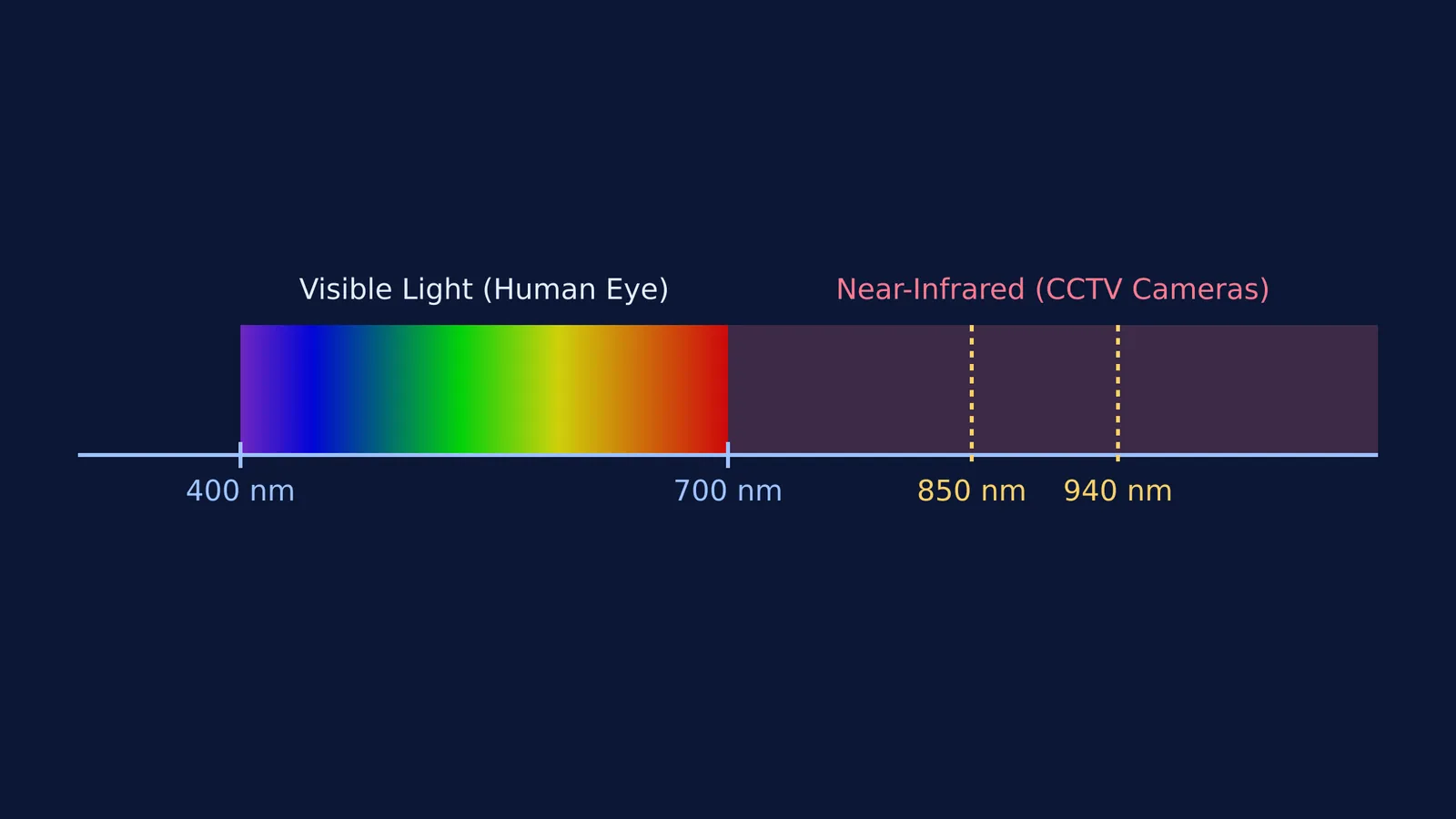
While human eyes need visible light—wavelengths from roughly 400 nm to 700 nm (Wikipedia)—to see anything, camera sensors are built differently. They can detect the near-infrared radiation that is completely invisible to us.
How do CCTV cameras see in the dark?
It comes down to three main components: an invisible flashlight, an image sensor that sees beyond human limits, and a mechanical switch.
During the day, a camera uses the sun's visible light to create a full-colour picture. But when ambient light drops below a certain threshold, a photocell triggers a ring of built-in infrared (IR) light-emitting diodes (LEDs) (Wikipedia).
These LEDs act as a spotlight that only the camera can see. The emitted light bounces off objects in the area and returns to the lens, much like a normal flashlight beam, but at wavelengths longer than the human eye can perceive. Because this illumination is generated by the camera itself, this technology is known as active infrared night vision.
What wavelengths do infrared LEDs use?
Most security cameras use IR LEDs that emit light at exactly 850 nanometres (nm) or 940 nm (Secuview). Both of these sit just past the red end of the electromagnetic spectrum.
850 nm LEDs: These are the most common because camera sensors are highly sensitive to this wavelength, giving them a long range. If you look straight at an 850 nm camera in the dark, you will see a faint red glow from the LEDs.
940 nm LEDs: These emit light further into the infrared band, making them genuinely invisible to the human eye. They are used for covert cameras where no red glow should be seen, though their effective range is shorter.
Why is CCTV footage black and white at night?
To produce a colour image, a sensor needs visible light—specifically red, green and blue wavelengths. Infrared light falls completely outside this colour range.
Because the sensor only measures the intensity of the reflected IR light (how bright or dark the reflection is), it drops colour processing entirely. Switching to monochrome (black and white) mode preserves the contrast and detail. Without this switch, the image would be a confusing mess of false colours as the sensor struggles to map infrared waves onto a visible colour palette.
The role of the IR-cut filter
If camera sensors are so good at seeing infrared, why do day-time images look normal? This is where the mechanical "click" comes in.
Sunlight contains a massive amount of infrared radiation. If a camera sensor captured this IR light during the day, it would ruin the picture—green grass might look white or purple, and black clothes might look grey. To stop this, cameras have an IR-cut filter: a small piece of glass that sits between the lens and the sensor to block infrared waves.
When the lights go out, a tiny motor slides the IR-cut filter out of the way. With the filter gone, the sensor is suddenly flooded with the infrared light generated by the camera's LEDs. When morning comes, the photocell detects the sunlight, the LEDs turn off, and the motor slides the filter back into place to restore accurate daylight colours.
Physics in the real world
Understanding how a camera manipulates light is a great example of applied physics. When you study the electromagnetic spectrum, it is easy to treat wavelengths as abstract numbers on a page. But knowing that an 850 nm wave is just long enough to evade the human eye while still triggering a silicon sensor connects the theory to something you can hold in your hand.
If you struggle to picture how lenses bend different wavelengths of light or how these sensors form images, the Fermi Simulation Lab has interactive simulations for the ideas that are easier to see than to read.
Study Checklist: The Electromagnetic Spectrum
When you revise the electromagnetic spectrum for your physics exams, use this framework to link theory to real devices:
Memorise the order of magnitude: Know the boundaries of visible light (roughly 400 nm to 700 nm).
Link bands to applications: Don't just learn "infrared is next to red"; remember that 850 nm to 940 nm is used by CCTV cameras and TV remotes.
Understand absorption and reflection: Different materials interact differently with various wavelengths. Glass is transparent to visible light but can act like a mirror to near-infrared light when close to the source.
Learn the sensors: The human eye relies on the retina, but artificial CMOS sensors detect a wider range of wavelengths, requiring filters to mimic human vision.


