

On this page
When you switch on a vacuum cleaner, it feels like the machine is actively pulling dirt from your floor. But in physics, there is no such thing as a "sucking" force. A vacuum cleaner relies entirely on a push—specifically, the push of the atmosphere around you.
The secret is a simple difference in air pressure. By creating a partial void inside the canister, the machine makes the room's air rush inside, dragging dust and debris along for the ride.
How does a vacuum cleaner create suction?
The process begins with an electric motor spinning a fan (or impeller) at high speed. The fan blades force air out through the exhaust port, leaving fewer air molecules behind inside the machine's body and hose.
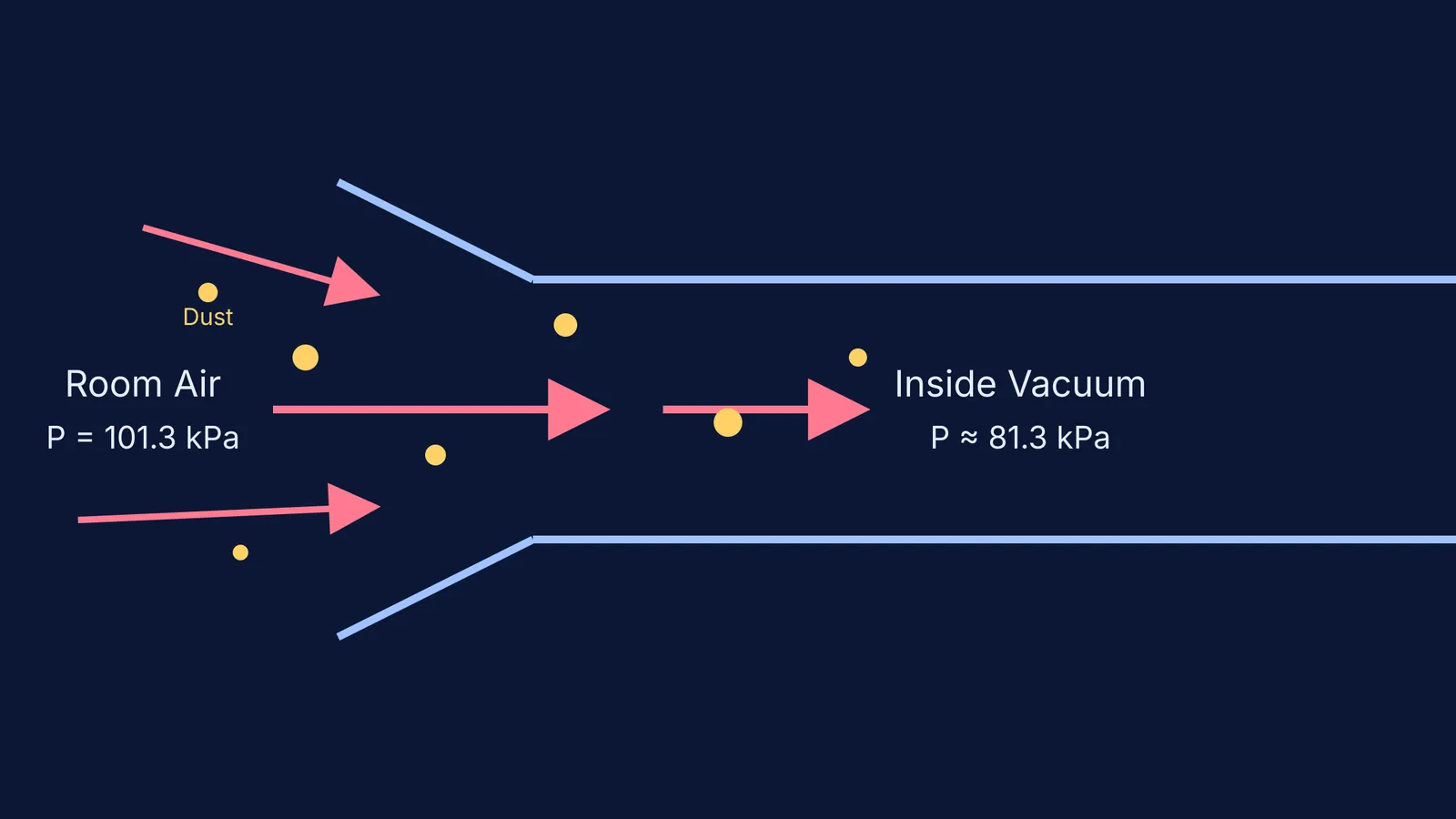
This drop in molecular density creates a low-pressure zone. A typical domestic vacuum cleaner lowers the pressure inside to about 20 kilopascals (kPa) below the surrounding atmosphere (Wikipedia), which normally sits at roughly 101.3 kPa.
Because air always moves from areas of high pressure to areas of low pressure, the normal air in your room rushes into the nozzle to balance the difference. If you have studied Pascal's law in hydraulic machines or Denis Papin and the pressure cooker of the 1600s, you know that a pressure difference across an area generates a powerful, very real force.
How does moving air lift the dust?
If the pressure difference creates the wind, how does the wind pick up the dirt? The answer is aerodynamic drag.
As the high-pressure room air rushes into the nozzle, it acts like a fast-flowing river. When this rushing air hits a resting dust particle, it exerts a friction force against the particle's surface. If the drag force from the moving air is stronger than the particle's weight and its adhesion to the carpet, the dust is swept into the airflow.
In fluid dynamics, the drag force on a tiny dust particle is directly proportional to the air's velocity. Double the air speed, and you double the force pushing the dust up the tube.
Why do narrow nozzles pick up heavier dirt?
If you want to pick up a heavy pebble or clean deep into a carpet, you attach a narrow crevice tool. Why does this make the vacuum feel stronger, even though the motor isn't spinning any faster?
The answer lies in the equation of continuity, a rule of physics which states that as a pipe gets narrower, the fluid passing through it must speed up to maintain the same flow rate. Because the nozzle's opening is small, the air must rush in much faster to fill the low-pressure zone inside.
This high-speed air creates a significantly higher aerodynamic drag force right at the nozzle tip, ripping heavier dirt out of the carpet fibres. If you struggle to visualise how narrowing a pipe forces a fluid to accelerate, the Fermi Simulation Lab lets you adjust nozzle widths and see the velocity vectors change in real time.
How do filters trap dust without stopping the air?
Once the fast-moving, dust-laden air enters the wide body of the vacuum cleaner, it slows down. But it must eventually exit back into the room.
Before it leaves, the air passes through a porous bag or a pleated filter. The filter is woven with tiny holes that are large enough for air molecules to pass through easily, but too small for the dust particles. The dust is caught in the trap, and the clean air flows out the exhaust.
However, if the filter becomes clogged with dust, it creates resistance. The fan struggles to push air out, which means the pressure inside the vacuum rises back toward normal room pressure. Without that crucial 20 kPa pressure difference, the outside air stops pushing into the nozzle, and the vacuum cleaner loses its power.


