

On this page
When you flip a wall switch, a tube light does not simply pass current through a filament to glow hot like an incandescent bulb. Instead, it relies on a two-step quantum process: converting electric current into ultraviolet radiation, and using a luminescent powder coating to down-convert those invisible rays into a balanced white glow.
Why does a tube light need mercury vapour?
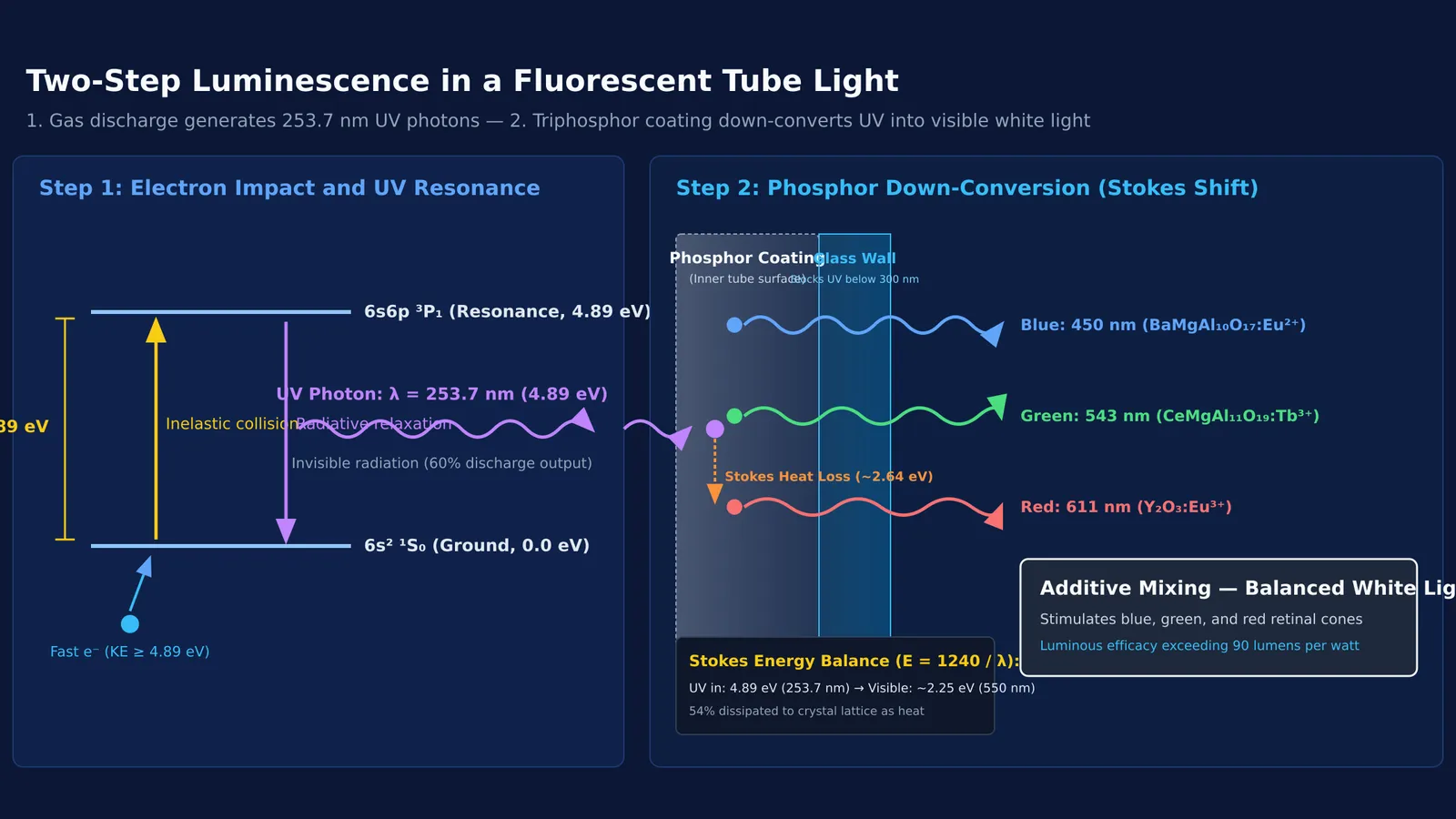
A standard fluorescent tube is a sealed glass envelope containing an inert buffer gas such as argon alongside a minute droplet of liquid mercury. When voltage is applied across tungsten cathode filaments at each end, thermionic emission releases electrons that accelerate down the tube under an electric field.
As these electrons collide inelastically with evaporated mercury atoms, they transfer kinetic energy to mercury's valence electrons. This collision process is the direct real-world application of Franck and Hertz's inelastic collision experiment. According to the NIST Atomic Spectra Database, mercury's ground state configuration is 6s² ¹S₀, with its primary resonance state at 6s6p ³P₁ (4.8865 eV above ground). When the excited mercury atom relaxes back to the ground state, it releases a single photon of ultraviolet radiation with an air wavelength of 253.7 nm.
In a low-pressure discharge, as detailed by C. R. Ronda, T. Jüstel, and H. Nikol00416-2), about 60% of electrical energy supplied to the positive column converts into this 253.7 nm emission, with another 2% at 184.9 nm. Because human vision only detects wavelengths between roughly 380 nm and 740 nm, this discharge remains completely invisible.
How does the phosphor coating convert UV into visible light?
To transform ultraviolet radiation into safe room lighting, the inner wall of the glass tube is coated with crystalline phosphors. As investigated since George Gabriel Stokes's 1852 Royal Society treatise on light, when a 253.7 nm photon strikes this coating, it is absorbed by activator dopant ions embedded within the crystal host lattice.
The absorbed energy promotes the activator ion to an excited state. Within picoseconds, non-radiative relaxation occurs: the crystal lattice vibrates, dissipating part of the absorbed energy as thermal phonons. When the electron drops back to its lower state, it emits a photon with less energy and a longer wavelength than the absorbed ultraviolet photon.
This down-conversion phenomenon is the Stokes shift. Ordinary soda-lime lamp glass absorbs wavelengths shorter than 300 nm, providing a safety barrier that blocks residual ultraviolet rays while letting converted visible light pass freely into the room.
For students who find atomic transitions and energy conversion easier to picture dynamically, the Fermi Simulation Lab provides interactive simulations for ideas that are easier to see than to read.
Which phosphors combine to create balanced white light?
White light is not a single wavelength but an additive mixture of colours that stimulates human retinal cones simultaneously. Just as the dispersion of white light through a prism separates sunlight into constituent spectral bands, lamp engineers combine specific phosphor emission bands to synthesize white illumination:
Calcium halophosphate phosphors: Discovered by Alfred H. McKeag and Peter W. Ranby and described in US Patent 2,488,733, commercial tubes used an apatite host lattice of Ca₅(PO₄)₃(F, Cl) co-doped with antimony (Sb³⁺) and manganese (Mn²⁺). Antimony absorbs 253.7 nm radiation and emits a broad blue band peaking at 480 nm, while transferring part of its excitation energy to manganese ions, which emit an orange-yellow band near 585 nm. Mixing complementary blue and yellow emissions yields economical cool or warm white light.
Narrow-band triphosphors: As documented in research by C. R. Ronda07065-2) and pioneered by J. M. P. J. Verstegen, modern high-efficiency tubes blend three rare-earth phosphors. Europium-activated barium magnesium aluminate (BaMgAl₁₀O₁₇:Eu²⁺) provides a blue peak near 450 nm, terbium-activated cerium magnesium aluminate (CeMgAl₁₁O₁₉:Tb³⁺) yields a sharp green peak near 543 nm, and europium-activated yttrium oxide (Y₂O₃:Eu³⁺) emits a red peak near 611 nm. Tuning these three narrow bands produces vivid white light with luminous efficacies exceeding 90 lumens per watt.
How do you calculate the photon energy and Stokes loss?
To evaluate fluorescent tube efficiency, we calculate the energy per photon using the photon energy relation E = 1240/λ, where photon energy E is in electron-volts (eV) and wavelength λ is in nanometres (nm). Detailed spectroscopic analyses compiled by C. R. Ronda, T. Jüstel, and H. Nikol00416-2) provide the operational numbers for this energy balance:
Ultraviolet excitation energy: At λ = 253.7 nm, each incoming ultraviolet photon carries E_uv = 1240 / 253.7 ≈ 4.89 eV of energy.
Emitted visible photon energy: A triphosphor white lamp produces visible light with an eye-sensitivity-weighted mean wavelength of approximately λ = 550 nm, corresponding to E_vis = 1240 / 550 ≈ 2.25 eV.
Stokes heat loss: The difference ΔE = 4.89 eV − 2.25 eV = 2.64 eV is surrendered to the phosphor lattice as vibrational heat. Over 53% of each ultraviolet photon's energy is lost during the down-conversion step alone.
Overall lamp efficiency: Multiplying the 60% electrical-to-UV discharge conversion by the 46% maximum Stokes energy ratio (2.25 eV / 4.89 eV) and accounting for an 85% to 90% phosphor quantum yield leaves an overall wall-plug luminous efficiency of approximately 25% to 28%.
The remaining 72% to 75% of electrical energy warms the room as thermal radiation, making fluorescent lamps four to five times more efficient than traditional incandescent bulbs, which convert less than 5% of their power into visible light.
When working through atomic structure problems or calculating energy conversions in a physics problem set, the Fermi Problem Library provides worked problems with a step-by-step solver that explains the reasoning rather than printing an answer.


