

On this page
When you tap an icon on your phone, the device does not feel the physical pressure of your finger. Instead, it senses your body's electricity.
The smooth glass on the front of your device hides a microscopic grid of electrical wires. Every time your finger approaches the screen, it alters an invisible electric field, and a dedicated chip pinpoints the exact coordinates of the disturbance in milliseconds.
What is underneath the glass?
Modern smartphones and tablets use a mutual capacitance touchscreen. Directly beneath the protective glass lies a transparent grid made of a material called indium tin oxide (ITO).
Most good conductors, like copper or aluminium, are highly reflective and opaque, which would block the light from the phone's display. ITO is a unique semiconductor alloy that conducts electricity well enough to carry the high-frequency signals but remains highly transparent to visible light, allowing the display underneath to shine through. You can explore why certain materials behave this way in our guide to energy bands in conductors and semiconductors.
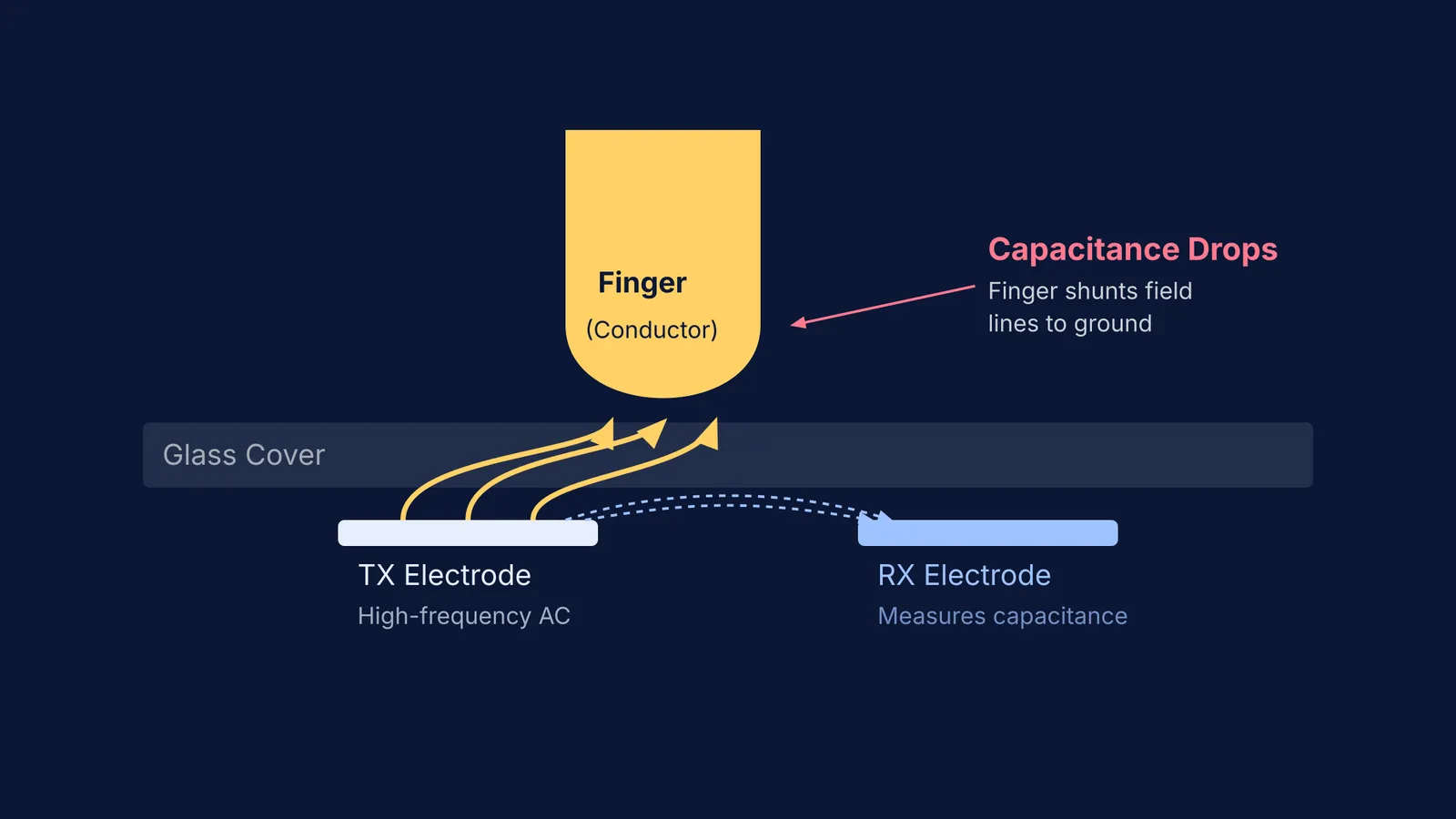
The grid consists of two sets of intersecting lines: transmit (TX) electrodes, which usually run in rows, and receive (RX) electrodes, which run in columns. The controller chip sends a high-frequency alternating current, such as 250 kHz, down the TX lines.
To understand why the grid is built this way, it helps to look at how a basic capacitor works. A capacitor consists of two conductive plates separated by an insulator, known as a dielectric. In the touchscreen, the TX and RX lines act as the plates, and the glass and air act as the dielectric. Because the TX and RX lines cross each other, an electric field forms at every intersection, creating a small baseline mutual capacitance. The electric field lines arch out from the TX electrode, pass through the glass, and land on the RX electrode.
How does the screen sense your finger?
The human body is largely made of salt water, making it a good electrical conductor. When your finger touches the glass, it enters the electric field created at the grid's intersections.
Because you are electrically grounded relative to the phone, your finger intercepts a portion of the electric field lines that would normally travel from the TX line to the RX line. It effectively shunts these field lines into your body. This diversion causes a measurable decrease in the mutual capacitance at that specific node.
The screen's controller constantly measures every node in the matrix. When it registers a sudden drop in capacitance, it records an (X, Y) coordinate. If you are preparing for competitive exams and need to visualise how charges and conductors interact in space, the Fermi Simulation Lab lets you experiment with electric fields dynamically to see these effects for yourself.
Why do gloves and plastic pens fail?
Your finger needs to be physically close to the electrodes to intercept the electric field. Winter gloves are made of insulating materials like wool or synthetic fibres. When you wear them, they keep your conductive skin too far away from the glass. The electric field lines cannot reach your finger to be shunted away, so the capacitance at the intersection remains unchanged and the screen ignores the touch.
To make gloves that work with touchscreens, manufacturers weave conductive threads, such as silver or copper, into the fingertips. These threads act as an extension of your body's conductivity, bridging the gap between your finger and the screen's electric field.
Similarly, a standard plastic pen will not register on the screen because plastic is an excellent insulator. Specialized capacitive styluses use a conductive rubber or metal tip connected to the user's hand through a metal barrel, ensuring the body's ground connection is maintained.
Worked example: how fast does the screen scan?
To ensure the phone feels instantly responsive, the controller must read the entire grid many times per second. Here is how the physics translates into the scanning speed of a device.
Consider a hypothetical smartphone screen with 30 transmit (TX) lines and 18 receive (RX) lines.
The total number of nodes (intersections) is 30 × 18 = 540 nodes.
If the phone has a touch sampling rate of 120 Hz [TODO: source for 120 Hz sampling rate], it reports the screen state 120 times every second.
The time allowed for one complete scan of the screen is 1 / 120 seconds, or roughly 8.33 milliseconds.
If the controller tests one TX line at a time (reading all 18 RX lines simultaneously for that row), it must perform 30 row scans in those 8.33 milliseconds. Time per TX line = 8.33 / 30 = 0.277 milliseconds (or 277 microseconds).
Within just 277 microseconds, the chip must send the high-frequency AC pulse, wait for the electric field to settle, measure the tiny capacitance on all 18 columns, and convert those analogue signals into digital data.
To master the physics behind these everyday devices, from calculating the capacitance of different shapes to understanding RC time constants in circuits, the Fermi Concept Library teaches the principles step by step, helping you understand the foundations before plugging numbers into a formula.


