

On this page
Your home's ceiling likely hides a neat application of both nuclear physics and optics. While they all serve the same purpose, the devices that protect us from fire do so by exploiting two entirely different physical principles: the ionisation of air by alpha particles, and the scattering of light.
Understanding how these sensors behave not only explains why your alarm triggers when you burn toast, but it also provides a real-world example of the physics and chemistry you study in school.
How does an ionisation smoke detector work?
Ionisation smoke detectors are highly sensitive to the tiny, invisible particles produced by fast-flaming fires. To detect these particles, the alarm relies on a steady flow of electricity through the air itself.
Inside the detector's chamber sits a minuscule amount of a synthetic radioactive element called Americium-241. A typical detector contains about 0.3 micrograms (or 1 microcurie) of this isotope. Americium-241 is a reliable alpha emitter. As it undergoes alpha decay, it fires heavy, fast-moving alpha particles into the surrounding air. Alpha particles are chosen because they have high ionising power but cannot penetrate even a sheet of paper, making them completely safe inside the plastic casing.
These alpha particles collide with oxygen and nitrogen molecules, knocking electrons free. This turns the neutral air molecules into positive ions and free electrons. Because the chamber contains two electrically charged plates—one positive and one negative—these charged particles drift towards the plates, creating a tiny, continuous electric current.
When smoke from a fire enters the chamber, the heavy smoke particles disrupt this delicate balance. The smoke particles attach themselves to the ions, either neutralising them or slowing them down so much that they cannot reach the plates. As a result, the electric current drops. The detector's circuitry senses this drop in current and triggers the alarm.
Because they respond to the smallest of combustion particles, ionisation alarms are excellent at catching fast-moving fires. However, they are also infamous for nuisance alarms. Small droplets of oil from frying or water vapour from a hot shower can mimic these tiny smoke particles, disrupting the current and setting off the siren.
How do photoelectric smoke detectors work?
Photoelectric (or optical) smoke detectors take an entirely different approach. Instead of a radioactive source, they use a light-emitting diode (LED) and a light-sensitive sensor (a photodiode). They are particularly good at catching smouldering fires—such as a cigarette burning on a couch—which produce larger smoke particles and can burn for hours before bursting into flame.
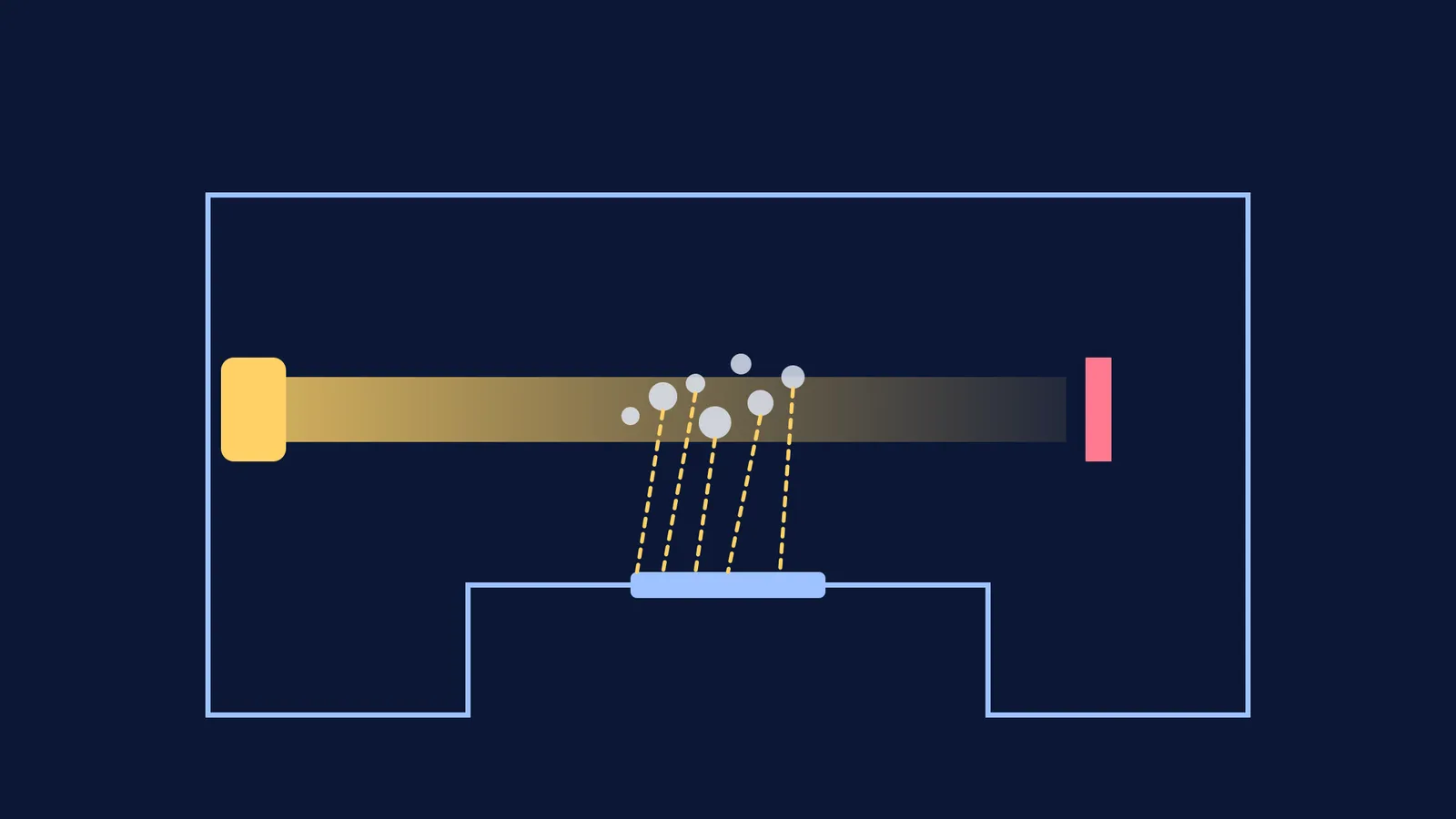
Inside a photoelectric detector's chamber, the LED shines a continuous beam of infrared light. Under normal conditions, this beam is pointed straight across the chamber and misses the sensor completely. The inside of the chamber is dark, and the sensor reads zero.
When smoke enters the chamber, the large smoke particles act like tiny mirrors. They scatter the light beam in all directions, similar to the way dust in the air scatters light in the Tyndall effect. Some of this scattered light bounces onto the photodiode. When the sensor detects a threshold amount of light, it completes the circuit and sounds the alarm.
If you struggle to picture how ions move in an electric field or how light scatters through a chamber, the Fermi Simulation Lab provides interactive simulations for the ideas that are easier to see than to read.
Which type is better for your home?
According to a study by the National Institute of Standards and Technology (NIST), escape times in modern home fires have shrunk drastically since the 1970s. Due to the widespread use of synthetic materials in modern furniture, occupants now have systematically shorter times to escape a flaming fire.
Because every second counts, and because it is impossible to predict whether a fire will smoulder or burst into flames rapidly, fire safety experts recommend having both types of protection. Relying on just one technology leaves a dangerous gap in your safety net.
By matching the physics of the detector to the layout of your home, you keep the nuisance alarms down and the real protection up. Modern building codes also demand that all alarms in a house are interconnected, meaning if a photoelectric sensor in the basement detects a slow-burning fire, the ionisation alarm in your bedroom will immediately wake you up.


