

On this page
The pole vault is a spectacular display of track and field athleticism, but it is also a pure demonstration of energy conversion. When you watch an athlete launch themselves six meters into the air, they are not relying on arm strength to lift their body weight. Instead, they are relying on physics.
So, how does a pole vault pole help athletes jump so high? The secret lies in a series of energy transformations, where the flexible pole acts as a temporary storage device to trade forward speed for vertical height.
How is energy converted in a pole vault?
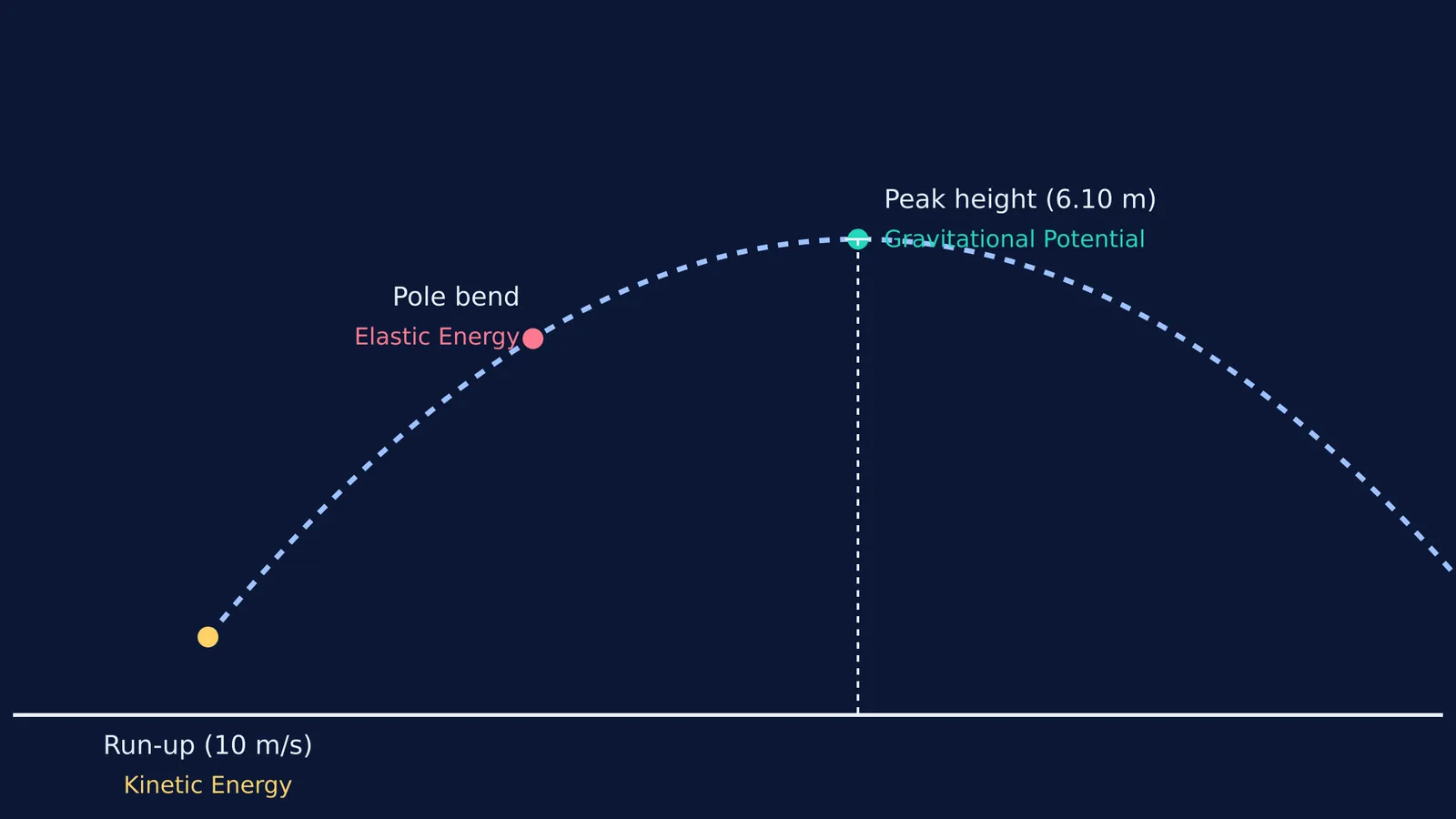
The entire vault is a textbook example of the conservation of energy. It happens in three distinct phases:
The Run-up (Kinetic Energy): The vault begins with a fast sprint. The athlete converts chemical energy from their muscles into kinetic energy. Because kinetic energy increases with the square of the speed (½mv²), running as fast as possible is the single most important factor for achieving a high vault.
The Plant (Elastic Potential Energy): When the athlete plants the pole into the take-off box, their forward momentum forces the pole to bend. The athlete’s kinetic energy is transferred into the modern fiberglass or carbon fiber pole, storing it as elastic potential energy.
The Lift (Gravitational Potential Energy): As the pole naturally recoils and straightens, it releases that stored energy. This "flings" the athlete upward, converting the elastic potential energy into gravitational potential energy (mgh).
This energy chain—from kinetic, to elastic potential, to gravitational potential—allows the athlete to reach heights far greater than a traditional vertical jump.
How high can you jump with a 10 m/s sprint?
We can calculate the theoretical height of a vault using a straightforward worked example. If we assume the ideal scenario where all kinetic energy is converted into gravitational potential energy, we set the two formulas equal to each other:
½mv² = mgh
Notice that the mass (m) appears on both sides, which means it cancels out. A heavier athlete has more kinetic energy, but they also require a proportional amount of energy to lift. The equation simplifies to:
h = v² / 2g
Let us run the numbers for an elite athlete sprinting at v = 10 m/s, using the gravitational constant g = 9.8 m/s²:
h = 10² / (2 × 9.8)
h = 100 / 19.6
h ≈ 5.10 meters
This calculation gives us the change in height. However, a running athlete's center of mass is already about 1.0 meter off the ground. Adding this initial height to the calculated lift gives a total center of mass height of 6.10 meters Real World Physics Problems.
Do you lose energy at the top of the vault?
In reality, a vaulter cannot convert 100% of their kinetic energy into height. During the plant, some kinetic energy is unavoidably lost when the pole collides with the back of the take-off box.
Furthermore, at the very top of the vault, the athlete must retain a small amount of horizontal velocity; otherwise, they would go straight up and fall right back down onto the bar. To safely cross over the bar and land on the mat, the vaulter needs a residual horizontal speed of about 1.0 m/s. According to the physics model, holding onto this final bit of speed only reduces the maximum potential height by about 5.0 cm Real World Physics Problems.
If visualising these invisible energy transfers feels difficult, interactive models can help. The Fermi Simulation Lab provides interactive simulations for the ideas that are easier to see than to read, so you can map out how an object's initial speed directly alters its peak height.
How do athletes clear the bar if their center of mass does not?
If an athlete running at 10 m/s can theoretically raise their center of mass to 6.10 meters, how do the best vaulters go higher?
Elite vaulters use their gymnastic ability to arch their bodies over the crossbar in a shape similar to a horseshoe. By draping their limbs downwards while their hips cross the bar, their actual center of mass remains lower than the bar itself. This technique allows them to successfully clear a bar even if their center of mass only reaches the height predicted by their sprint speed.
Finally, athletes do not simply hang onto the pole passively. During the swing phase, they actively pull and push off the pole, performing additional work to inject more energy into the system right before they release the pole.
*Related reading:*


