

On this page
When your phone is on silent, how does it physically grab your attention? The answer lies in exploiting unbalanced forces and resonance. Modern smartphones rely on one of two tiny machines to turn electrical energy into a physical buzz: an Eccentric Rotating Mass (ERM) or a Linear Resonant Actuator (LRA).
How does an ERM vibrate?
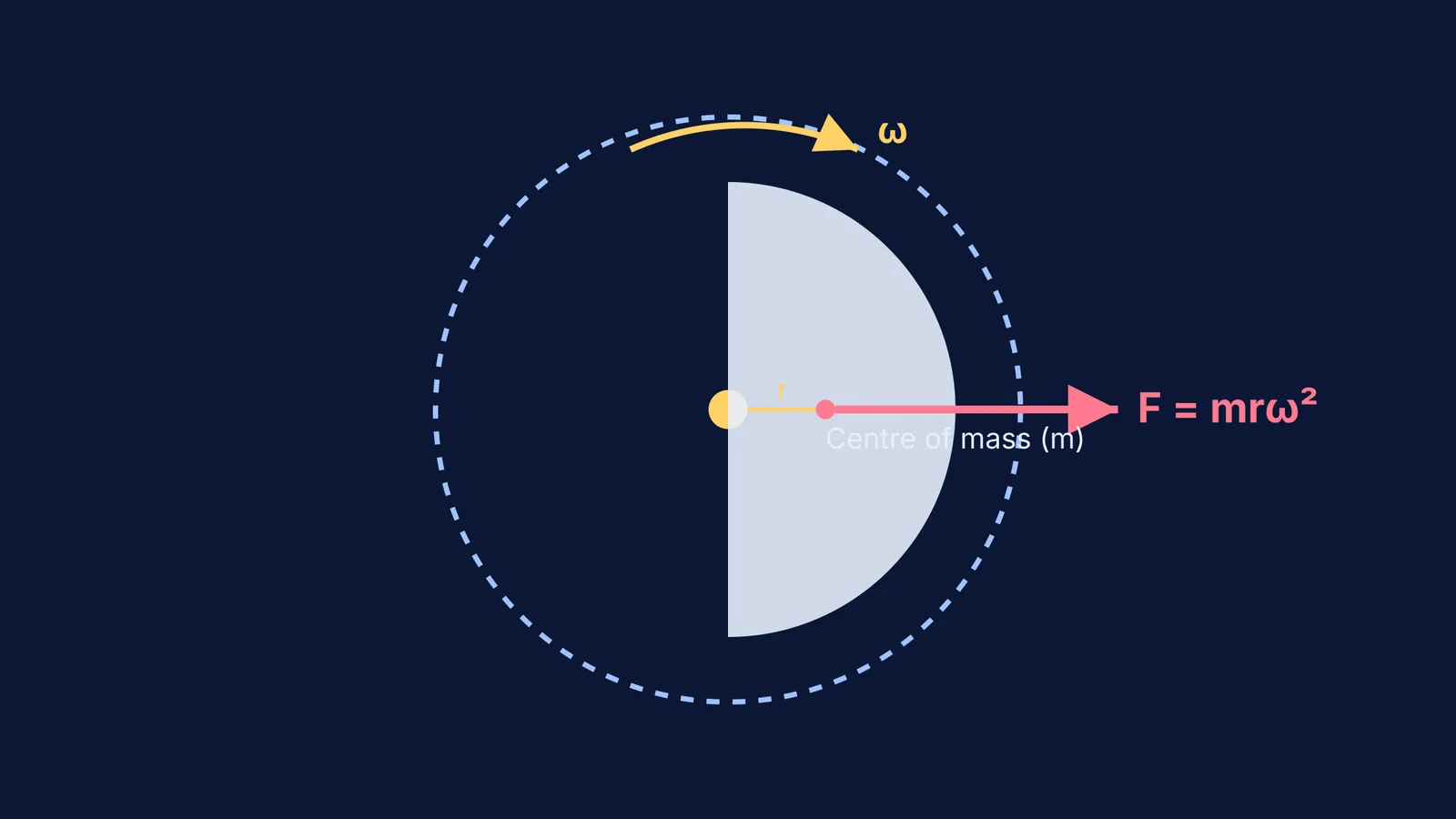
Older and budget-friendly phones typically use an Eccentric Rotating Mass (ERM) motor. If you crack one open, you will find a small DC motor with an off-centre weight attached to its shaft.
Because the mass is not balanced around the axis, spinning it generates a centripetal force that constantly changes direction. This rotating force vector pulls the motor—and the phone it is bolted to—in a rapid circle, which your hand feels as a rumble.
To understand the mechanics, you can calculate the unbalanced force using F = mrω² (where *m* is the mass, *r* is the distance from the axis, and *ω* is the angular velocity). If you are studying rotation, you will know that an offset force also creates a turning effect, though here the motor's rigid mount prevents it from twisting. You can explore how torque depends on the distance from the pivot in Torque as r × F: finding torque about a point with vectors. By continuously forcing the phone's centre of mass to shift, the motor turns electrical power into kinetic energy, vibrating the entire handset.
However, ERMs have a drawback: they take time to spin up to speed and slow down as they overcome inertia. That lag makes them feel "mushy." Furthermore, you cannot change their frequency without also changing their amplitude; feeding the motor more voltage simply makes it spin faster and hit harder.
How does a Linear Resonant Actuator work?
To mimic the crisp feel of a physical keyboard click on a flat pane of glass, engineers needed an actuator that could respond rapidly. The solution is the Linear Resonant Actuator (LRA), now standard in premium smartphones.
An LRA works much like a tiny loudspeaker. Instead of spinning a continuous weight, it suspends a magnetic mass on a precision-engineered spring inside a voice coil. When an alternating current (AC) is driven through the coil, it creates a flipping magnetic field that pushes and pulls the mass back and forth in a straight line. (To see how changing currents induce magnetic fields, read Faraday's law for a changing B: the circulating E inside a solenoid). Because the mass only travels along a single axis without having to rotate around a spindle, the system wastes far less energy on friction.
Because the mass moves linearly in a brushless design, an LRA can deliver advanced haptic effects and precise taps rather than just a prolonged buzz (Precision Microdrives). Without brushes to wear out, the only moving part is the spring itself, which gives the actuator a much longer lifespan before failing.
Why are LRAs tuned to a specific frequency?
An LRA is a spring-mass system, meaning it has a natural resonant frequency where it "wants" to oscillate (much like the pendulum in SHM through a tunnel across the Earth: period and speed at centre).
Most Y-axis LRAs in smartphones operate at a resonant frequency between 175 Hz and 235 Hz (Precision Microdrives). This is not an accident: human skin is most sensitive to vibrations in the 200–300 Hz range (Android Developers). By driving the AC signal at the exact resonant frequency, the LRA achieves maximum vibration strength while drawing minimal battery power. If you supply a frequency even slightly outside this optimal window, the amplitude drops, because the magnetic pushes are no longer perfectly timed with the natural bouncing rhythm of the spring.
Seeing the forces in action
Visualising how these unseen fields and rotating masses interact can be tricky when you are just reading about them. If you want to see how changing the offset mass alters the force, or how driving a spring at resonance causes the amplitude to spike, you can set up the variables in the Fermi Simulation Lab. Playing with the physical constants directly makes the maths behind the buzz much easier to picture.


