

On this page
When you climb three flights of stairs in an apartment block or at a metro station, your fitness app logs three flights almost immediately. Satellite GPS signals degrade inside concrete structures and cannot resolve minor vertical elevation changes indoors. Instead, your phone relies on a micro-electro-mechanical systems (MEMS) barometric pressure sensor soldered directly to its circuit board.
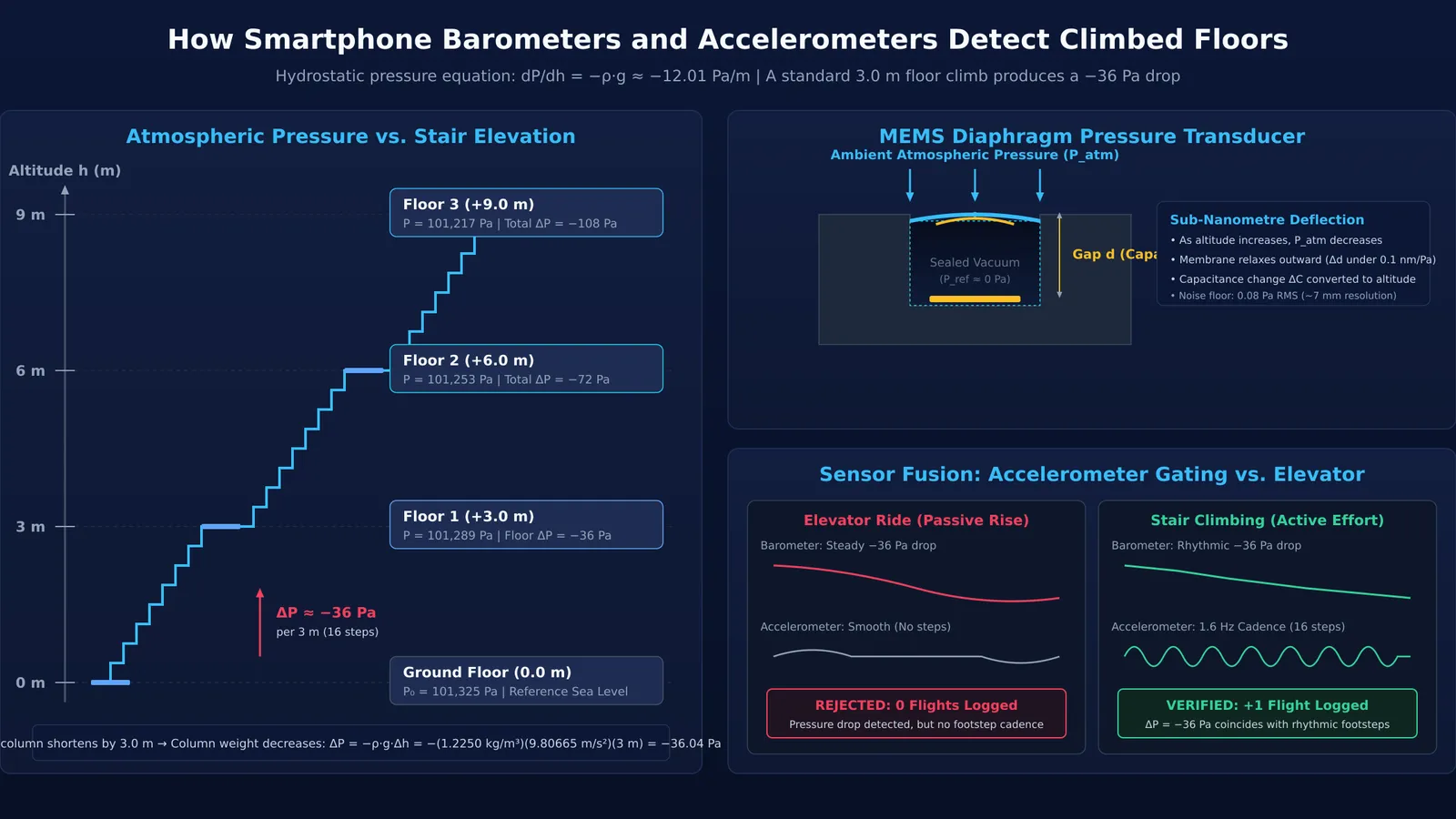
A modern smartphone barometer, such as the Bosch Sensortec BMP581 pressure sensor, is smaller than a sesame seed, measuring roughly 2.0 mm by 2.0 mm by 0.75 mm. Inside, a microscopic silicon membrane sits suspended over a vacuum-sealed reference cavity. As you climb stairs, the column of air above you shortens, ambient air pressure drops, and the membrane flexes slightly outward. Capacitive electrodes measure this deflection down to fractions of a nanometre, converting pressure changes into vertical displacement.
This sensor is the modern successor of Evangelista Torricelli's invention of the mercury barometer in 1643 and Blaise Pascal's mountain barometer experiments in 1648, which first proved that air has weight and that atmospheric pressure thins as you ascend.
Why does air pressure drop as you climb stairs?
In fluid mechanics, the pressure at any depth equals the weight of the fluid column pressing down from above. This principle underpins both liquid and atmospheric systems, as explored in hydrostatic pressure and fluid depth problems. In differential form, the hydrostatic equation states:
dP/dh = −ρ × g
Here, dP/dh is the rate of pressure change with vertical height h, ρ is air density, and g is the acceleration due to gravity.
According to the U.S. Standard Atmosphere, 1976 (NASA report), standard air density at sea level and 15 °C is ρ₀ = 1.2250 kg/m³, with standard gravity g₀ = 9.80665 m/s². Evaluating this product yields:
|dP/dh| = 1.2250 kg/m³ × 9.80665 m/s² ≈ 12.01 Pa/m
Because air density is nearly constant across a single building, air pressure drops by approximately 12 Pa (0.12 hectopascals) for every metre you climb.
Visualising invisible air columns and how pressure varies with height can be challenging from equations alone. For students building physical intuition, the Fermi Simulation Lab provides interactive simulations for ideas that are easier to see than to read.
How do you calculate the pressure change per floor?
In health tracking conventions and indoor positioning research, one flight of stairs is standardly defined as roughly 3.0 metres (10 feet) of elevation gain, which requires about 16 steps. To distinguish active steps from passive movement, fitness devices configure their motion sensors following routines such as Apple Support guidance on activity calibration.
Using the hydrostatic formula, we can calculate the exact pressure change for one standard flight:
Identify height gain: Δh = 3.0 m.
Apply standard sea-level density and gravity: ρ ≈ 1.225 kg/m³ and g ≈ 9.81 m/s².
Calculate the pressure drop:
ΔP = −ρ × g × Δh ΔP = −(1.225 kg/m³ × 9.80665 m/s² × 3.0 m) ≈ −36.04 Pa
A standard 3-metre climb produces a pressure drop of roughly 36 Pa (0.36 hPa). The Bosch Sensortec BMP581 pressure sensor features an RMS noise floor down to 0.08 Pa and a relative accuracy of ±6 Pa (about ±0.5 metres). Because 36 Pa is more than 400 times larger than the sensor's noise floor, your phone readily detects individual floors.
When working through hydrostatic calculations involving atmospheric columns and manometers, the Fermi Problem Library offers worked problems with a step-by-step solver that explains the reasoning rather than printing an answer.
How do phones tell stairs apart from elevators?
If a phone relied solely on air pressure, environmental fluctuations would cause erratic tracking. Research in *Sensors* by Hao Xia and co-authors showed that multi-sensor barometric processing filters out atmospheric fluctuations and drift (DOI: 10.3390/s150407857). Without multi-sensor validation, two common events would produce false counts:
Weather shifts: A passing low-pressure storm front can drop barometric pressure by 200 to 500 Pa over several hours, registering phantom flights while you sit still.
Elevators: Riding an elevator creates the exact same 36 Pa pressure drop per floor without physical effort.
Smartphones solve this using sensor fusion, combining the barometer with a 3-axis accelerometer. In a 2023 study in *IEEE Sensors Journal*, Harun Jamil and colleagues demonstrated that combining accelerometer and barometric data reliably classifies stair climbing while rejecting passive elevator rides (DOI: 10.1109/JSEN.2022.3228120).
Your phone validates four conditions before logging a flight:
Pressure drop: The barometer records a drop of roughly 35 to 40 Pa within a typical climbing window (5 to 25 seconds).
Stepping cadence: The accelerometer detects vertical impacts matching human stair cadence (1.2 to 2.2 steps per second).
Acceleration profile: Elevators show smooth acceleration and deceleration curves without rhythmic footsteps.
Drift rejection: High-pass filters discard gradual weather-induced pressure changes occurring across hours.


