

On this page
How does air from the bellows reach the reeds?
The sound of an Indian harmonium begins with its hand-operated bellows. The musician pumps an external bellows with one hand, drawing ambient air through one-way leather valves on the outward stroke and pushing it inward on the return stroke.
Inside the casing, this air enters a spring-loaded reservoir bellows. The reservoir stores pressurized air and smooths out the pumping strokes, supplying continuous airflow at steady pressure to the wind chest.
Pressing a key lifts a spring-loaded wooden valve called a pallet, padded with felt and leather. This uncovers an opening on the soundboard, directing pressurized air across a specific tuned reed. In our overview of displacement and pressure waves in sound, we explore how local pressure variations initiate acoustic waves in air.
Why does a vibrating reed chop airflow into sound?
A common misconception is that a brass reed generates sound by vibrating directly against open air like a loudspeaker cone. Because an individual reed has a surface area of only a few square centimetres, it radiates sound very weakly in open space.
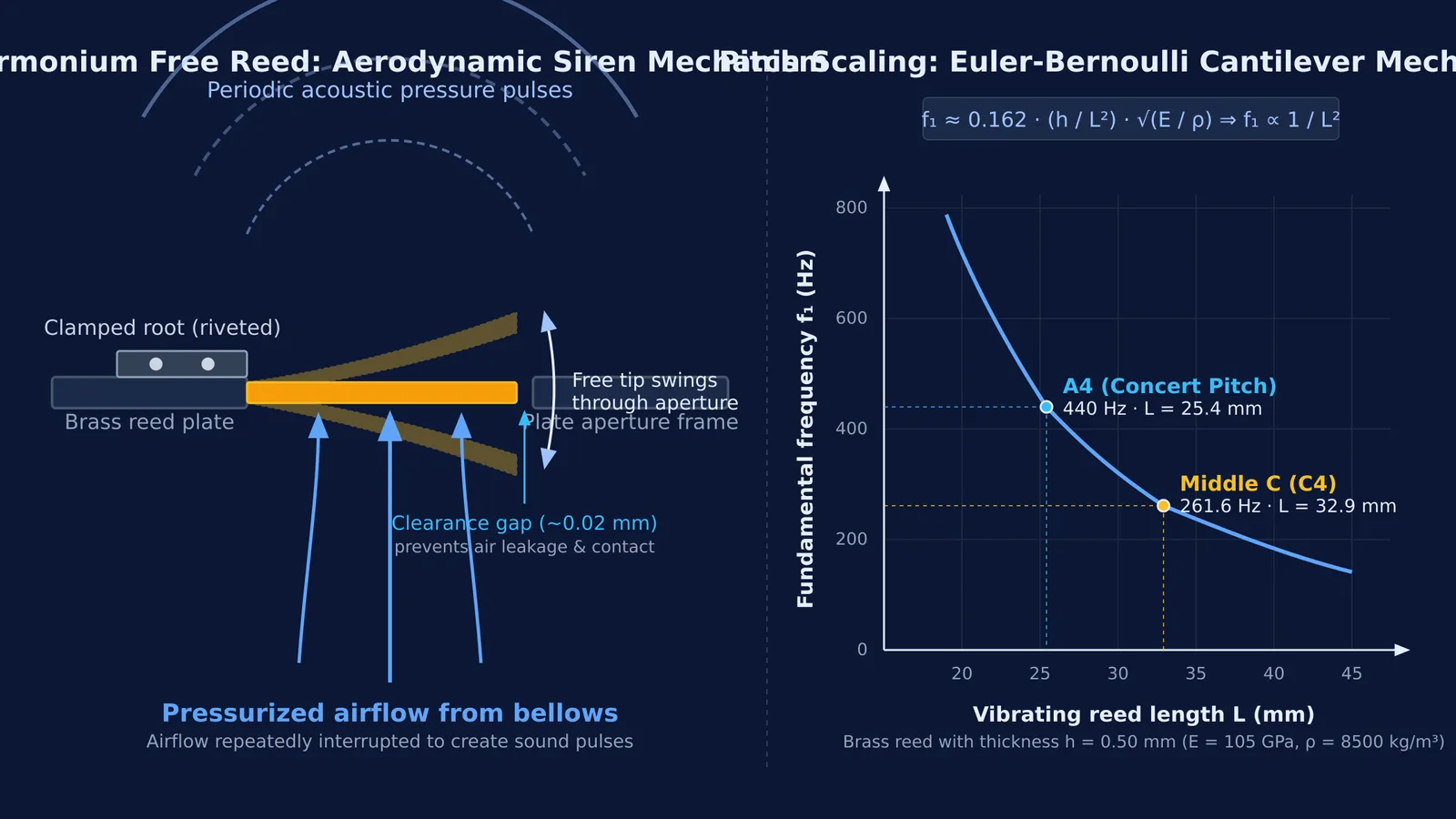
The harmonium instead operates as an aerodynamic siren. As physicist James P. Cottingham outlines in *Physics Today*, a thin brass tongue is riveted at one end over a rectangular opening in a brass plate. The harmonium reed swings freely through this opening with a boundary clearance typically around 0.02 mm (a few hundredths of a millimetre).
When pressurized air rushes through this narrow slit, air velocity rises and local pressure drops via the Bernoulli effect, drawing the flexible tongue into the slot. As the tongue enters, it blocks the escaping air. Pressure builds up behind the reed, while the metal's elastic restoring force pulls it back out.
In measurements published in *The Journal of the Acoustical Society of America*, Cottingham showed that aerodynamic feedback maintains self-sustained vibration while causing playing frequency to shift slightly with blowing pressure. Each vibrational cycle chops the air stream into a sudden puff. These periodic pressure pulses radiate as sound waves rich in harmonic overtones, giving the harmonium its characteristic buzzing timbre.
What determines the pitch and frequency of each note?
In the NCERT Class 8 Science syllabus, sound pitch is defined by frequency: the number of vibrations per second, measured in Hertz (Hz). Higher vibration frequencies create higher musical pitches.
Each reed functions as a uniform cantilever beam clamped at one end. In *The Physics of Musical Instruments*, Neville H. Fletcher and Thomas D. Rossing show that the fundamental frequency f₁ of an ideal cantilever reed follows the Euler-Bernoulli equation:
f₁ ≈ 0.162 × (h / L²) × √(E / ρ)
Here, h is reed thickness, L is vibrating length, E is Young's modulus, and ρ is material density. This relation reveals key acoustic principles:
Length squared relation: Frequency is inversely proportional to length squared (f ∝ 1/L²). Halving the length quadruples frequency (two octaves higher). Raising pitch by one octave (doubling frequency) requires shortening the vibrating length by a factor of √2 ≈ 1.414.
Thickness relation: A thicker reed (larger h) increases stiffness and raises pitch linearly.
Width independence: Tongue width cancels out because stiffness and mass scale equally with width.
Unlike a vibrating string whose frequency scales with 1/L, as seen in the sonometer experiment, a cantilever reed's 1/L² scaling lets a harmonium span over three octaves in a compact wooden case. For ideas that are hard to picture from text alone, the Fermi Simulation Lab provides interactive simulations for ideas that are easier to see than to read.
How do instrument makers tune harmonium reeds?
Because a harmonium lacks tuning pegs, craftsmen tune each brass reed by hand before assembly. Artisans selectively scrape metal from specific points along the tongue:
Sharpening the note: Filing metal off the free tip reduces moving mass where vibrational amplitude is greatest. Lowering inertia without altering root stiffness increases frequency, sharpening the pitch.
Flattening the note: Scraping metal near the clamped base thins the root. Because bending stiffness scales with thickness cubed (h³), thinning the base weakens the restoring force, lowering frequency.
To see this formula in action, consider brass with Young's modulus E = 105 × 10⁹ Pa and density ρ = 8500 kg/m³, giving √(E / ρ) ≈ 3514 m/s, sourced from *The Physics of Musical Instruments*. For a reed with thickness h = 0.50 mm (0.0005 m) tuned to concert pitch A4 at 440 Hz:
L = √[ (0.162 × 0.0005 m × 3514 m/s) / 440 s⁻¹ ] ≈ 0.0254 m = 25.4 mm
To produce middle C (C4, approximately 261.6 Hz) with the same brass thickness, length scales by √(440 / 261.6) ≈ 1.297, yielding a reed length of 32.9 mm. Our review of sound in Class 8 covers related frequency and pitch problems. When reviewing mechanical oscillations, the Fermi Concept Library covers every concept in physics with its own lesson and its place in the map.


