

On this page
A Cartesian diver is a classic science experiment that turns an ordinary plastic bottle into a miniature submarine. When you squeeze the bottle, the small object floating inside dives to the bottom; when you let go, it floats right back up to the surface.
Despite the name honouring the French philosopher René Descartes, the device was first described in print in a 1648 book by Raffaello Maggiotti, a student of Galileo. Maggiotti used the setup to demonstrate that water resists compression. Today, the diver remains one of the clearest ways to see how pressure, volume and density interact in a closed system.
How does a Cartesian diver in a bottle work?
The physical setup is straightforward. A small, hollow object (the diver) is placed inside a closed plastic bottle filled entirely with water. Inside the diver itself, there is a small trapped bubble of air. Before you squeeze the bottle, the air bubble provides enough lift so that the diver remains buoyant at the surface.
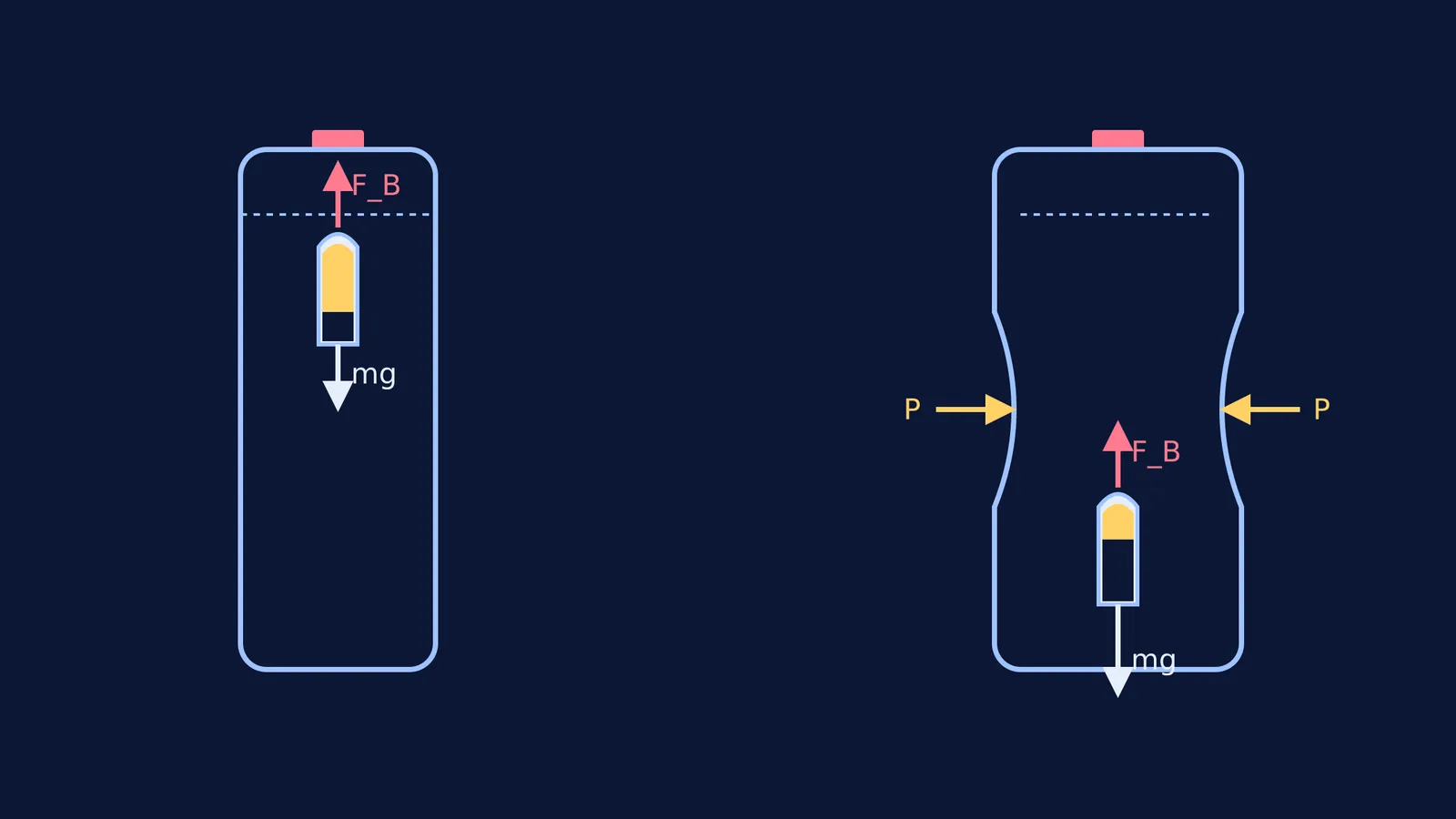
When you apply force to the outside of the bottle with your hands, the internal pressure increases. Pascal's law tells us that any pressure applied to an enclosed fluid is transmitted undiminished throughout that fluid. This means the water pushes against the trapped air bubble inside the diver from all sides simultaneously.
Because water is an incompressible liquid, the extra pressure forces the gas to shrink. This demonstrates Boyle's law: at a constant temperature, the volume of a gas is inversely proportional to its pressure. (For more on how gases behave without resistance, see the free expansion of an ideal gas). If you want to see these variables shift in real time, you can play with fluid mechanics and gas laws in the Fermi Simulation Lab.
Why does squeezing the bottle make it sink?
The secret to the diver's motion lies in the relationship between mass, volume and density. As the air bubble compresses under pressure, it takes up less space, allowing more water to flow into the diver through its opening at the bottom to fill the gap.
The overall volume of the diver's rigid outer shell has not changed, but the inside now contains more heavy water and less light air. This increases the total mass of the diver, which in turn increases its overall density.
Archimedes' principle states that the upward buoyant force on an object is equal to the weight of the fluid it displaces. When the diver takes on water, its average density becomes greater than the density of the surrounding water. At this tipping point, the downward pull of gravity overcomes the upward buoyant force, and the diver sinks.
When you release the squeeze, the pressure drops. The air bubble expands back to its original volume, pushing the excess water back out. The diver becomes less dense than the surrounding water and floats back to the top. According to a 2002 paper in the *American Journal of Physics*, the diver undergoes a "fold catastrophe", meaning that once you exceed a critical pressure threshold, it will sink irreversibly to the bottom until the pressure is released (AJP). The fold catastrophe mathematically describes how a small, smooth change in one parameter (the pressure from your hands) can lead to a sudden, discontinuous change in the system's state (the diver plunging to the bottom rather than settling halfway). This non-linear behaviour occurs because as the diver sinks, the hydrostatic pressure from the water above it increases, compressing the bubble even further and accelerating the descent.
Often, students can state these physical laws but struggle to apply them to a multi-step problem like a sinking object. Fermi's AI tutor can work out what you already know and build a plan for the session, guiding you through the reasoning step by step.
How do you make a Cartesian diver at home?
You do not need specialised laboratory equipment to test this yourself. Building your own diver helps you physically feel the exact pressure needed to overcome neutral buoyancy.
Find a bottle: Take a 2-litre plastic bottle and fill it to the very brim with water. Leaving no air at the top ensures that the force of your squeeze acts directly on the water, rather than wasting energy compressing an air gap near the cap.
Make the diver: Use a glass eyedropper or a plastic pipette. Draw up just enough water so that it barely floats when tested in an open glass of water. If you do not have a dropper, a sealed ketchup or soy sauce packet often works perfectly because they trap a tiny bit of air during manufacturing.
Seal and squeeze: Drop your diver into the 2-litre bottle and screw the cap on tightly. Squeeze the sides of the bottle firmly with both hands.
If you use a clear glass dropper, you can watch the water level rise inside it as you squeeze. This gives you direct visual proof of Boyle's law at work before the diver even begins its descent. If you want to create a more advanced diver, you can attach small paperclips to the bottom of the pipette to adjust its initial mass precisely. This fine-tuning allows you to create a diver that floats with almost zero buoyancy, meaning the slightest touch to the bottle will send it diving. Experimenting with different amounts of trapped air and added weight is an excellent way to practice balancing forces in a fluid.


