

On this page
When you study coordination compounds (like counting ionisable chlorides in Werner complexes) for chemistry exams, one of the first ways to classify them is by the variety of ligands surrounding the central metal atom. This distinction dictates the molecule's symmetry and directly affects how many isomers it can form.
What is a homoleptic complex?
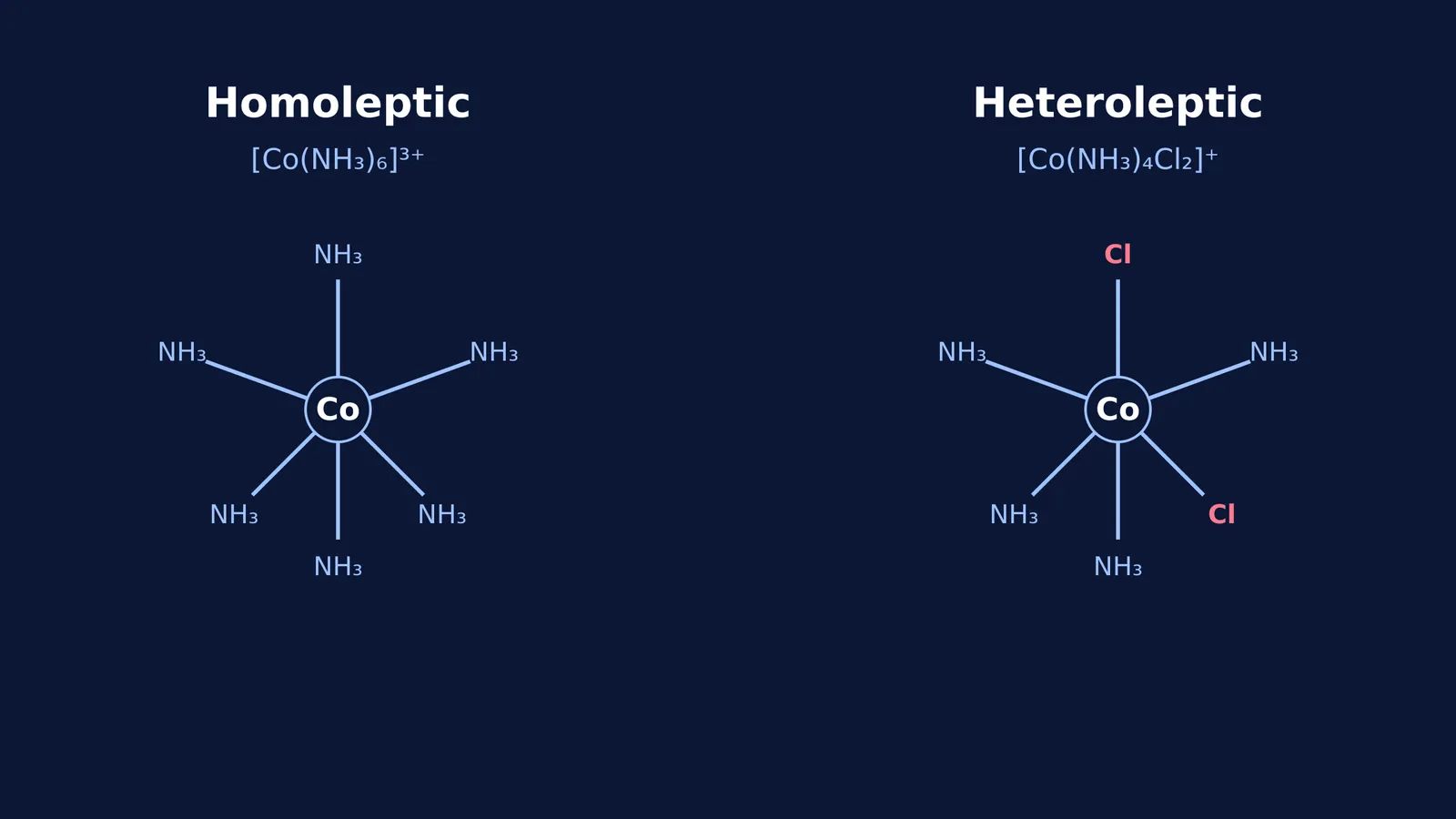
A homoleptic complex is a coordination compound where the central metal atom or ion is bound to only one type of ligand (Wikipedia). The prefix "homo-" means same, indicating that the chemical environment around the metal is completely uniform.
For example, in the hexaaquacobalt(II) ion, or [Co(H₂O)₆]²⁺, all six ligands are identical water molecules. Other common examples include the hexaamminecobalt(III) ion ([Co(NH₃)₆]³⁺) and the hexacyanidoferrate(II) ion ([Fe(CN)₆]⁴⁻). Because every position around the metal is occupied by the same group, homoleptic complexes tend to have high symmetry.
What is a heteroleptic complex?
A heteroleptic complex is a coordination compound bound to more than one type of ligand. The prefix "hetero-" means different, signalling a mixed environment around the central metal.
A classic example is cisplatin (PtCl₂(NH₃)₂), where the central platinum atom is coordinated to two chloride ions and two ammonia molecules. Another is the tetraamminedichloridocobalt(III) ion ([Co(NH₃)₄Cl₂]⁺). Adding variety to the ligands lowers the overall symmetry of the complex, much like the irregular shapes of interhalogen compounds, and opens up new structural possibilities.
How do they differ in isomerism?
The most important practical difference between these two types of complexes is their ability to form geometrical isomers.
Homoleptic complexes with simple monodentate ligands cannot form geometrical isomers. Because every position around the central metal is occupied by an identical ligand, swapping the positions of any two ligands produces the exact same molecule. They can only show stereoisomerism if they use complex, chelating ligands that create optical isomers, similar to how organic molecules count stereoisomers from chiral centres.
Heteroleptic complexes, however, frequently exhibit geometrical isomerism because their different ligands can be arranged in distinct spatial ways. In a square planar heteroleptic complex like PtCl₂(NH₃)₂, the two chloride ligands can sit next to each other (*cis*) or opposite each other (*trans*). In octahedral complexes with a 3:3 mix of ligands, such as [CoCl₃(NH₃)₃], they can form *facial* (*fac*) or *meridional* (*mer*) isomers.
Visualising these 3D isomers from a flat textbook page can be tough. If you need help seeing the difference, the Fermi Concept Library maps out every concept in chemistry. If you get stuck on isomerism problems, Fermi's AI tutor can work out what you already know, build a plan for the session, and teach you how to spot planes of symmetry.
Why does this distinction matter in reactions?
Beyond just structure, the homoleptic or heteroleptic nature of a complex changes how it behaves in chemical reactions. In a homoleptic complex, all metal-ligand bonds are typically of the same strength. If you perform a substitution reaction to replace a ligand, every position is equally likely to react.
In a heteroleptic complex, the metal-ligand bonds have different strengths depending on the nature of the ligands. Some ligands exert a stronger pull or push on the electrons in the complex (a phenomenon known as the trans effect). For instance, in square planar complexes, a strong ligand can make the ligand directly opposite to it leave much faster. This makes heteroleptic complexes incredibly useful for synthesising specific isomers in a controlled way, such as manufacturing the anti-cancer drug cisplatin without accidentally making its inactive *trans* form.
Can a homoleptic complex have optical isomers?
While homoleptic complexes with simple, single-point (monodentate) ligands cannot form geometric isomers, they can still show optical isomerism if they use chelating ligands. Chelating ligands attach to the central metal at two or more points.
If a homoleptic complex contains three bidentate ligands, they can wrap around the metal to form a propeller-like shape. Because a propeller can twist to the left or to the right, the resulting complex will have two non-superimposable mirror images. A classic example is the tris(ethylenediamine)cobalt(III) ion, [Co(en)₃]³⁺. Even though it is entirely homoleptic (containing only ethylenediamine ligands), its left-handed and right-handed forms are distinct optical isomers.


