On this page
Most science exams for school students are a single paper. The Dr Homi Bhabha Balvaidnyanik Competition, popular in Maharashtra and open to students elsewhere, is different: it moves from a written test to hands-on experiments, an interview and a small research project. That makes it a good first taste of how scientists actually work. This post explains each stage for students in Class 6 and 9 and their parents.
Who runs the competition and who can take part?
The competition is conducted by the Greater Bombay Science Teachers' Association (GBSTA), which says on its competition page that it has run it since 1981. Key points from that page:
Only students in Class 6 and Class 9 can take part.
All boards are welcome: Maharashtra State Board, CBSE, ICSE, IB and other state boards.
The medium is English or Marathi. Semi-English students choose one, and it stays the same for every stage.
Students outside Maharashtra can take part; GBSTA's 2026-27 pamphlet says that if more than 100 students register from a school's home state, a centre is given there, otherwise students choose a city in Maharashtra.
Registration is online through a school or individually. GBSTA says registration through private classes is strictly prohibited.
What does the written test cover?
Stage 1 is 100 multiple-choice questions on science and general knowledge in science, marked out of 100, with 90 minutes listed on the competition page. GBSTA says it puts less emphasis on recall and more on understanding, reasoning and application.
The syllabus is based on Maharashtra State Board science textbooks, plus related content from CBSE, ICSE and IB books:
Class 6: roughly 10% from the Class 4 syllabus, 20% from Class 5, 60% from Class 6 and 10% general science knowledge.
Class 9: roughly 10% from Class 7, 20% from Class 8, 60% from Class 9 and 10% general science knowledge.
So a Class 9 student should revise Class 7 and 8 science too, not just the current year.
What happens in the later stages?
From the competition page:
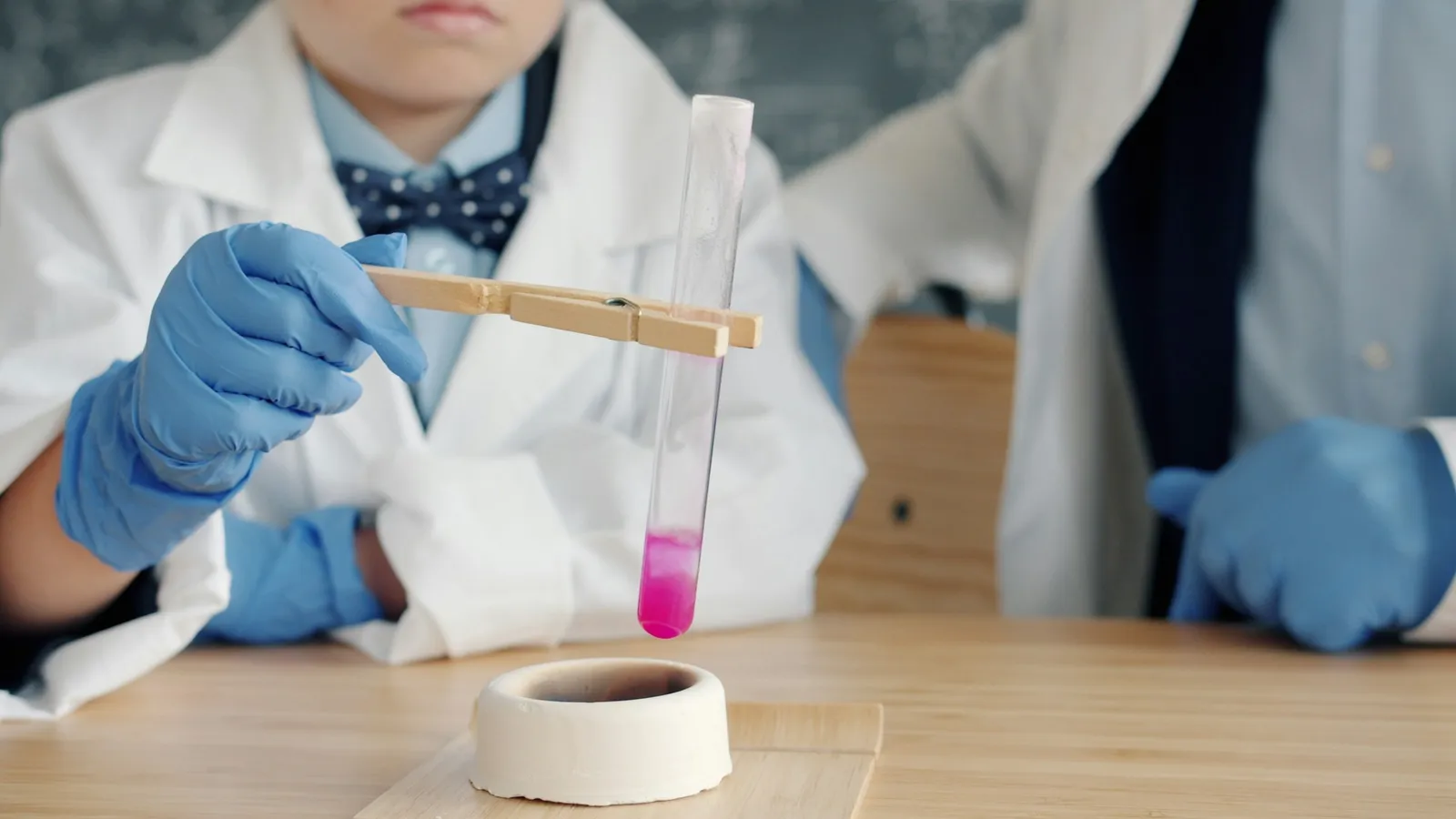
Stage 2, practical test (30 marks). The top 7.5% in each region and medium from Stage 1 qualify. Class 6 students do 5 experiments of 6 marks each in 30 minutes. Class 9 students do one physics and one chemistry experiment (10 marks each) and answer 10 biology questions on specimens (10 marks).
Selection for Stages 3 and 4: 30% of the Stage 1 mark plus the Stage 2 mark, with the top 10% going forward.
Stage 3, general interview (30 marks), about 5 to 7 minutes.
Stage 4, action research project (30 marks): the student submits a project report and is interviewed on it.
How are medals decided? A worked example
The 2026-27 pamphlet says medals are based on a total out of 120: Stage 1 converted to 30%, plus the three later stages of 30 marks each. That checks out: 30 + 30 + 30 + 30 = 120.
Example with sample marks. A Class 9 student scores 76 out of 100 in Stage 1. Converted to 30%: 76 × 0.3 = 22.8.
To reach Stages 3 and 4, add the practical mark. With 24 out of 30: 22.8 + 24 = 46.8 out of 60.
Final total with an interview of 25 and a project of 26: 22.8 + 24 + 25 + 26 = 97.8 out of 120.
Notice that the three later stages carry 90 of the 120 marks. A good written score gets you in, but practical skill, clear speaking and real project work decide the medal.
For 2026-27 the pamphlet lists a gold medal for the top 10% (with a one-time scholarship of Rs 5,000), silver for the next 60% (Rs 3,000) and bronze for the rest (Rs 2,000).
What are the 2026-27 dates?
The pamphlet gives a tentative schedule: school registration from 1 to 31 July 2026 (with late fee to 18 August), the written round on 28 November 2026, its result on 20 December, practicals on 10 January 2027 (Class 6) and 24 January 2027 (Class 9), the action research report by 8 March and interviews on 14 March 2027. GBSTA says it may change the schedule or mode, so check msta.in.
How to prepare, by stage
Written: revise the last three years of science textbooks; explain each diagram aloud.
Practical: do simple experiments at home or school and write down observations with units.
Interview: talk about one science idea at dinner each week, in your own words.
Project: keep a notebook with dates, measurements and photos from the start.
When a textbook idea does not make sense, look at it from another angle. The Fermi Simulation Lab has interactive simulations for ideas that are easier to see than read. For the scientist the competition is named after, read our profile of Homi Bhabha.
If you are a parent, ask your child's school this week whether it registers students for the competition.