

On this page
When you study biological macromolecules, you quickly encounter the terms homopolymer and heteropolymer. Both describe long chains of repeating units, but a polymer's classification depends entirely on the variety of its building blocks, or monomers. Understanding this difference is essential for making sense of how biomolecules function in living organisms.
Why are proteins heteropolymers?
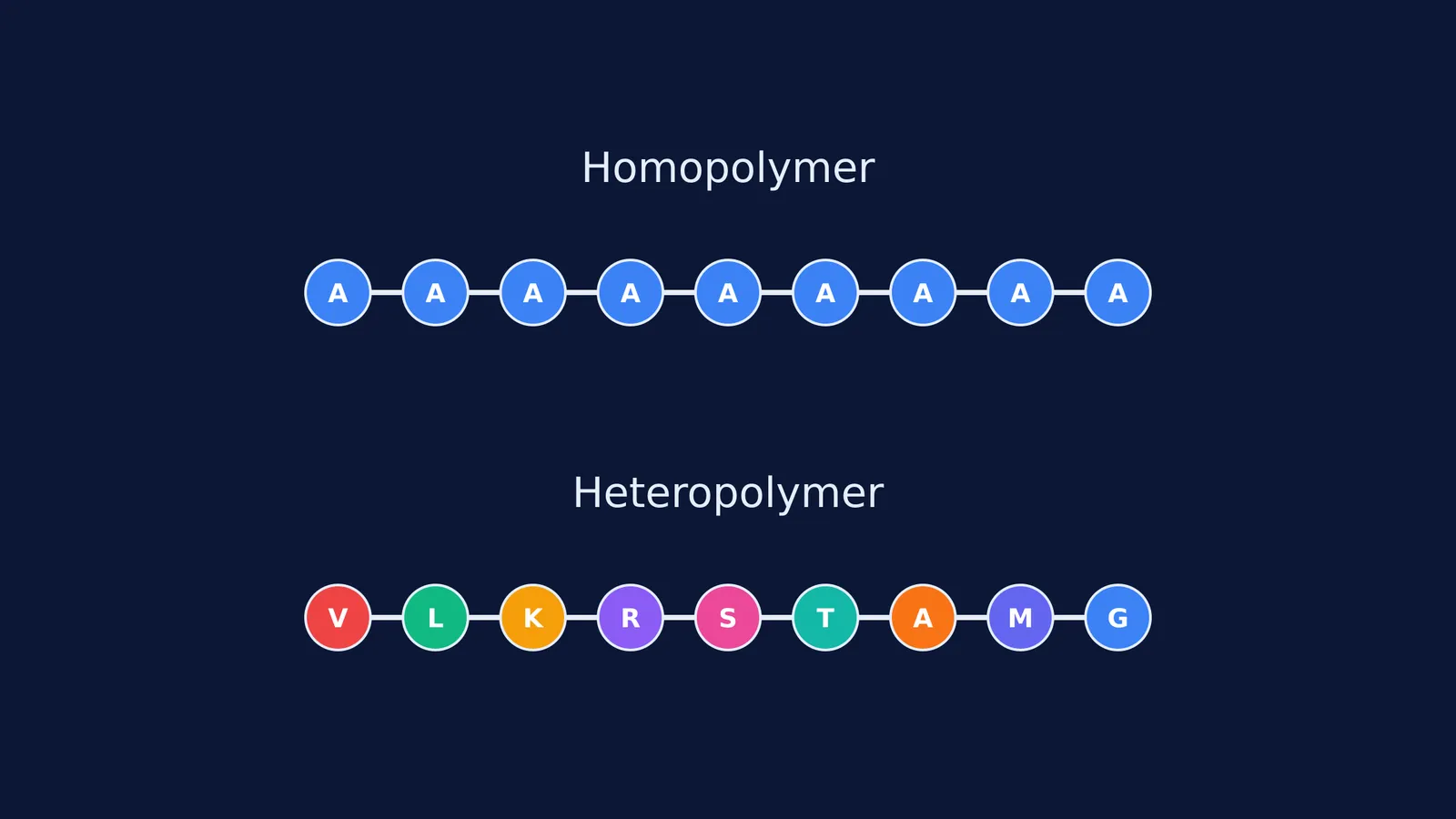
A heteropolymer is a chain made from two or more different types of monomers. Proteins are the classic biological example of this structure.
Proteins are large macromolecules that comprise one or more long chains of amino acid residues (Wikipedia). Because there are 20 different amino acids commonly found in nature (Wikipedia), a single protein chain is constructed as a specific, highly ordered sequence of these varying units. Since the chain is not made of a single repeating block but a diverse mixture—such as a sequence of alanine, followed by valine, then leucine, and so on—it is strictly classified as a heteropolymer.
This immense variation in sequence is what allows proteins to fold into incredibly complex three-dimensional shapes. The specific order of the amino acids dictates how the chain coils and folds, which in turn determines the protein's unique biological activity. Because of this heteropolymeric nature, proteins can perform a vast array of functions within organisms, ranging from catalysing metabolic reactions as enzymes, to providing structure to cells, and transporting molecules across membranes.
If you need help reviewing how these different amino functional groups behave, the Fermi Concept Library has a lesson on the chemistry of amino acids and peptide bonds.
Why is cellulose a homopolymer?
A homopolymer, in contrast, is a polymer made from only one type of monomer that repeats over and over again along the entire length of the chain.
Cellulose is an organic compound and a polysaccharide consisting of a linear chain of several hundred to many thousands of β(1→4) linked D-glucose units (Wikipedia). When a plant builds a cellulose molecule, it uses exactly the same monomer every single time. Because every building block in the extended chain is an identical glucose molecule, cellulose is defined as a homopolymer.
This structural uniformity gives cellulose its legendary strength. The identical glucose units pack closely together, allowing strong hydrogen bonds to form between adjacent chains. This creates rigid microfibrils that give plants their structural integrity. Cellulose is the most abundant organic polymer on Earth, forming the vital structural component of the cell walls in green plants and many forms of algae.
Other familiar carbohydrates share this homopolymeric property. For example, when you learn about reducing and non-reducing sugars, you will also study starch and glycogen. Like cellulose, starch and glycogen are homopolymers of glucose. They differ from cellulose only in how those glucose units are bonded and branched, rather than in the type of monomer used.
How to tell homopolymers and heteropolymers apart?
To figure out whether a biological molecule is a homopolymer or a heteropolymer, you do not need to memorise long lists. Instead, use this simple analytical framework:
Identify the macromolecule: Determine if the substance is a protein, a carbohydrate, or a nucleic acid.
Find the monomer: Identify the basic repeating unit. Is it an amino acid, a monosaccharide, or a nucleotide?
Count the types of monomers:
If there is only one type (e.g., only glucose in cellulose or starch), the molecule is a homopolymer.
If there are two or more types (e.g., the 20 different amino acids in proteins (Wikipedia), or the distinct bases in DNA), the molecule is a heteropolymer.
This rule applies consistently across all of biology. For example, RNA is built from four distinct nucleotides (adenine, uracil, guanine, and cytosine) (Wikipedia), meaning it is also a heteropolymer. If you are studying genetics, you might explore the RNA polymerases in eukaryotes to see how these complex heteropolymeric chains are meticulously assembled in the cell nucleus.
Whenever you are stuck memorising these classifications for an exam, focus purely on the monomers. Once you know what building blocks a chain is made of, you will always know its polymer type.


