

On this page
What are the nine structural isomers of heptane?
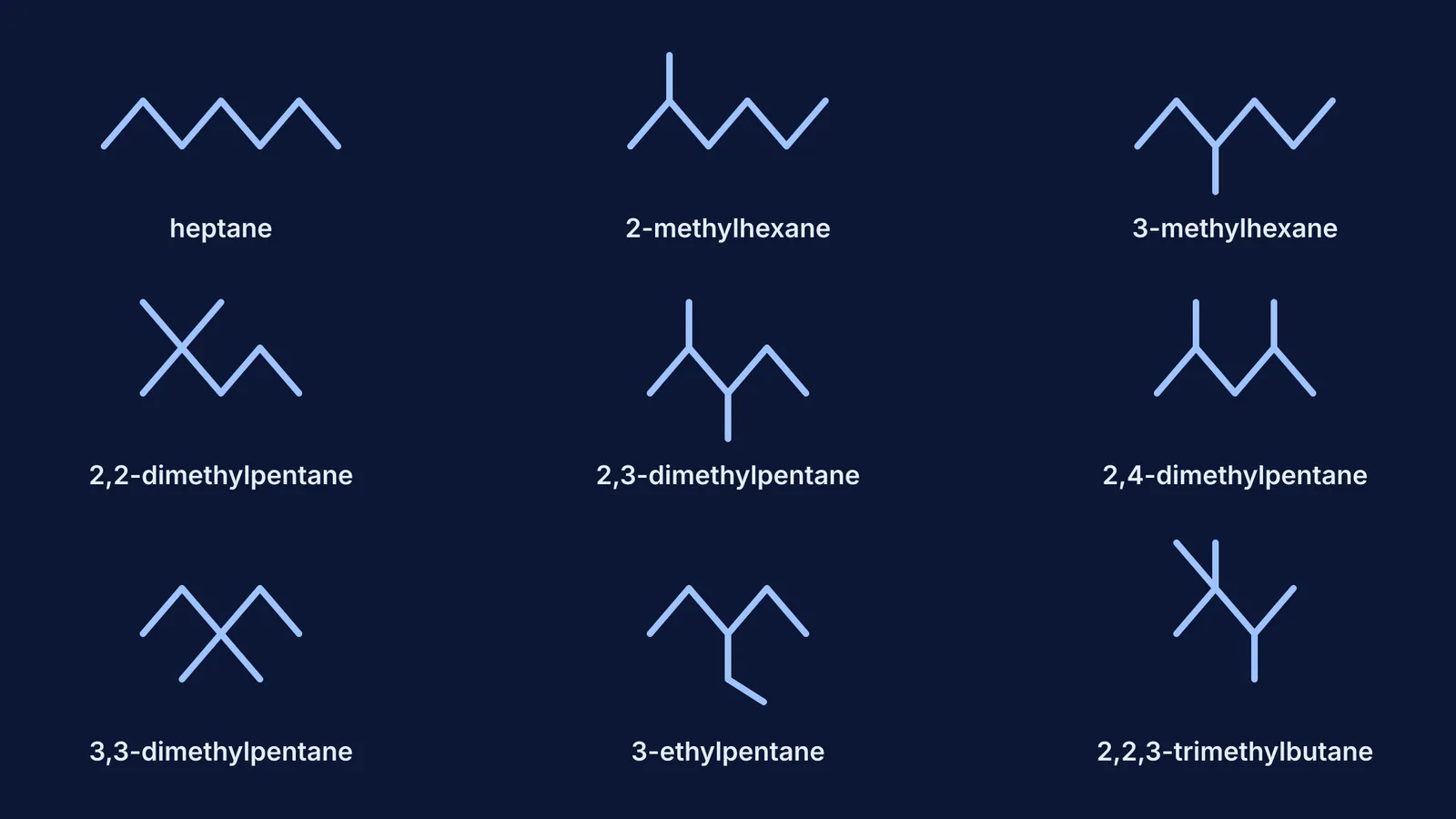
Heptane (C₇H₁₆) has exactly nine structural isomers. A landmark study of alkane isomers by Henry Henze and Charles Blair in the *Journal of the American Chemical Society* (Henze & Blair, 1931) established that the saturated 7-carbon hydrocarbon yields exactly nine constitutional forms. Thermodynamic measurements in the *Canadian Journal of Chemistry* confirmed these nine distinct straight-chain and branched forms through experimental heats of mixing (Couchon et al., 1978). Under the IUPAC Compendium of Chemical Terminology, these variants are constitutional isomers because their atoms are connected in different orders.
When sketching them under exam conditions, guessing randomly leads to duplicates. The reliable method starts with the longest carbon chain and systematically shortens it, moving methyl and ethyl branches along the backbone.
If you want to practice identifying carbon backbones and substituents, the Fermi Concept Library covers every concept in physics, chemistry, biology, mathematics and computing, each with its own lesson and its place in the map.
How many isomers of heptane have a 7-carbon or 6-carbon chain?
Start with the unbranched chain:
heptane: A straight chain of seven carbon atoms (CH₃–(CH₂)₅–CH₃), historically called *n*-heptane.
Next, shorten the main chain to six carbons (hexane). You have one methyl group (−CH₃) to place. Attaching it to terminal carbons 1 or 6 simply restores heptane:
2-methylhexane: Place methyl on carbon 2 (CH₃–CH(CH₃)–(CH₂)₃–CH₃).
3-methylhexane: Place methyl on carbon 3 (CH₃–CH₂–CH(CH₃)–(CH₂)₂–CH₃).
Placing methyl on carbon 4 yields 3-methylhexane numbered from the opposite end. IUPAC rules require numbering from the end closest to the branch, making 4-methylhexane a duplicate.
How many isomers of heptane have a 5-carbon chain?
Shorten the main chain to five carbons (pentane), leaving two carbons to attach as either one ethyl group (−C₂H₅) or two separate methyl groups (−CH₃).
An ethyl group must attach to middle carbon 3. Attaching it to carbon 2 extends the continuous chain to six carbons, duplicating 3-methylhexane:
3-ethylpentane: An ethyl group on carbon 3 (CH₃–CH₂–CH(C₂H₅)–CH₂–CH₃).
Using two methyl groups gives four distinct arrangements across internal positions 2, 3, and 4:
2,2-dimethylpentane: Both methyl groups on carbon 2.
3,3-dimethylpentane: Both methyl groups on carbon 3.
2,3-dimethylpentane: One methyl on carbon 2 and one on carbon 3.
2,4-dimethylpentane: One methyl on carbon 2 and one on carbon 4.
Which heptane isomer has a 4-carbon chain?
Shortening the chain to four carbons (butane) leaves three methyl groups to distribute across internal carbons 2 and 3.
One carbon must take two methyls while the other takes one:
2,2,3-trimethylbutane: Two methyls on carbon 2 and one on carbon 3 (CH₃–C(CH₃)₂–CH(CH₃)–CH₃).
A 3-carbon parent chain (propane) is impossible for C₇H₁₆. Propane has only one internal position (carbon 2). Fitting four additional carbons without extending the backbone would require attaching all four to carbon 2, which exceeds carbon's maximum valency of four bonds.
How can you verify you haven't drawn the same isomer twice?
Two systematic tests prevent accidental duplication:
The IUPAC naming test: Derive the systematic name for each sketch. If two drawings share the same name, they are identical. Numbering always starts from the end nearest a substituent, so placing a branch two carbons from the right end of hexane is 2-methylhexane, not 5-methylhexane.
The longest chain test: Trace the longest continuous carbon sequence without lifting your pen. Bends in drawings often disguise continuous chains as branches. Placing an ethyl group on carbon 2 of pentane yields a 6-carbon backbone (3-methylhexane) rather than 2-ethylpentane.
In competitive exams, check whether a question asks for structural isomers or total isomers including stereoisomers. Exactly two heptane isomers are chiral: 3-methylhexane and 2,3-dimethylpentane, each having four distinct groups on carbon 3. Both exist as pairs of enantiomers, raising the total isomer count from 9 to 11 when stereocentres are included, as explained in our guide on counting stereoisomers from the number of chiral centres.
What is the step-by-step checklist for drawing all isomers?
When finding isomers of any alkane, follow this routine:
Draw the unbranched chain (7 carbons).
Shorten the backbone by one carbon (6 carbons) and place one methyl group at each valid internal site.
Shorten the backbone by two carbons (5 carbons); test an ethyl branch, then test all combinations of two methyls.
Shorten the backbone by three carbons (4 carbons) and place three methyls on internal sites.
Stop when further shortening forces the chain to exceed the chosen backbone length or violates valency.
Verify IUPAC names to eliminate duplicates.
When practicing isomer problems and IUPAC nomenclature, the Fermi Problem Library provides worked problems with a step-by-step solver that explains the reasoning rather than printing an answer.
You can apply this method to other systems: review simpler structural isomers in Class 10: butane and pentane drawn out, or move on to functional groups by drawing the C4H10O isomers: telling the four alcohols and three ethers apart.


